Question: How is coccidiosis treated in Broiler chickens?
Ayah Syahri
Semarang-Central Java
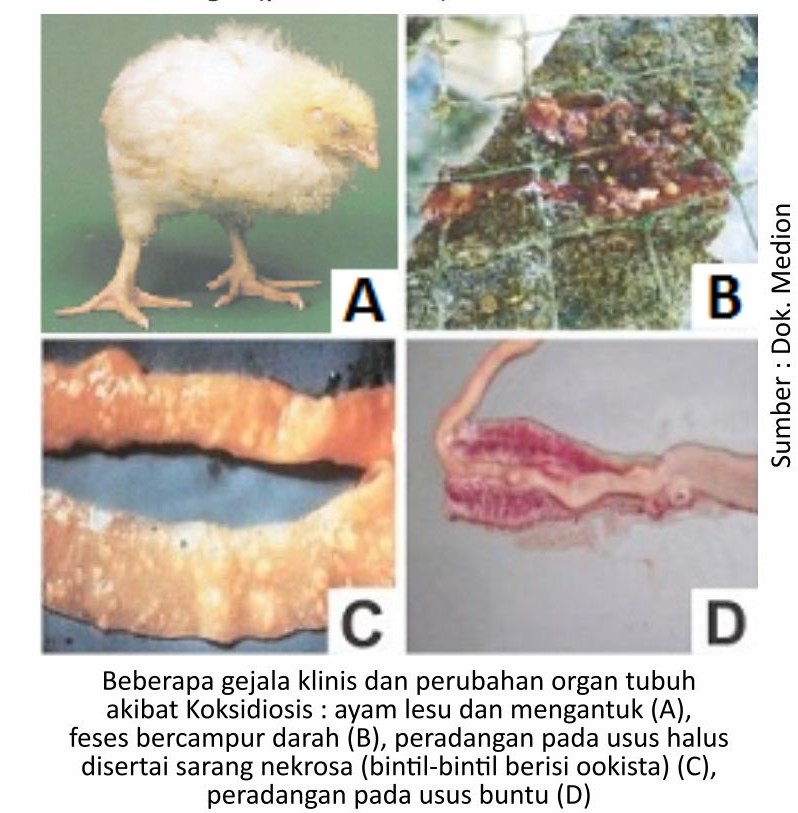
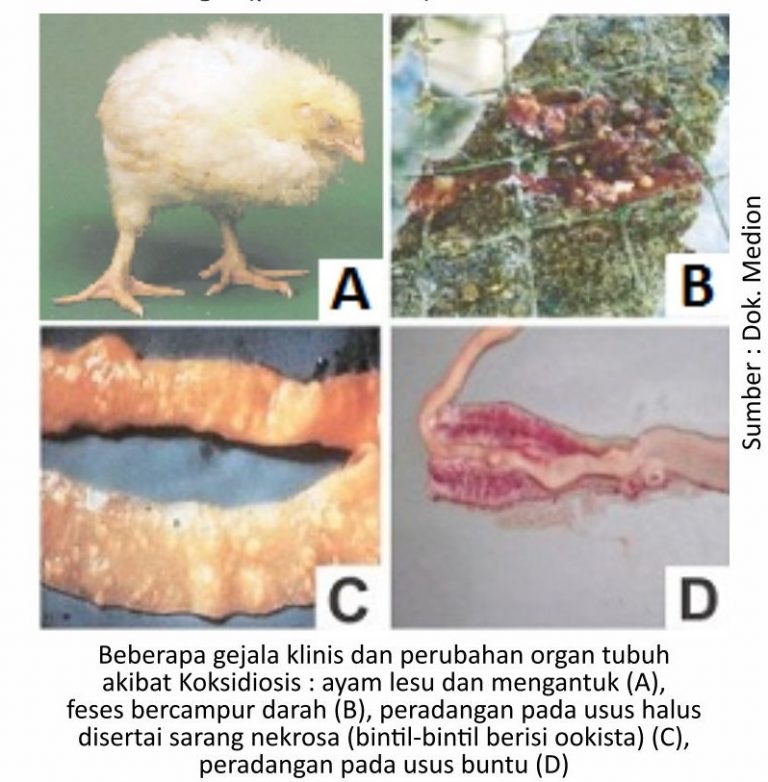
I have a 15-day-old broiler. Visible symptoms of lethargy, closed eyes or drowsiness, and feces mixed with blood. What are the symptoms of the disease including? What medications can be given?
Answer
Dear. Mr. Shahri, thank you for the question. Looking at the clinical symptoms caused, the father's chicken is indicated to be affected by coccidiosis. Coccidiosis is a disease that causes damage in the digestive tract, especially in the small intestine and cecum. This ultimately has an impact on the process of digestion and absorption of nutrients that are not optimal, causing losses in the form of low weight growth, decreased egg production, and death (mortality) is high up to 80-90%. In addition, coccidiosis can also cause immunosuppressive effects that make chickens vulnerable to infection with other diseases.
Coccidiosis disease is caused by protozoan parasites belonging to the genus Eimeria. Coccidiosis infection itself starts from the entry of oocysts (a kind of egg) Eimeria which has undergone sporulation (producing spores) into the body of the chicken. These oocysts can be transmitted through cub cages, cage equipment, rations, drinking water or litter contaminated.
Chickens affected by coccidiosis will initially show clinical symptoms such as drowsiness, drooping wings down, coarse feathers (not shiny) and low appetite. Of the 12 types, there are 5 species Eimeria sp. which pathogens in chickens, namely E. tenella, E. maxima, E. necratix, E. acervulina and E. brunetti. Indications for infection Eimeria tenella it usually occurs acutely and in chickens will be found to release bloody feces to cause death. Infection Eimeria maxima causes feces to contain thick reddish exudate and mixed with blood spots.
From the results of chicken surgery, changes in body organs that will be found if the cause E. tenella it is an enlarged appendix filled with blood or fluid mixed with blood. While species Eimeria others cause abnormalities in the form of thickening of the intestinal wall, accompanied by inflammation kataralis (fester) until haemorrhage (bleeding).
Chickens affected by coccidiosis can be treated by administering anti-oxidant drugs. The administration of anticoxidia is intended to control and suppress the development of Eimeria in the body of the chicken so that the amount in the body of the chicken can be suppressed in a low level. Anti-oxidant drugs are usually given by the 3-2-3 method, namely 3 days of medication, 2 days of drinking water without medication and 3 days of medication. Products that can be used are Coxy, Sulfamix (sulfonamide tunggal), Anticancer, Duoko, or Trimezyn (sulfonamide combination). The drugs that have a broader spectrum of Therapy or Koksidex. Usage Therapy administered at a dose of 0.2 g/kg body weight or 1 g/liter of drinking water for 5-7 consecutive days. Examples of Medion antikoksidia drugs are Toltradex. Usage Toltradex it can be given for 2 consecutive days at a dose of 0.14 ml per kg of body weight given through drinking water.
In addition to the administration of anticoxidia, other measures that must be taken when dealing with coccidiosis include:
- Give multivitamins such as Fortevit and Vita Stress for supportive therapy. Vitamin A serves to accelerate the healing of damaged epithelium of the intestinal mucosa. While vitamin K will reduce bleeding that occurs. However, the administration of both vitamins should not be mixed directly with Toltradex because the potency of vitamins A and K will decrease if they are combined in the form of one dosage.
- If possible, remove feces mixed with blood from sick chickens to avoid other chickens pecking at them. This is because the red color of the feces will attract the attention of other chickens to peck and there is a process of transmission of coccidiosis.
- Perform handling management litter with good order litter dry. Some things we need to pay attention to litter stay dry and function optimally, among others:
- Use litter with an optimal thickness, which is 8-12 cm
- Perform flipping management litter to prevent litter wet
- Check the condition and installation of drinking water
- Pay attention to the quality of the ration. Do not give rations with too high salt and protein content (adjust as needed)
- Set the ventilation system through the curtain opening and closing system to ensure that the ammonia level in the cage is not too high
- During the rainy season, repair the damage and errors of the cage structure
- Avoid keeping chickens with high density, maximum 8 heads / m2 for postal cages.
- When preparing cages, especially for postal cages, whitewash the floor to reduce the number of oocysts present.