Pertanyaan dari Bapak Agus Krisdiyantoro – By email
Will the environment with high humidity be safe if disinfected regularly spray (eg 2 times a week)? Then what class of disinfectants are safe to use in such an environment?
Answer
Thank you Mr. Sofyan Sugiarto for the question submitted. Frequency (,) can be done 2x every week even the frequency can be increased if there is a case of disease with a note of attention to technique and time , cage.
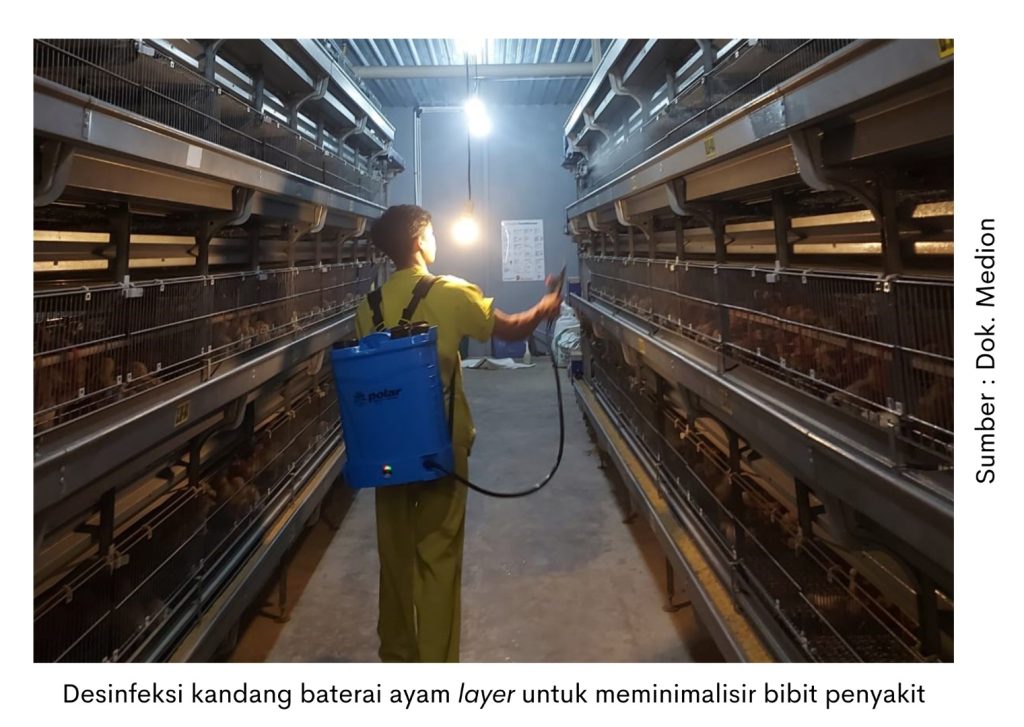
Technique and timing , improper care can aggravate the previously high humidity level of the cage. Important things to consider when doing ,, among them:
- Do , disinfect when there is still a slight gust of wind
- Avoid , disinfect during peak humidity in the cage usually at night or in the morning
- Avoid , disinfect during rain or increased humidity conditions
- Spray disinfection is carried out with very soft particles of water or in the form of a mist
- Distance and pressure , it must be consistent so that the disinfectant is evenly distributed over the entire area of the cage
- For di cage closed house, , from the front (inlet) to area (outlet) in order to follow the direction of air flow.
The use of appropriate disinfectants is one form biosecurity that needs to be applied in a cage to minimize the number of disease seeds in the cage environment. Disinfectants are used to kill or inhibit the growth of pathogenic microorganisms such as bacteria, viruses, and fungi that can cause disease in chickens.
To optimize the working power of disinfectants, it is necessary to pay attention to several things as follows:
Choose the appropriate type of disinfectant
Choose a disinfectant according to the type of disease seeds to be eradicated. For example, disinfectants from groups ammonium kuartener (Quats) kurang efektif membasmi virus yang tidak beramplop seperti virus Gumboro, Reovirus, dan Avian Encephalomyelitis. The choice of disinfectant should also pay attention to the condition of the chickens. When it will be used to spray cages with chickens or disinfect drinking water, choose safe disinfectants such as Desinsep, Antisep, Neo Antisep or Medisep. When the cage is empty all disinfectants can be used.
Proper dosage and mode of administration
How to apply disinfectant in a way , it should be done until the surface is wet with disinfectants.
Use quality water
the pH of the water should be neutral or 5 to 8 and the water is not hard (content of Ca2+ and Mg2+ ions slightly) so that the disinfectant works optimally. pH and water hardness can affect the performance of disinfectants, especially the Quats and Iodine groups.
Note the presence of organic matter
Remove organic materials (such as blood, mucus and feces) that stick to the surface of the cage or equipment so that the contact time and disinfectant work are faster and more effective. Aldehyde group disinfectants are not affected by organic materials (eg Formades and Sporades). Proper washing of the cage is necessary for the disinfectant to work optimally.