Vaccination activities play an important role in maintaining the health of the chicken's body, but often we find a reaction phenomenon post vaccination is a symptom of respiratory distress that is a concern for farmers. This raises the question of whether the reaction post vaccination is a natural thing or this is a problem that we need to be aware of.
Importance of vaccination
Vaccination is the act of inserting vaccines into the body of livestock as a measure used to prevent disease attacks. Vaccination activities are carried out to include certain microorganisms that have been weakened or killed and formulated in such a way as to stimulate the formation of protective and uniform antibodies in the body of livestock. In principle, it is important that vaccinations are given before an infection occurs.
Disease attacks often appear in various regions both caused by viruses and bacteria, preventive measures need to be taken, one of which is to provide protection from the chicken's body by vaccinating.
This is a consideration because viral diseases cannot be cured by administering drugs and the presence of bacterial diseases that have already attacked is difficult to eradicate completely so it is easy to reappear, for example Coryza disease. In addition, health costs for prevention are cheaper when compared to treatment costs or when there are already cases of illness.
Active and inactivated vaccines
Based on the nature of the live agent of infection contained in the vaccine is divided into 2, namely active and inactivated vaccines. An active vaccine is a vaccine that contains microorganisms that have been weakened, that is, the microorganisms are still alive. After the vaccine is given, the infectious agent will go to the target immune organ to multiply or multiply itself then to the lymphoid organs to bully the formation of immunity.
Freeze-dried active vaccine (freeze dry), so it needs to be dissolved first using a solvent in the form of a buffer solution, plain water or aquades (in accordance with the application). Vaccination using active vaccine is applied through several ways, namely eye/ nose/mouth drops, drinking water, ,, or wing pricks, or injections.
The thing to note when administering active vaccines is that the vaccine must be used up within 2 hours after the vaccine is dissolved. This is because the active vaccine that has been dissolved and is outside the storage temperature (2-8°C) for more than 2 hours, the virus titer will decrease and affect the potential of the vaccine.
Inactivated vaccines contain microorganisms that have been killed, but are still immunogenic or able to bully the formation of antibodies, inactivated vaccines are formulated with adjuvant namely sa compound added to a vaccine that work to enhance the action of a vaccine with a depo Ive effect. The depo effect means absorption little by little into the blood circulation.
Once in the body, the inactivated vaccine does not need to replicate or multiply but directly bullies lymphoid tissue to form antibodies. Inactivated vaccines are in the form of liquid suspensions or emulsions because they contain adjuvant. Vaccination using an active vaccine is applied by intramuscular or subcutaneous injection. Things to note when administering active vaccines are that they must be used up within 24 hours because the vaccine that has been unsealed and has been pierced with a needle has been in contact with outside air so it is feared that it has changed the potential of the vaccine.
Reaction Post Vaccination
Post-vaccination reactions are reactions that occur with the use of active vaccines. In the body of livestock, microorganisms contained in the active vaccine, in the body of livestock will multiply in the target organs. This multiplication process is what causes post-vaccination reactions. Post-vaccination reactions to the use of active vaccines for respiratory diseases are in the form of mild respiratory distress in ND and IB vaccinations or watery eyes in ILT.
This is a sign that the body responds to the presence of the vaccine through the formation of antibody titers, if no reaction is found post vaccination on active vaccine this can indicate the vaccine is not working or the body's response to form immunity is not optimal. Reaction post vaccination is usually characterized by mild respiratory disorders such as snoring symptoms in ND, IB vaccinations, or watery eyes in ILT.
Reaction post vaccination usually occurs on the second to third day after vaccination and will stop approximately a week after the administration of the active vaccine. Until the reaction post vaccination is natural because it describes that the chicken's body is responding to the vaccine by forming antibodies.
Things to watch out for when a reaction occurs post vaccination is when the symptoms caused are more severe, prolonged or death occurs this condition can occur if the vaccination is done on chickens that are not healthy, there are stress factors, uncomfortable cages such as high ammonia levels and air circulation that is not smooth, or improper vaccination application.
Reaction post vaccination occurs in a long time is often referred to as rolling reaction. Rolling reaction this is caused by a non-uniform dose of active vaccine, for example, some chickens get the vaccine under the dose and the vaccination is not completed in the same day. This will lead to shedding or the release of the virus resulting from the multiplication of live vaccines from chickens that get one dose to other chickens whose vaccination doses are less or have not been vaccinated. This condition causes the chickens to dose less like getting vaccinated again and the reaction occurs again post vaccination.
Does Inactivated Vaccine Cause Reactions Post Vaccinations?
Once we know the reaction post vaccination on the active vaccine, then what is the reaction post vaccination can also occur in inactivated vaccines? Sometimes in the application of thigh injections found a paralyzed and swollen Chicken condition at the injection site, this is not caused by microorganisms from the vaccine, but from the vaccination process is too rough or exposed to bones and nerves in chicken legs.
Paralysis or swelling after vaccination using inactivated vaccines can be avoided with proper application, namely injections carried out on the outer thigh and the upper third of the chicken thigh. The goal is to get thick muscles and avoid nerves because the nerve location is on the inside of the chicken thigh. In addition, needle replacement during vaccination needs to be done every 500 chickens and damaged needles need to be replaced with new needles to prevent paralysis and swelling.
Prevention and treatment of reactions Post Vaccination
Preventive measures that can be taken to anticipate reactions post overvaccination includes :
Chickens in good health
Make sure the chickens to be vaccinated are in good health and not under stress. Sick or stressed chickens, the immune system or immunity in the chicken's body is in a decreased condition so that it can increase the risk of reactions post more severe vaccinations.
The received dose is uniform
The dose received by each chicken must be uniform and administered simultaneously and run out within a maximum of 2 hours. When chickens get a non-uniform dose of active vaccine, it will trigger the appearance of rolling reaction. In addition, the administration of active vaccines that have the same target organs in the respiratory tract such as ILT with active ND and IB needs to be spaced at least 1-2 weeks to prevent reactions post more severe vaccines.
Comfortable environmental conditions
Ensuring comfortable environmental conditions, especially good air circulation, no dust, and low ammonia levels. Therefore, the condition of the cage must be optimized, both from the density of the cage, ventilation system and chicken feces cleaning schedule.
To overcome the high levels of ammonia in the cage can use Ammotrol which contains herbal extracts that are able to reduce ammonia levels in the cage. To maintain air circulation, management needs to open and close the curtain according to the needs of the chicken and avoid conditions litter the wet / damp.
Minimising the population of infectious diseases
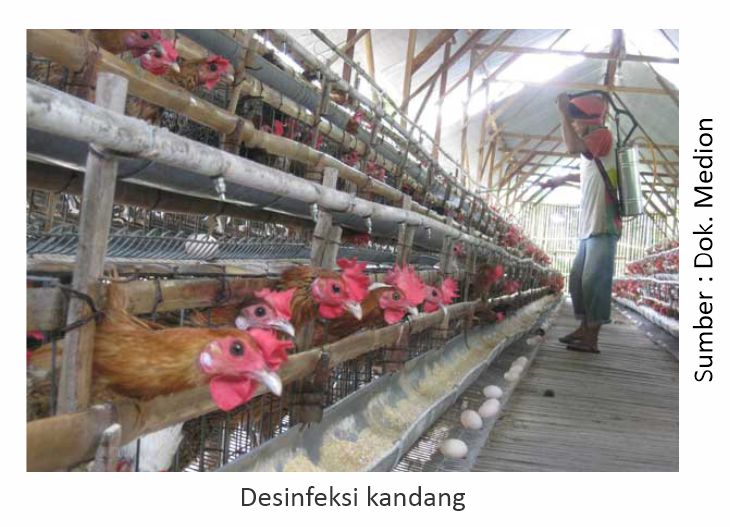
The population of disease seeds should be minimized, especially in livestock areas because the presence of disease seeds, especially the cause of respiratory diseases can trigger a reaction post vaccinations are getting worse . Seedlings of the disease can also cause vaccination failure and antibodies will not be formed optimally. Measures to minimize the population of seed diseases by spraying the cage at least 2 times a week using Antisep, Neo Antisep, Medisep, or Zaldes.
- Avoid immunosuppression factors. Stress, mycotoxins, Gumboro disease, Marek disease and some other immunosuppressive factors that can inhibit the formation of antibodies and cause reactions post over-vaccination. To minimize immunosuppression factors, give Imustim as an immunostimulant to maintain and increase immunity and improve the immune system that decreases in chickens.
- Provide supportive therapy with multivitamins, such as Fortevit or Vita Stress to increase the stamina of the chicken's body and be able to suppress stress due to vaccination and protect chickens from infection. In addition, it can also be given herbal products, namely Respitoran which helps to overcome respiratory disorders due to post-vaccination reactions.
From the discussion above, it can be concluded that post-vaccination reactions are normal in vaccinations, but what needs to be considered is to keep the condition of chicken stamina optimal.