As already known that milk contains nutrients that are important for the body, such as calcium, vitamins, fats and proteins. The quality of milk production needs to be considered so that the nutritional content is maintained. Quality milk production is produced from dairy farms with good management.
Livestock health management is one thing that needs to be considered. One disease that is susceptible to attack dairy cows is mastitis. Mastitis is often the main problem because it can lead to a decrease in milk production in large quantities.
Clinical and subclinical Mastitis
Mastitis is an inflammatory disease of one or more udder quarters caused by pathogenic microorganisms or bacteria. Mastitis occurs due to infection of microorganisms to the udder through the nipple hole then microorganisms develop in the glandular tissue that causes inflammation.
The cause of mastitis is bacteria that infect udder tissue. Some of them like Staphylococcus aureus, Streptococcus agalactiae, Streptococcus dysgalactiae, Escherichia coli, and Streptococcus uberis. The bacteria that cause mastitis can come from two categories, bacteria that are contagious and those that come from the environment. Mastitis contagiuscontagious mastitis) is a mastitis whose source of transmission is from an infected udder and spreads to a healthy udder during the milking process. The infection can be transmitted through the sponge used to clean the nipples, from the milker's hands, or through the machine used at milking time. Environmental Mastitis (environmental mastitis) is mastitis that occurs due to bacterial contamination that comes from the environment, such as water, cage mats or from feces that are around cows.
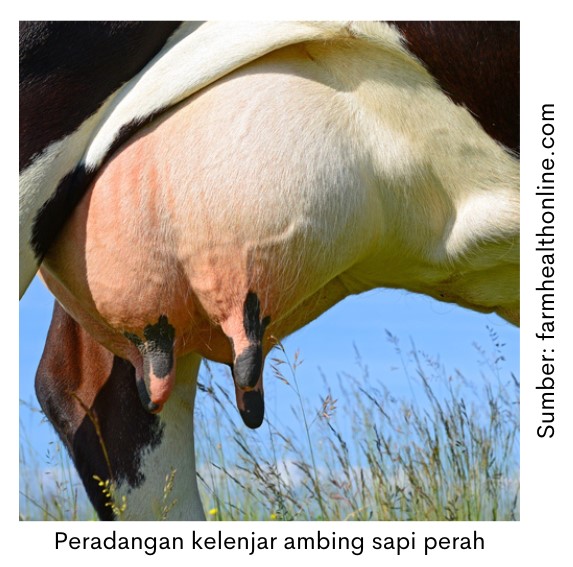
Predisposing factors or triggers of mastitis include injuries to the nipples due to rough milking treatment, rough floor texture and poor sanitation both in the cage area, cow body, equipment and dirty milking hands. Then it can also be due to poor nutritional status of cows, both from the quality and quantity of feed.
Mastitis can be differentiated into subclinical and clinical mastitis. Clinical Mastitis is characterized by clinical symptoms that can be seen in the form of swelling of the udder, pain, heat, redness to decreased udder function. It was also found that the physical condition of the milk changed. In problematic milk, lumps consisting of milk protein will be seen. In severe conditions the clot also contains blood proteins that break off from the vessel wall.
While subclinical mastitis, physically there is no change in milk and udder, but if a mastitis test is carried out, there is an increase in the number of white blood cells in milk. Usually as many as 97-98% of mastitis cases are subclinical mastitis so it is very important to watch out. If the diagnosis of subclinical mastitis is late, the action or treatment taken will also be late and even aggravate the condition. The sooner the cow is treated, the greater the chance of recovery.
Mastitis Prevention Strategies
Mastitis can be prevented or minimized by applying some of the following :
- Improved sanitation
Clean the cage area by spraying the cage some time before milking. Milking equipment also does not forget to be cleaned such as a bucket to hold milk, milk can, sieve, funnel prepared in a clean state. Before use, the equipment needs to be cleaned and washed with soap. Then rinse with boiling water and then dried. In addition to the cage, the cow's body must also be cleaned. If the cow is dirty it will contaminate or degrade the quality and hygiene of the milk.
2. Implementation of good milking management that needs to be done include:
- Wash hands with soap before flushing. This is also done every time will change the milked cow. With clean hands will reduce the spread of mastitis.
- Udder cleaning before and after milking with a clean cloth and not used alternately with other livestock. Clean the cow's nipples with warm water then wipe with a dry cloth.
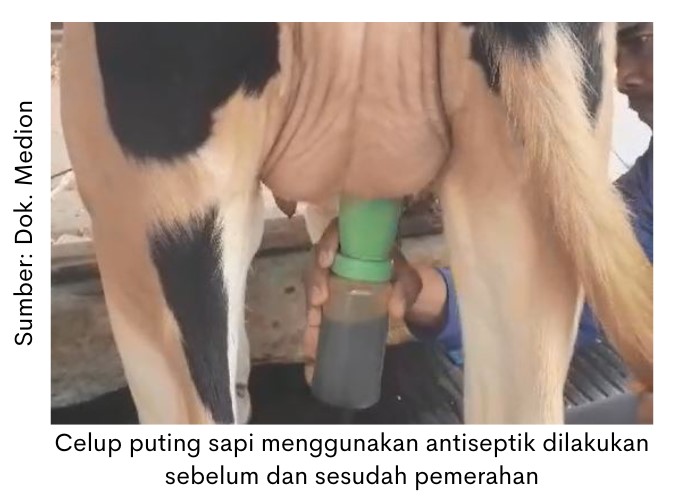
- Do teat dipping or dyeing nipples before milking for approximately 30 seconds with Antisep or Neo Antisep to prevent bacteria from entering the nipples of dairy cows. Dry the nipples with a dry, clean wipe.
- The first examination of milk coming out of the udder (pre-milking) is done by taking about 3-4 showers into a glass and then checking the quality of milk, for example, color or the presence of lumps. This needs to be done on each cow before milking to ensure the quality of milk and as warning or early warning if there is a suspicion of mastitis. This first milk release is also at the same time to open the nipple channel and clean the bacteria that are around the nipple hole. If it is necessary to find out the cattle are infected with subclinical mastitis then do the test California Mastitis Test (CMT) at least 1x in 1 lactation cycle.
- In manual milking done by hand, gently hold the nipple while milking. Try to make milking done by the same person and time. Milking can be carried out 60-120 seconds after stimulation.
- Milking is done using a machine, the installation of the milking unit can be done 1 minute after taking the pre-milking milk. Before removing the milking machine, make sure that the udder is thoroughly squeezed. Pay attention to the pressure of the vacuum engine of the machine, it should not be too strong.
- After milking, the nipple is wiped with a cloth soaked in warm water. Then dipping/ dip the nipple again into the antiseptic solution Antisep to disinfect the nipple canal while it is still open to lower the risk of developing mastitis.
- Immediately clean the milking area from the remnants of spilled milk. If using a milking machine, clean it after use.
- Give feed after milking so that the cattle do not immediately lie down so that the nipple does not touch the floor. Spinchter or nipple hole takes about 20-30 minutes to close completely after milking so that in that time interval is susceptible to the entry of contaminated microorganisms.
- The milking milk is filtered with a clean filter cloth and placed in a milk can. The milk production must be immediately sent to the milk reservoir so that it does not deteriorate and become contaminated.
3. Provide nutrition as needed
Provide feed with sufficient nutrients (minerals, vitamins, energy and protein). If you need to add Mineral Feed Suplement S to increase milk production in dairy cows and prevent mineral deficiency. (And, of course, multivitamins.)Injekvit B-Plex or Vita B Plex Bolus Extra Flavor) to increase the power of the cow's body, as well as improve metabolism so that productivity is better.
Herbs to prevent Mastitis
With a variety of research that has been done, herbs can be used in the world of animal husbandry, one of which is for the Prevention of mastitis in cattle. Supplements Mastigrin is a herbal product that has properties to help reduce the incidence of mastitis and increase milk production. Mastigrin dapat mengurangi jumlah somatic cell count (SCC) dan total plate count (TPC) dari susu.
Advantages Mastigrin there is no withdrawal time/downtime and drug residues, so it is safe to use during the lactation period and milk can be consumed. The dose that can be given is 2.5 g per 100 kg of body weight mixed in the ration for 5-10 consecutive days. Mastigrin it can also be given to sheep and goats at a dose of 1.3 grams per 100 kg of body weight. Some herbal compounds in supplements Mastigrin provides benefits as anti-inflammatory and antibacterial, as well as to increase the hormone prolactin in helping launch milk production.
Mastitis causes great harm to dairy farmers. Well-conducted prevention and assisted by supplementation can reduce the incidence of mastitis in dairy cows. Greetings.