Bapak Asep
Bogor-West Java
How to prevent the occurrence of chickens layer lay eggs early or early?
Answer:
Thank you Mr. Asep for the question. Chicken rearing layer the good thing is to realize a healthy chicken with the fulfillment of the target (weight, feed intake, age of first egg laying, peak production, percentage of egg production and average egg weight) according to the standard every week. Chicken layer early egg laying can be caused by several factors, including:
- Excess weight
Pullet with excess weight, it will reach genital maturity earlier and begin to produce eggs faster. Ideally chicken layer it begins to produce at 18 weeks of age. If egg production is achieved early, the eggs produced will be small and the egg laying period will be short, so the percentage of production will be low. This is due to the fact that the reproductive system of chickens is not yet fully mature, but is already forced to produce eggs. Excess weight can be overcome by performing the following steps:
- Separate chickens with excess weight in one tier of the same battery for easy monitoring and handling. Can be placed in the lowest battery enclosure.
- Carry out weighing and monitoring of body weight every day until the body weight according to the standard is reached. The number of chickens weighed as much as 60-100 heads (2-5% of the population) per cage and make sure the uniformity reaches 80-85%. This means that more than 80% of the chickens in one cage have almost the same body weight with a tolerance of ±10% of the standard body weight. This regular monitoring will facilitate faster evaluation and treatment if the chicken's weight exceeds the standard prematurely.
- Chickens with a body weight exceeding the standard do not need to increase the amount of ration for the next week.
- Check the energy and protein content of the feed. Excess energy and protein consumption will be converted into energy reserves in the form of fat in the body. Check also the homogeneity or uniformity of feed mixing.
- To utilize excess fat in the body, can add Strong N Fit into drinking water. Strong N Fit able to convert body fat into energy so as to prevent excess weight on pullet.

2. Overexposure
Light can affect the physiological functions of some parts of the chicken's cerebrum, in particular the hypothalamus gland. Lighting that comes from sunlight or lights will stimulate the hypothalamus gland which then stimulates the pituitary gland, thyroid, and parathyroid. The pituitary gland produces hormones follicle stimulating hormone (FSH) and luteinizing hormone (LH). The FSH hormone functions to ripen follicles or egg cells in the ovaries (ovaries), while the LH hormone functions to bully the ovulation process (release of eggs from the ovary to the oviduct or oviduct). These two hormones are very instrumental for the formation of an egg. The thyroid gland will also be stimulated to secrete thyroxine hormones that play a role in growth, while the parathyroid glands produce parathyroxine hormones that are very important in the metabolism of calcium (Ca) and phosphorus (P) needed in the formation of bones and egg shells.
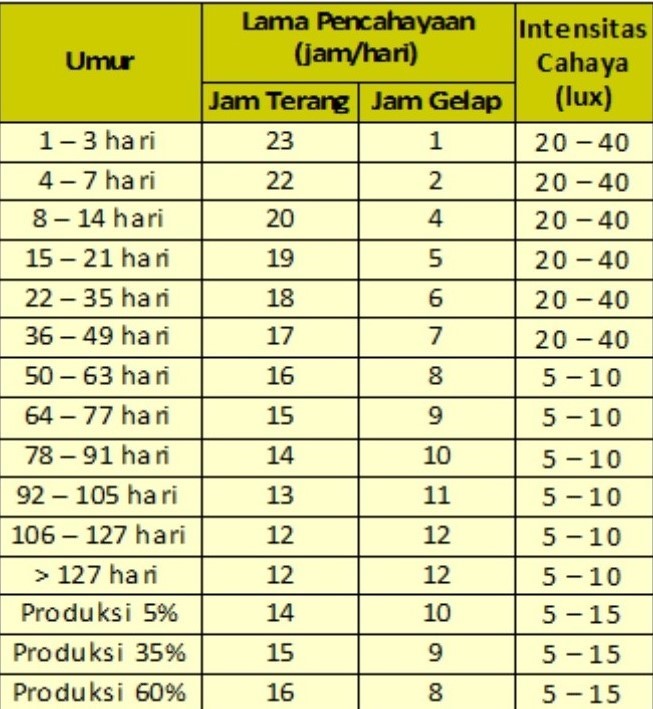
If the light is received pullet excess, then there will be early genital maturity and chickens begin to lay eggs before their ideal age. To avoid this, long light during the phase pullet administered within 12 hours per day or only from sunlight) with the lowest intensity (5-10 lux). It aims to prevent premature sexual maturity (early egg laying) and body weight that exceeds the standards that trigger the occurrence prolapse.
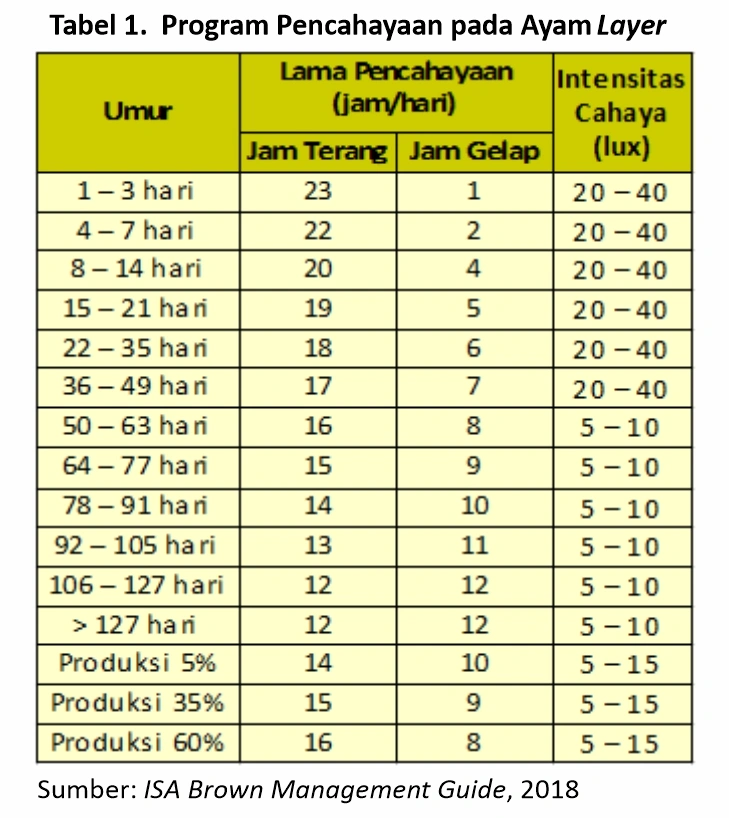
Chart 1. indicates the benchmark duration and intensity of lighting for chickens layer current phase pullet and laying. Additional lighting can be carried out when there are chickens in the cage that have begun to lay eggs. However, it should also be noted the achievement of chicken weight. Ideally additional lighting is provided when the chicken reaches the ideal weight to start producing. For example, to strains ISA brown at the age of 18 weeks with a body weight of 1.42 – 1.73 Kg.