Various diseases that can attack livestock can certainly interfere with productivity which leads to losses. The disease can occur as a result of disease agents or improper management practices. One of the diseases that are closely related to management practices by neglecting environmental hygiene is myasis. Myasis can affect all ages of livestock ranging from young to adult age resulting in livestock discomfort and pain.
Occurrence of Myasis and its effects
Myasis or often called maggots is an infestation of fly larvae on living tissue that attacks warm-blooded animals. In Indonesia the most common occurrence in cattle 65.5% and goats 22.34% (Wardhana et al., 2018). The disease begins with an open wound that is left untreated. The smell of fresh blood on the wound will attract the arrival of flies Chrysomia bezziana (green flies) and lay eggs in the wound. Within 12-24 hours, the eggs will hatch into larvae.
Cattle affected by myasis will feel discomfort, decreased appetite, weakness, and sometimes fever. Myasis can cause enormous economic losses, especially in livestock centers. The impact of livestock will experience a decrease in body weight and milk production, tissue damage, and anemia. This indirectly also has an impact on the decline in the selling price of cattle in the market. Actually, myasis does not cause death if quickly treated. But if the wound is not treated within 1-2 weeks then in addition to myasis, there will also be a secondary bacterial infection that can cause death.
Factors Contributing To Myasis
Some factors that favor the occurrence of myasis are summer, transition, low levels of Hygiene and environmental sanitation and poor wound care. Cases of myasis generally occur in newly born female cattle, namely in the vaginal area and newly born cattle, namely in the navel or umbilicus area. In addition, there are other conditions that are susceptible to myasis, namely infected livestock Lumpy Skin Disease (LSD) and mouth and nail disease (PMK).
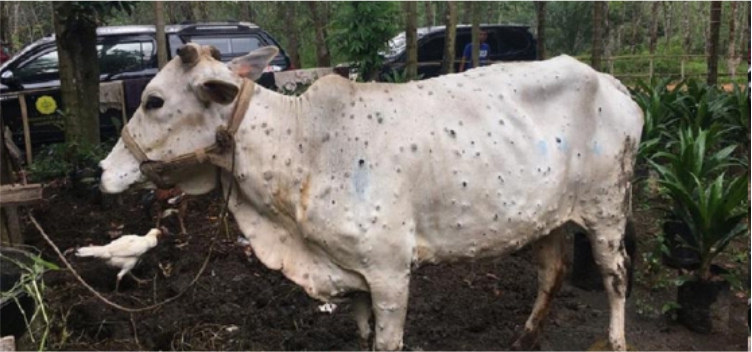
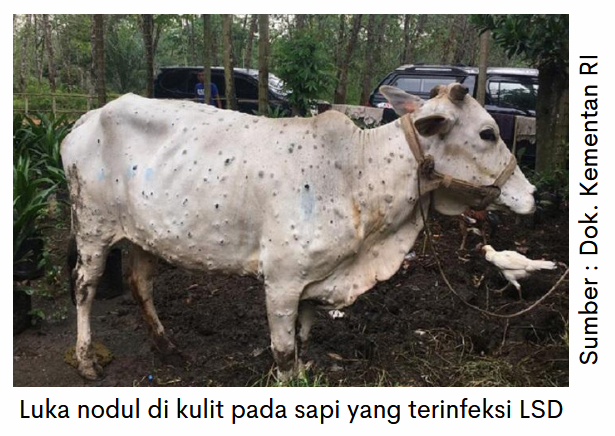
LSD is an infectious skin disease that affects cows and buffaloes. The most visible clinical symptom in the case of LSD is the presence of wounds on the skin in the form of nodules measuring 1-7 cm. Nodule wounds are prone to myasis and secondary infection if not treated.
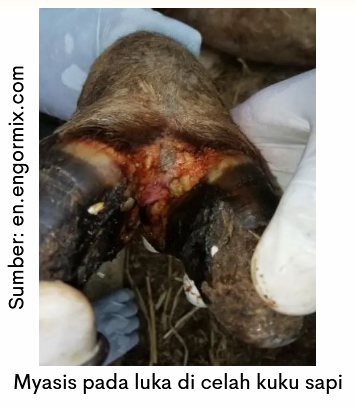
FMD is an infectious disease that affects even/split hoofed animals such as cows, buffaloes, goats, sheep and pigs. Some of the symptoms of livestock infected with FMD are excessive salivation, blisters in the mouth area and wounds between the hoof cracks.Similar to LSD disease,the presence of an open wound in the nail gap can invite the arrival of flies so susceptible to myasis.
Cattle infected with FMD are also prone to experiencing pain in the thigh and leg area. The wound (decubitus) can occur due to cows lying too long on one side of their body so that there is often friction between the protruding part of the body and the base of the cage. If left alone and the condition of the cage is dirty, it will be prone to infection and prone to myasis.
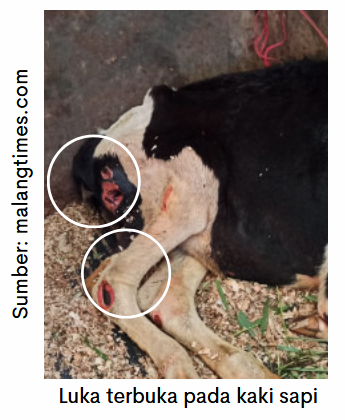
Preventing Myasis in open wounds
Here are some ways to prevent myasis in open wounds :
- Clean the wound from adhering dirt with clean water.
- Give an antiseptic (Antisep/Neo Antisep) to speed healing and prevent secondary infections.
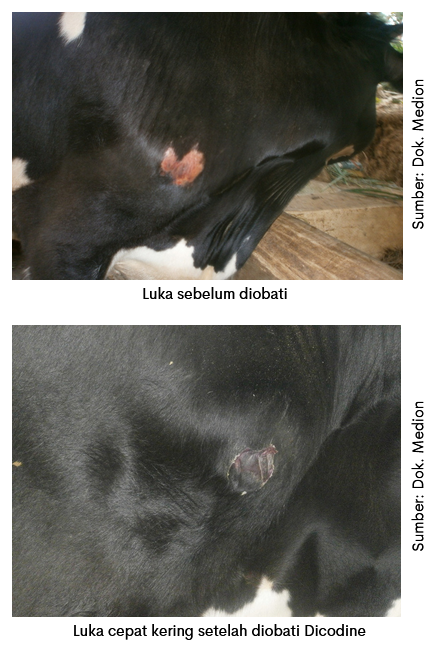
- Clean the floor with a damp cloth (Desinsep) and control the presence of flies in the cage with Flytox/Delatrin.
Dicodine is a spray that has larvicidal and insecticidal activity. So in addition to preventing the occurrence of myasis, Dicodine it can also be given to treat cases of myasis that have already occurred. How to use it is practical, only sprayed with a distance of 10 cm in the wound area that has been cleaned. The repetition can be done once every 3-7 days until the wound heals.
Open wounds on the body of cattle need to be handled properly so that healing can be faster and avoid myasis or secondary infection. If there has been myasis or secondary infection, it will have an impact on the healing process that takes longer and certainly makes the condition of the livestock decrease. May be useful.