Question
Mr. Tedi – By email
Sir/Madam, why does the oviduct of native laying hens protrude and bleed after being given commercial layer feed? Before using commercial layer feed, there were no problems. Is there any Medion product that can help prevent this issue? Thank you for your assistance.
Answer:
Thank you, Mr. Tedi, for your question. The condition in which the oviduct or egg tube is pushed out along with the egg is called prolapse. Prolapse occurs due to excessive contractions and the egg being obstructed by abdominal fat or because the egg size exceeds the hen’s skeletal capacity. Hens that experience prolapse generally lose productivity; therefore, this condition should be prevented as early as possible.
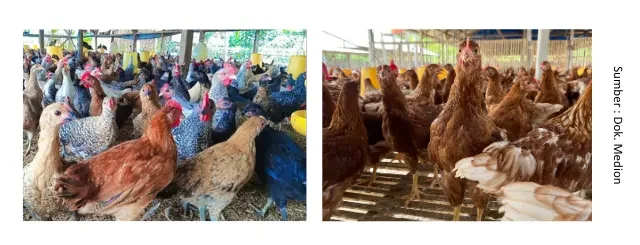
Native or local chickens have non-uniform phenotypic and genotypic characteristics. Compared to commercial layer chickens, native chickens have a lighter body weight—around 1,404 grams at maturity (Rahayu et al., 2014)—whereas commercial layers reach approximately 1,800 grams at maturity. The differences in body weight and characteristics between native and commercial layers result in varying nutritional requirements. The heavier the bird, the higher its nutritional needs for both maintenance and production. The following table presents the standard nutritional requirements for native laying hens and commercial layer feed according to SNI (Indonesian National Standard).
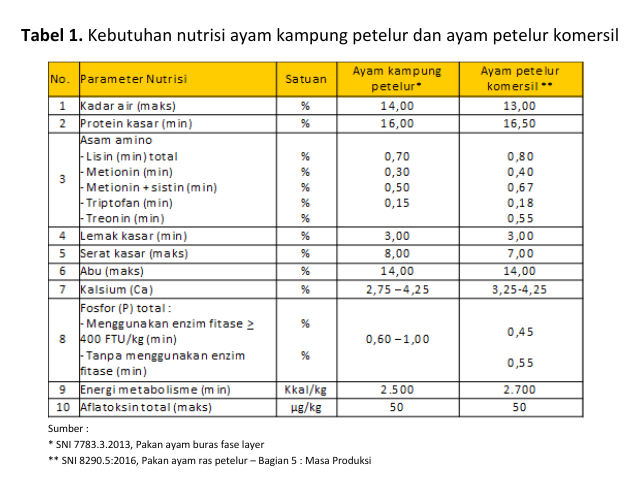
According to SNI, there are differences in the nutritional requirements of native laying hens and commercial layer chickens. The nutritional parameter that can contribute to prolapse is metabolizable energy. Metabolizable energy affects both body weight and egg size. When egg size increases without being supported by proper skeletal development, prolapse can occur.Skeletal development is crucial during the starter to grower phase (up to 12 weeks of age). The success of skeletal growth can be assessed by achieving the ideal body weight in females (around 1.20–1.50 kg). Additionally, excessive metabolizable energy can trigger fat accumulation in the abdominal area. This excess fat can press against the reproductive tract, hindering the egg-laying process and increasing the risk of prolapse.To prevent prolapse, ensure that the chicken’s body weight corresponds to its production phase (neither too thin nor too fat). Provide nutrition that meets the chicken’s needs and ensure optimal feed intake, as both factors are key to achieving proper body weight.If excessive fat accumulation has already occurred, you may add Strong N Fit. The L-Carnitine content in Strong N Fit helps convert fat into energy.

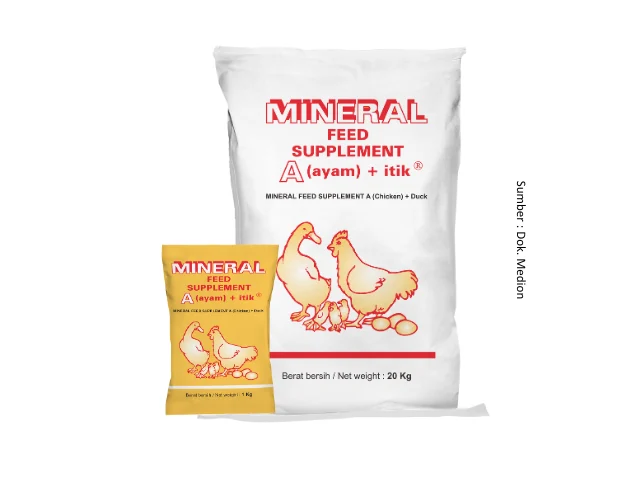
Skeletal development must also be carefully monitored, particularly regarding calcium and phosphorus intake in the feed. Calcium and phosphorus play essential roles in the mineralization of the skeletal system and are required for metabolic processes. Additionally, vitamin D3 is necessary to enhance calcium absorption in chickens.A well-developed skeletal structure can support a heavier body weight and helps minimize the risk of prolapse caused by oversized eggs. Add crushed stone grit and limestone powder to aid skeletal development. You can also supplement with Mineral Feed Supplement Ayam (dosage: 1 kg per 50 kg of feed), which contains calcium, phosphorus, and vitamin D3 to support bone growth and formation in chickens.
If prolapse has already occurred, cull the affected hens as they are no longer productive and are at risk of being attacked by other birds (cannibalism). For chickens with excessive body weight, separate them for special treatment. Reevaluate the feed formulation and adjust feed allocation (do not increase feed portions). Hopefully, this information is helpful.