Efforts to reduce the concentration of disease seeds on farms should be done precisely and strictly. These activities need to be carried out from post-harvest to the preparation of the cage before being filled with chickens again. This includes proper sanitation and disinfection of the cage and the implementation of cage rest. All that needs to be done to get the condition of the cage back clean and ready to be occupied by chickens in the next maintenance period.
Post-Harvest Cage Cleaning
Post-Chicken harvested or rejected, the remnants of chicken rearing materials such as feces, feathers, mucus, and litter still left in the cage. Organic matter such as feces is one of the media for disease transmission. Moreover, it can also reduce the effectiveness of disinfectants because it will block contact between disinfectants and disease seeds. This is where it is important to carry out optimal cleaning of the cage by removing all organic matter present before disinfection. The stages of cage preparation that need to be done include :
- Remove cage equipment such as rations and drinking places. Wash the chicken ration (TRAand the chicken (TMA) to remove adhering mucus and lichen, and then rinse. Then put it in a baking dish (Medisep) for 30 minutes and dry. All cage equipment that has been clean can be stored first in the storage warehouse.
- Scrape off husks, feces or remnants of cage waste using a shovel or broom until no residue remains. Husks and feces can be directly packed into sacks for sale.
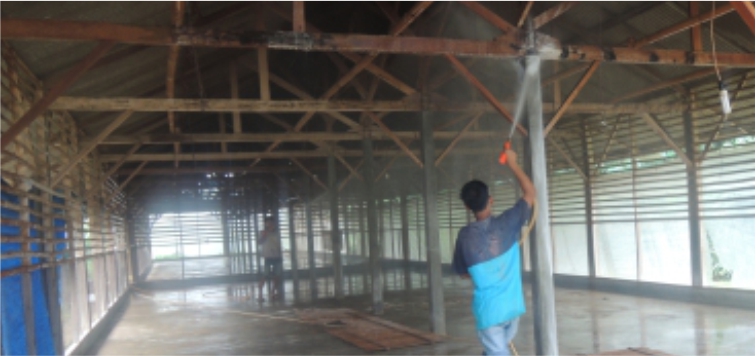
- Clean all parts of the cage covering between the walls and the floor of the cage by spraying high-pressure clean water. Including curtains to the ceiling. Then do the washing and brushing of the floor, between the floors, bulkheads and walls of the cage using detergent and then rinse again with water. Then disinfect the entire cage both inside and outside with Formades or Sporades.
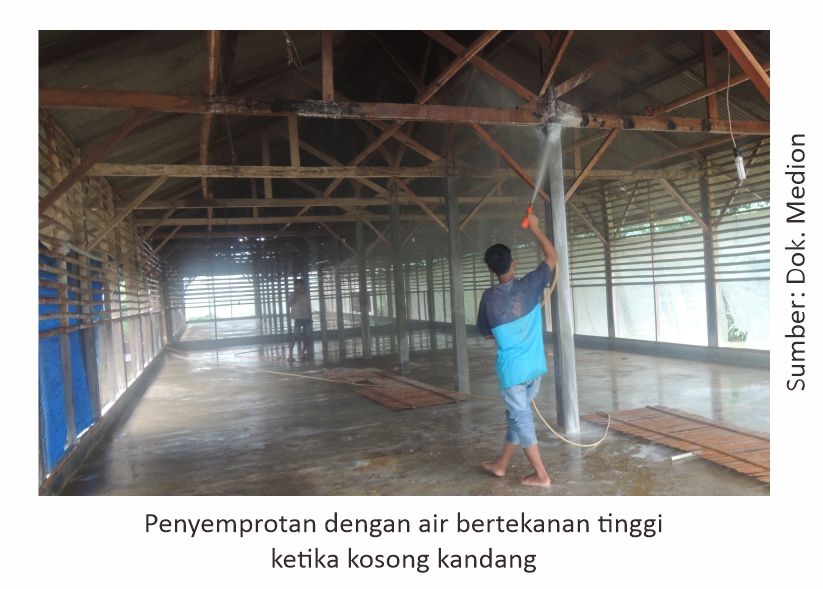
- Clean the grass and shrubs around the cage so that they do not become a place to live for disease vectors such as Franky beetles, mosquitoes and other insects.
- Also clean the ditch / ditch next to the cage so that the drainage flow is smooth.
- Spray insecticide on the cage and the surrounding environment to eradicate fleas or insects.
- Perform Liming under the stage cage and all parts of the cage
- Perform Liming under the stage cage and all parts of the cage to reduce moisture and kill the remnants of disease-causing microorganisms.
- Perform a thorough inspection of the cage if there is a leak in the cage, slat holes, or perforated curtains for immediate repair.
- Drain torn water and flushing water pipes to remove biofilm adhering along the lines of water installations.
Cage Rest Period
After the cage has been thoroughly cleaned and disinfected, it is mandatory to empty the cage for some time. It is recommended that this cage rest period is at least 14 days counting from the time the cage is finished cleaning and sprayed with disinfectant. Moreover, if the cage has a case history of the disease, then the rest period of the cage up to 4 weeks or even more, especially for seedlings that durability long enough in the environment such as viruses AI and Marek (Biosecurity for Poultry Flock, 1997). The goal is to minimize the spread to break the cycle of disease seeds in the cage.
Poultry broiler chickens that are kept without a cage rest period, have a lower immune system than chickens that are kept with a cage rest for 3 weeks. According to Tony Unandar (2011), from research conducted by Klasing (2005) known low immunity system is described from:
- Hormone levels adeno corticotropic hormone (ACTH) is higher. The high level of the hormone ACTH indicates that the chicken is under stress. These conditions can further lead to prolonged immunosuppression so that chickens are vulnerable to disease seedling attacks.
- Rates interleukin-1 (inflammation indicators) are higher. The high level of interleukin indicates that the remains of disease seeds in cages without cage rest are capable of causing an inflammatory reaction in the chicken's body, although the chicken does not show significant clinical symptoms. Furthermore, for example, inflammatory reactions occur in the intestine will result in the process of absorption of nutrients is not optimal so that the value of feed conversion will decrease.
Do not forget to also do some important things such as the following:
- Checking all other supporting facilities related to maintenance procedures (water sources, electrical installations, etc.).
- Check and ensure the condition of all equipment can function optimally. For example, if the heating brooder does not work, immediately contact the service personnel.
- Make a list checklist equipment (ration place, drinking place, heater, etc.) required for preparation chick in and has been adjusted to the number of DOC.
Welcome to the DOC
After the cage rest period is completed before the maintenance period/chick in, we need to optimally prepare the cage and equipment.
- Replace all clean cage equipment as well as curtain walls and slat covers (for stage cages).
- Prepare OVK (medicines, vaccines, vitamins) and form recording.
- Spray back the cage with Formades.
- Preparation for making a cage brooder:
- Scatter litter/ sprayed husks Sporades. Ensure conditions litter optimal with a thickness of 5-8 cm so that the warmth felt by the chicken is more optimal.
- Install chick guard from zinc material to resist wind flow and as a heat reflector.
- Installation of inner blinds to optimize heat from brooder especially in the mornings and evenings so that the chicks always get a comfortable temperature for their growth.
- Turn on the gas heater Infrared Gas Brooder Medion (IGM).
- Prepare sugar water, vitamin solution and feed to give as soon as possible after the chicks arrive in the cage. Because it is useful in accelerating the absorption of the remaining yolk which is a temporary source of nutrients and a source of immunity (maternal antibodies) chicks.
- Check again the suitability of the number of ration places, drinking places and heaters needed according to the number of DOC.
- Then the cage is ready for activities chick in.
Use Of Disinfectants
Disinfection activities that are not carried out optimally will cause the purpose of cleaning and preparing the cage in reducing disease seedlings to be in vain. The use of disinfectants should not be arbitrary because it must consider several factors such as the type of seed disease, organic matter, pH and hardness of the solvent, contact time, and dose of use. The goal is for the disinfection process to run more effectively.
There are several things that must be considered related to the use of disinfectants, namely:
- Types of disinfectants
Selection of disinfectants in the preparation of the cage when the cage is empty and there is no chicken then it can use such Formades or Sporades. As for the disinfection of cage equipment, you can use Medisep. For disinfection of drinking water can be used Desinsep.
- Proper dosage and mode of administration
The dose of disinfectant should be adjusted to the rules of use listed on the product etiquette or packaging. How to use a dehumidifier (,) should be carried out until the surface is wet with disinfectants.
- Use quality water
The pH level of the water should be neutral or 5-8, and the water is not hard (the content of ions Ca2⁺ and Mg2⁺ little) so that the disinfectant works optimally. PH levels and water hardness can affect the working power of disinfectants, especially the QUATS and iodine.
- Contact time
Shortly after application, the disinfectant begins to degrade so that its effectiveness gradually decreases. As a result, the shorter the contact time required to eradicate microbes, the more efficient the disinfectant. Disinfection of the QUATS group and oxidizing agent known to have a relatively short contact time (10-30 minutes) compared to Phenol so it has a faster killing power.
The purpose of preparing the cage is to restore the bearing capacity of the cage and environmental aspects that have been used for a period. Then it is very important to do cleaning, disinfection, until the cage is completely empty. So that the cage is ready to support the successful performance of chickens. Greetings.