Goat is a livestock that is quite widely cultivated by farmers in Indonesia and every year the population of goat livestock tends to continue to increase. This indicates that raising goats is a promising business.
The magnitude of business opportunities are often faced with challenges that continue to lurk, one of which is the threat of disease. Diseases in goats can be caused by various factors, both non-infectious and infectious.
Non-infectious diseases are closely related to poor maintenance and feed management, while infectious diseases can be caused by viruses, bacteria, fungi or parasites.
Indonesia, which has a tropical climate, is an ideal condition for the growth of parasites. Both ectoparasites and endoparasites with favorable conditions often cause health problems in livestock as in goats.
One type of ectoparasite that often attacks goats is a mite that causes scabies (scabies). Cases of scabies are widespread and can be found throughout Indonesia. Transmission is fast enough in one population can cause significant losses for farmers if not immediately addressed.
Causes
Scabies (scabies) with another name scabies is caused by ectoparasites of the mite type. The life cycle of these mites is relatively short, however, they multiply so quickly that they can spread easily between animals in one cage.
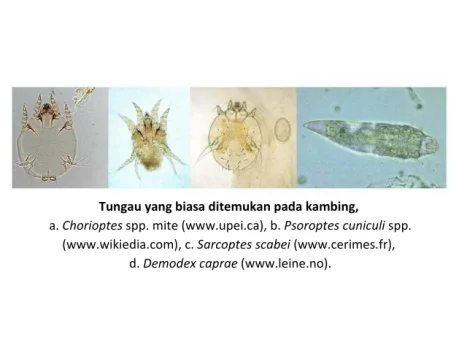
As with other parasites, mites have a specific host and depend on that host to survive. Here are some specific mites causing scabies in goats:
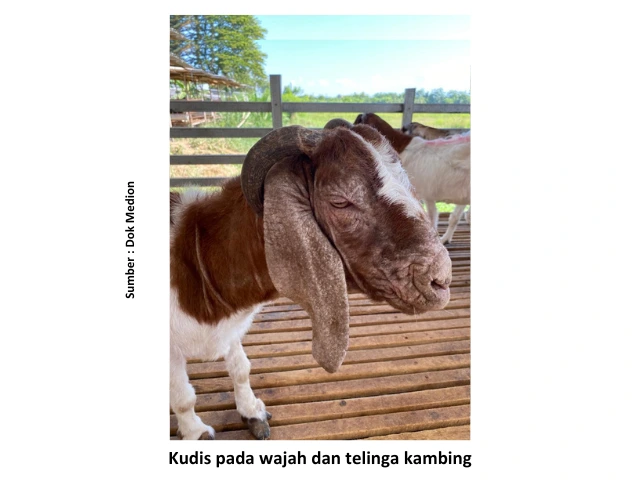
- Sarcoptes scabiei var caprae, this mite infestation is usually found in the area of the eyes and ears of goats, but can spread throughout the body. This type of mite will create a kind of Burrow / tunnel in the skin layer of the epidermis and will lay eggs and develop at that location. Scabies caused by these mites can be transmitted to humans or be zoonotic.
- Chorioptes caprae, this mite infestation is specific to goats and cannot be transmitted to humans. Chorioptes do not make burrows/tunnels in the skin layer, but are on the surface of the skin, especially on the legs, abdomen, scrotum and tail.
- Psoroptes cuniculi, same as Choriptes, these mites do not form Burrows / tunnels but are on the surface of the skin, especially the ears.
- Demodex caprae, this mite infestation is in the deeper layers of the skin, namely in the hair follicles. The predilection location is on the face, neck and shoulder area.
In general, the life cycle of mites that infest goats is approximately the same and the entire process takes place on the host's body. Initially adult female mites will lay eggs on the host's body and hatch into larvae within a few days. Subsequently, the larva will develop and molt into a nymph.
Nymphs also develop and molt into adult female or male mites. The male mite will fertilize the female mite, then the female mite molts back and lays eggs. The cycle will continue to repeat in the same host or be transmitted to other hosts. In this life cycle process, if the mite is separated from the host, it only lasts a few days in the environment.
Transmission and predisposing factors
Cases of scabies can be quickly transmitted in one population, moreover, there are favorable factors. The transmission of scabies in goats mainly occurs directly due to contact with goats that are already sick.
This route of transmission is the most common from one goat to another when they come into contact with each other or gather in a cage. Indirect transmission can also occur through various media such as Cage equipment, breeder clothing or an environment that has been contaminated with mites.
Environment, maintenance management and endurance of goats are predisposing factors that play a role in determining the risk of scabies in goats. The environment of the cage is dirty because it is not routinely cleaned, damp and lack of sunlight can be favorable conditions for mite infestation.
Likewise, poor maintenance management such as the absence of isolation cages for sick livestock and overcrowding in one cage will increase the risk of transmission. The condition of the goat's immune system that is down due to stress or lack of nutrients can also cause susceptible to diseases such as scurvy.
Other predisposing factors in the host that can aggravate the clinical symptoms of scabies are goats that are deficient in vitamin A and protein or are suffering from other diseases.
Clinical symptoms and impact
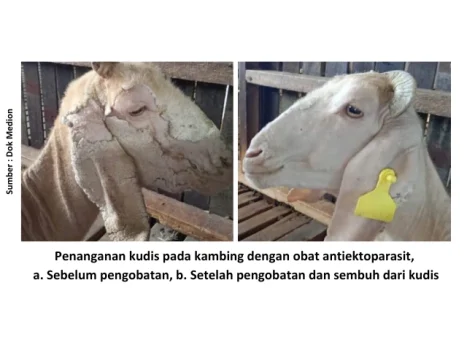
Generally, clinical symptoms in cattle that have scabies are reddish skin, then formed like blisters and inflammation, sometimes to discharge due to irritation.
On the surface of the skin will then form a scab or crust and alopecia (baldness). Cattle will feel itchy so often scratching or rubbing his body on the sides of the cage.
This will make perlukaan and vulnerable to infection. Long-standing or chronic mite infestations can cause livestock to develop anemia.
Cases of scabies in goats can certainly affect their productivity. The goat's appetite will decrease followed by weight loss, milk production and reproductive performance.
The anxiety and discomfort caused by the itching felt can reduce the quality of life and well-being. Livestock will experience stress and decreased endurance so susceptible to other diseases.
Handling and Prevention
The first treatment of scabies in goats needs to be done is the same as handling other cases of infectious diseases, namely separating with healthy livestock. Furthermore, the treatment of scabies can be done with:
- Administration of antiectoparasites Wormectin Plus Bolus by animal health workers to treat scabies. Repetition of giving Wormectin Plus Bolus carried out according to the severity and advice of animal health workers, it can be once every two weeks or once a week.
- Provision of supportive therapy with multivitamins Vita B Plex Bolus Extra Flavor.
- Bathing cattle in lime sulfur.
- It is equally important to spray the cage with antiectoparasites such as Delatrin to kill mites around the cage. It also aims to prevent scabies infection from recurring.
Scabies transmission that can be widespread and its impact is not small needs to be prevented by various efforts. Here are some precautions that can be taken:
- Do not sell and buy livestock suffering from scabies so as not to transmit the disease to other livestock or other areas
- Quarantine or isolate newly arrived livestock (avoiding contagion of suffering livestock but still in the incubation period) and observe their health. Cases of scabies in goats often start from bringing new livestock into the barn.
- Spray antiectoparasites on the cage and its surroundings with Delatrin to kill the mites that cause scabies because the mites can survive outside the host's body / in the environment a few days.
- Keep the cage clean and spray the cage regularly with disinfectant (Medisep/Antisep/Zaldes).
- Make sure the circulation and lighting in the cage is sufficient so that it is not damp
- Maintain the health and endurance of livestock with multivitamins Vita B-Plex Bolus Extra Flavor.
Scurvy in livestock whose occurrence can be found throughout Indonesia continues to threaten the health and productivity of livestock.
After better understanding the causes of scabies with clinical symptoms and their effects, treatment and especially prevention efforts can be done as well as possible. Thus the health of livestock can be maintained and maximum productivity.