Pink eye is a common eye disease that affects ruminants, such as cattle, goats, and sheep. Although it is often considered a “mild”disease, pink eye it can cause great economic losses to livestock farms due to decreased production, weight loss, maintenance costs and high risk of transmission. This red eye symptom is a common problem that occurs throughout the year, especially in the dry season to the beginning of the rainy season, in female cattle and the pre-weaning phase. This disease is mainly characterized by inflammation of the conjunctiva (lining of the eye) and cornea, which causes the eyes to become red, watery, painful, and can lead to blindness if left untreated. Understanding the symptoms, causes, and ways to prevent it is an important step for farmers to maintain the health of livestock while preventing greater economic losses.
Penyebab dan Penularan Pink Eye
Pink eye or often called inflammation of the eye, cataract or bular eye disease is a disease of the eye caused by bacteria and often attacks goats and sheep. Pink eye in ruminants is often caused by a combination of bacteria, irritant agents, and environmental factors. The disease is caused by the main agents Moraxella bovis as well as its participants Moraxella bovoculi, Mycoplasma bovoculi, Chlamydia spp., and viruses such as IBR (Infectious Bovine Rhinotracheitis) in cows. Whereas in sheep and goats the causative agent Rickettsia conjungtivae, Mycoplasma conjungtivae, or Brahnanella catarali.
The disease is transmitted horizontally from sick cattle to healthy cattle either through direct contact through eye secretions or indirectly through dust, fly vectors and equipment contaminated with bacteria. These factors do not cause direct, but aggravate the risk of occurrence of infections such as :
1. Dust, strong wind and tall grass that hurt the eyes
Flying dust can stick to the cornea and conjunctiva, triggering repeated friction that causes mild inflammation to small wounds in the eye tissue. This condition is further exacerbated by strong winds that carry fine dust and dry the surface of the eye, so that the tear film that serves to protect the cornea of the eye becomes unstable.
2. Fly attack Musca autumnalis
Flies attack mainly Musca autumnalis it is one of the most important factors in the spread pink eye. This type of Fly has a habit of sucking the secretions of the eyes, nose, and mouth of livestock, so it becomes a medium for carrying and transferring pathogenic bacteria from one individual livestock to another. When a fly lands around the eye, it can cause irritation that triggers cattle to rub their faces, exacerbating damage to the surface of the cornea and paving the way for infection. Fly populations usually increase in hot summers and humid environments, which indirectly increases the risk of outbreaks pink eye on the farm.
3. Exposure to ultraviolet rays (especially in the dry season)
Strong UV rays can damage the epithelial layer of the cornea, which is the main protector of the eye from microorganisms. When this layer is irritated or micro-damaged, the eye's ability to defend itself against bacteria and viruses decreases significantly. In addition, dry conditions are often accompanied by dust and low humidity levels, which further aggravate the dryness of the eye surface and make it more sensitive to light.
4. Dirty and damp conditions of the cage
An environment filled with dirt, standing water, and poor ventilation creates an ideal place for bacteria, viruses, and fly populations to multiply. High humidity causes eye irritation to occur easily because dust and dirt adhere to the surface of the cornea more easily. Livestock living in unsanitary conditions also experience environmental stress, which ultimately lowers the immune system and makes them more susceptible to disease.
5. High cage density in one area increases the risk of transmission
When too many animals are placed in a narrow space, contact between individuals becomes more intense and frequent, so the chances of transferring bacteria or viruses through eye, nose, or physical touch splashes increase dramatically. This situation also worsens the air quality in the cage.
Symptoms Pink Eye
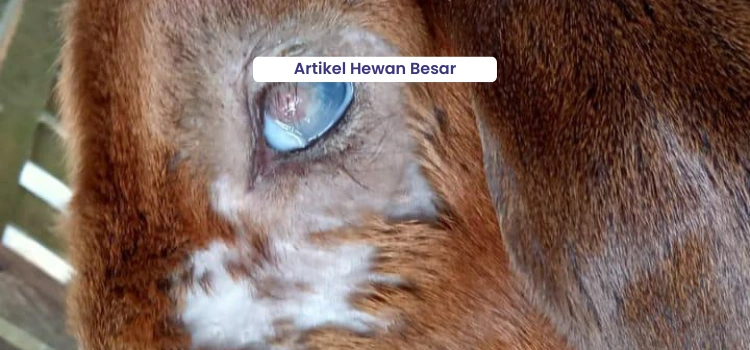
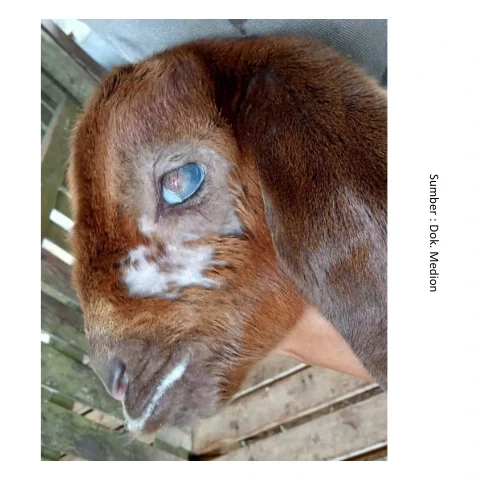
Pink eye attacks all age livestock with a mortality rate of less than 5% but the level of pain is quite high up to 70-80%. Sick cattle will appear symptoms of red and inflamed eyes, sensitive to light (avoid light), excessive tear discharge, cloudy cornea, corneal blood vessels dilate, infection can occur in one eye or two eyes. Symptoms pink eye in cattle, sheep, and goats it generally appears gradually, ranging from mild signs to more serious eye damage if not treated immediately. In the early stages, cattle usually show excessive watery eyes (lacrimation), often blink, or rub their faces on objects around because they feel uncomfortable. As the disease progresses, the eyes appear reddish, swollen, and sensitive to light, making the cattle more likely to avoid sunlight. The initially clear eye fluid can turn cloudy or purulent as a result of a bacterial infection. In more severe cases, the cornea can experience turbidity (keratitis) and even ulceration, which has the potential to cause temporary to permanent vision loss. Behavioral changes such as decreased appetite, decreased body weight, and appearing lethargic also often accompany this condition due to the pain experienced by livestock. These symptoms need to be recognized early so that treatment can be done more quickly and effectively.
Handling Efforts Pink Eye
Handling if livestock are already sick by separating sick livestock from healthy livestock, treatment with effective antibiotics, the following explanation:
- Good environmental management
A good Cage is certainly in clean conditions, has enough sunlight, shade, is safe and strong. Make sure the air circulation in the cage is good and not a lot of dust. Adjust the cage density to ensure all livestock have the same opportunity to receive rations, drinking water, movement space and oxygen so that growth and productivity are uniform. The floor of the cage should dry quickly and be easy to clean. Slat Plastik Medion can be used as a base on the stage cage in sheep/goats. Apply routine cleaning of the cage area regularly, disinfect the cage using disinfectants such as Medisep or Zaldes at least once a week, clean the feed by taking the rest of the feed and clean the dirt in the feed. Dirt that is under the stage Cage also needs to be routinely cleaned at least once a week. Control of vectors such as flies is also very important, considering that flies are often the cause of eye irritation as well as carriers of pathogens. If there are adult flies that have wandered a lot in the cage, the breeder can get rid of them with insecticides such as Flytox and Delatrin.
- Provision of balanced and complete nutrition
Quality feed must necessarily contain the necessary nutrients such as carbohydrates, proteins, fats, vitamin and mineral complexes. And given in sufficient quantities according to the needs of livestock. The grass should be mowed and chopped first before being given to livestock. Give such feed supplements, such as vitamins, minerals, amino acids contained in Mix Plus Cattle Pro and Mineral Feed Supplement S to maintain the health and growth of ruminants. Fulfillment of feed with vitamin A, E, and minerals such as zinc (Zn) and selenium (Se) plays a major role in strengthening eye tissue and increasing the resistance of livestock to infection. Provide a sufficient amount of clean and fresh water at all times (always available).
- Isolation and quarantine
Separation of sick livestock so that it does not become a source of infection and treatment can be carried out immediately. Keep livestock out of direct sunlight.
- Health Control and treatment
perform daily health control can be done at least 2x a day. Giving multivitamin supplements is useful for preventing and treating diseases caused by vitamin deficiency, increasing appetite, and increasing productivity. Routine vitamin administration is carried out once every 2-3 months, but it can also be given when the livestock is sick or looks weak. For example, by giving vitamins Vita B-Plex Bolus Extra Flavor, Injekvit B Plex or ADE-Plex Inj. Do treatment with antibiotics that are effective for gram-negative bacteria, such as Medoxy-LA or Neo Meditrile-I. Infection, inflammation, and redness of the eyes can also be treated with sterile eye drops, namely M-Drops. Antibiotic preparations in M-Drops it can help fight infections in the eye by inhibiting protein synthesis in target bacteria, causing death in target bacteria. M-Drops it also works as an anti-inflammatory by binding to glucocorticoid receptors thereby inhibiting pro-inflammatory signals, and enhancing anti-inflammatory signals. Awarding M-Drops effective in treating infections and eye irritations in livestock.
Prevention Strategies Pink Eye
Disease Control can be done effectively with the implementation of Biosecurity, the implementation of health programs vaccination and supplementation as well as the implementation of good maintenance practices. Disease prevention measures with biosecurity need awareness and cooperation of all parties, both owners, workers, visitors, buyers, feed providers/suppliers, medical personnel and government support. The thing that can be controlled by farmers is the application of biosecurity in the cage area. Application of biosecurity with 3 zones (dirty zone, transition zone and clean zone). As well as maintaining the cleanliness of the cage environment and equipment by not allowing cow dung to accumulate. Disinfect the cage regularly using Medisep, Antisep or Neo Antisep. Control vectors by eliminating habitats and insect elimination with Delatrin. Insect control (flies and mosquitoes) must be done intensively by using insecticides and keeping the cage clean. Prevention pink eye in livestock can be done effectively through the implementation of planned grazing rotation. This rotation system helps move livestock from one pasture to another before the area becomes too dense, dirty, or full of plants that can irritate the eyes, such as tall, sharp grass. Trim grass around grazing areas and livestock traffic lanes, thereby reducing contact with plants that can injure the cornea of the eye. Provide a place to shelter/shaded enclosure so as to prevent direct sunlight from contacting the livestock. Ventilation of the cage also needs to be sufficient so that air circulation runs well. It's a good idea to start with a healthy diet (Vita B Plex Bolus Extra Flavor/ADE Plex Inj) and anthelmintic (Wormzol-B/Wormzol Suspension) regularly 2-3 months. It is necessary to maintain good resistance of the livestock body to the attack of disease agents.
Proper cage management, cleanliness of the cage is maintained, as well as the provision of Complete Nutrition and vitamins can minimize the impact of the case Pink Eye which often happens on farms. As well as early detection and rapid treatment is essential to prevent permanent eye damage. Congratulations useful.