Self mixing is a technique of concocting / formulating rations where farmers mix their own ration ingredients into rations.
In drawing up the composition of the ration self mixing exactly, there are 2 things to consider. First, the complete fulfillment of nutritional needs for chickens. Nutritional needs that need to be considered in chicken rations layer are metabolic energy, crude protein, crude fiber, crude fat, minerals (calcium and phosphorus), vitamins, trace mineral (essential micro minerals) and amino acids (total and undigested amino acids). Make sure that the ration prepared is able to supply the nutrient needs of chickens in accordance with the production phase. The second thing to consider is the price of the ration. It would be very good if in drawing up the composition of the ration we could get the cheapest price (least cost). Do not let the nutritional needs of chickens are met but the cost of rations issued from the formulation itself (self mixing) it is higher than if we buy the finished ration from the factory.
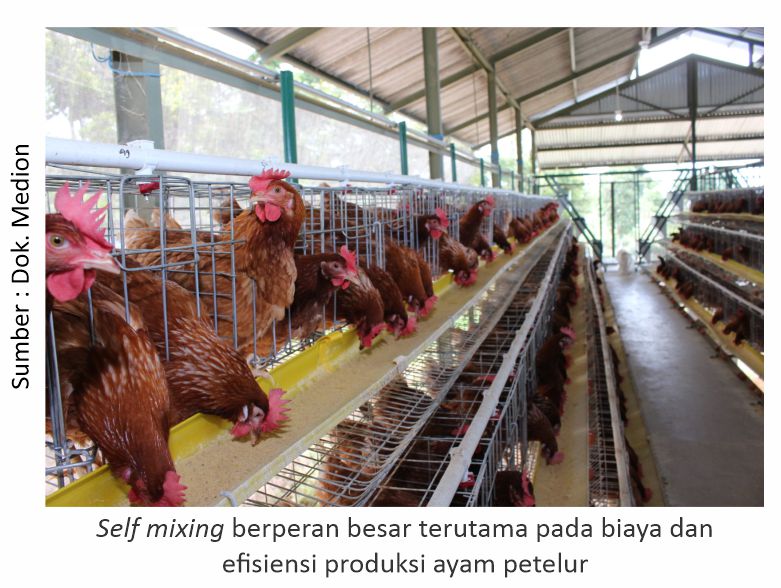
Benefits Self Mixing
With self mixing farmers have a choice in action. Not only rely on or depend on one source of supply, namely rations so factory output.
Usually, just in Phase starter, chickens are given a finished ration. Start grower or at the age of 70 days, chickens can begin to be given rations self mixing. There are even some farmers who provide rations self mixing the chicken is 30 days old.
To learn more about the benefits of self mixing here, here's the explanation:
- Efficient
Basic calculation of efficiency self mixing include cost production ration. The amount of dollars that must be spent to produce 1 kg of eggs is the benchmark for determining the choice of ration. So the size is not solely the low price incurred when making or buying rations. It is necessary to make sure that the output self mixing to produce 1 kg of eggs is able to lower than using the manufacturer's ration. When the obtained productivity is low, the quality of production is low, it does not mean anything. On the contrary, despite the higher costs incurred, when the results obtained are commensurate, this means a profit. For that layer breeders must carefully consider this.
- Monitoring ration quality
In addition to more efficient, other benefits self mixing that is, the farmer is more free to determine the composition of the ration according to the condition of the chickens. The quality of the ration can also be controlled by yourself. In this case, the farmer is more free to control the ration since the raw material comes to the farm, starting from the selection of the type, quality, price of raw materials, to the formulation process.
With self mixing, the stability of the ration can also be better maintained. Even if the price of the mixture is more expensive due to the increase in raw material prices, the count cost production can still be pressed lower than the factory ration.
- Ration formulations can be made as needed
Other advantages of self mixing this is because each farm can adjust the ration formulation based on needs. For example, in hot weather, feed intake chickens tend to be low due to decreased appetite.
Order Quality Control Self Mixing Successful
In self mixing, the main challenge that must be faced by farmers is to ensure the quality of rations that are formulated to ensure the quality of rations in accordance with the needs of chickens. Here's the description:
- Raw material quality control
The principle is garbage in, garbage out. That is, if the raw materials used in self mixing good and meet the standards, then the resulting ration mixture will be of good quality. Some things that must be done and considered, including:
- Knowing the storage time of raw materials in supplier.
- We recommend that farmers have several alternatives supplier raw material ration as a comparison of quality and price. It is also useful if suddenly there is supplier who can not / stop supplying raw materials rations to our farms.
- When raw materials come to the farm, immediately record no. batch, name supplier, date, and amount of raw material load. After that, carry out a physical quality check of the received raw materials. After inspection, the next raw materials stored in the warehouse rations, and sorted by no. batch as well as the date of arrival.
- Check the moisture content (KA) of raw materials ration using digital measuring instruments. A good rate is =14%. If there is no choice of other raw materials with low KA, then raw materials with KA >14% must be dried first before being stored in a warehouse or raw materials were used immediately so as not to arise fungi and mycotoxins.
- The smell should not be rancid, it should be the specific smell of the feed ingredients used.
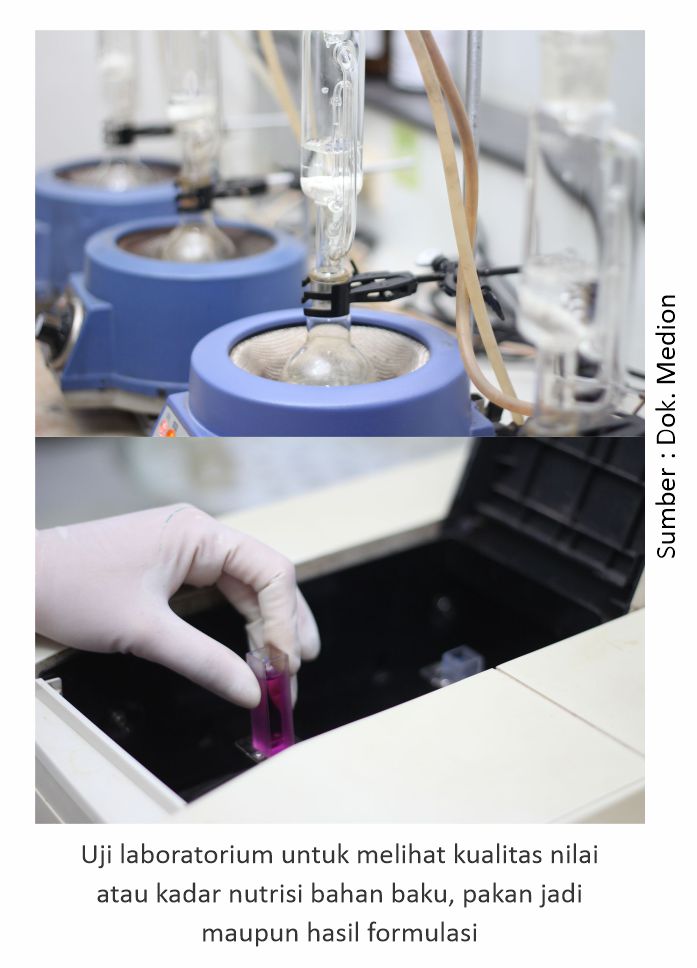
- Inspection of raw materials ration can also be done by looking at the chemical quality. This examination can be done at Medion Laboratory (MediLab). In addition to ration quality checks, MediLab also provides ration formulation services.
2. Ration formulation control
For breeders self mixing, the ration formula that has been compiled is not standard forever. If in the field there is a decrease in the quality of ration raw materials, such as soybean meal, then reduce the use of soybean meal and add portions of MBM (meat and bone meal) and PMM (chicken meat meal). The point is, do not let the quality of the complete ration given to chickens decrease.
3. Control of the process of mixing rations
When the process of mixing rations or mixing, the potential occurrence of human error very high, so it can affect the quality of the resulting ration. Results mixing must be homogeneous so that if the sample is taken at a point mixer a representative value will be generated. This is because the homogeneity of the ration affects whether or not the nutritional needs of each chicken are met. Results mixing with insufficient homogeneity, it will have an impact on livestock productivity, and can even lead to death.
Therefore, there are several critical points that need to be considered in order to produce a homogeneous mixture, namely :
- Different particle sizes of ration materials reduce the likelihood of evenly mixing raw materials. The solution is to reduce the size of the ration material so that the particles can be scattered randomly and evenly.
- Ration materials that have very small particles and small amounts for example premix the first (premixing) so equally.
- Charging mixer too full can hinder the mixing process at the top mixer. Mixing will run efficiently if mixer filled to 60-90% of its capacity.
- Pay attention to the length of mixing time (mixing duration). The length of mixing time is usually 4-5 minutes for mixer horizontal or 10-15 minutes to mixer vertikal. Perform a mixing homogeneity test. Instead, the duration mixing too long can allow segresi (separation of particles).
4. Ration storage control
Poor storage conditions have the potential to cause contamination resulting in nutrient levels decreased rations. As for the provisions of the storage conditions and warehouse rations are good among them:
- Apply the storage system first in first out (FIFO: stored by date of arrival of ration material) or first expired first out (FEFO: stored by expiration date). If there is poor quality raw material and does not allow it to be stored longer, it can be used first even if it has just arrived.
- Provide a stock of rations in the warehouse as needed so that they run out quickly and are not stored for too long. The shelf life of a good chicken ration generally lasts for 21-30 days from the date of production (batch).
- It is advisable that the construction of a ration shed refers to the required cage building procedure. General requirements for ration storage warehouses include being closed, having a good air circulation system, not humid, clean, optimal temperature (26-28°C), and free from insects and rodents (rats). Another requirement is the position of the floor higher than the ground level and avoid dust.
- Use pallet (with a height of 5-15 cm) under the pile of rations. Try that the ration does not stick to the walls. Leave a distance of at least 50 cm from the walls of the barn. Stack pallet up to a maximum of 3 pallet, respectively pallet contains 6 stacks of ration sacks.
- Provide a stock of rations in the warehouse as needed so that they run out quickly and are not stored for too long. The shelf life of raw materials and a good chicken ration generally lasts 21-30 days.