A broiler farmer in Padang city is restless because it has been several periods of production, the chicken pedingnya Gumboro disease. This time Gumboro attacked his chickens at the age of 24 days, whereas Gumboro's vaccination had been done at the age of 10 days. The farmer was dizzy from looking for the cause of the recurrence of the case. Evaluation of all aspects of management, including biosecurity as well as the home break has been done well, but Gumboro still attack. What the hell happened? What actions should such breeders take?
Gumboro Attack Update
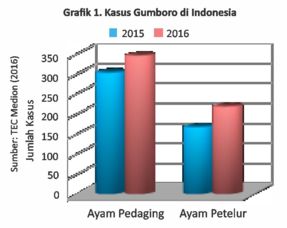
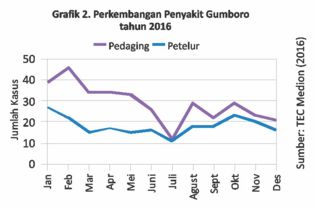
If we look again at Gumboro case in Indonesia today, it can be seen in the data that has been summarized by the team Technical Education and Consultation (TEC) Medion that the incidence of Gumboro cases in broilers tends to increase significantly from 2015 to 2016. The increase in cases of Gumboro disease is believed to be in line with the increase in the chicken population in Indonesia by about 6% of the population in 2015 (Ditjen PKH, 2016). Meanwhile, if we look again at the number of cases each month (can be seen in graph 2) Gumboro cases are quite high in broiler farms and layers since the beginning of the year. The number of cases then decreased in March to July, but increased again in August. After a decline in September, the increase in cases occurred again in October and is expected to increase again in early 2017.
If we look at the virus side, the team Research and Development (R&D) Medion has collected and observed strains of Gumboro virus in the field. These isolates were then studied or analyzed by means of RNA extraction, polymerase chain reaction (PCR) dan DNA sequencing. As a result, 90% of the field isolates studied included strains very virulent infectious bursal disease (vvIBD) is a malignant Gumboro virus that causes outbreak high and show clinical symptoms.
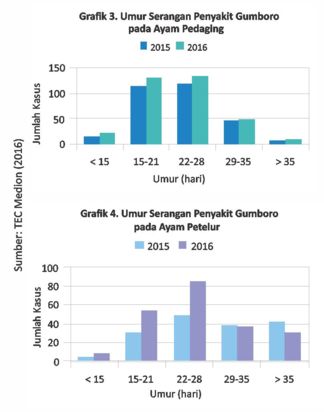
Meanwhile, judging from the attack pattern, it is known that chickens aged 20-60 days are susceptible to Gumboro attacks. This information is reinforced by TEC Medion data which states Gumboro disease in broilers and layers most often attacks the age of 22-28 days in the First Order and the second order followed by the age of 15-21 days (graphs 3 and 4).
Tec Medion Data throughout 2016 also showed that CRD disease, colibacillosis, and coccidiosis is a disease that most often appears with Gumboro. In broilers, Gumboro disease is often complicated by coccidiosis, mild CRD to complex CRD. While in laying hens, there are CRD and colibacillosis. As we know that Gumboro is immunosuppressed, so it gives a great chance of secondary infection attacking chickens. Therefore, farmers need to be more careful about Gumboro disease attacks.
About Gumboro and its triggers
The disease, which was first discovered in Gumboro, Delaware, United States, is one of the causative agents of immunosuppression. This is because Gumboro attacks the organs bursa Fabricius which belongs to one of the main immune-forming organs in poultry. It is located at the top of the anal hole (cloaca) of the chicken. This immune Organ begins to develop actively at the age of 3-4 weeks and undergoes reduction, and then disappears when the chicken is 16-18 weeks old. It is conceivable if the virus has already attacked and damaged the organs bursa Fabricius before the age of 3 weeks, chickens will experience a permanent decrease in body resistance (immunosuppressive). If so, various diseases will easily attack.
Based on data and experience in the field, it can be concluded that there are several factors that cause Gumboro is still often eyeing the farm in between:
- Faecal cleaning is not optimalthe cause is still the spread of Gumboro virus because sometimes there is still spraying disinfectant without cleaning the cage first or cleaning is not optimal (there are still remnants litter/ feces on the sidelines of the cage floor). This condition will certainly result in the work of disinfectants will not be optimal, especially in the use of Antisep (oxidizing agent). This type of disinfectant works influenced by organic matter (feces, blood, and mucus). So that the virus still sticks to the feces and can one day infect other healthy chickens.
- Gumboro virus has a non-amplified structure, has the advantage that it is more stable to live in a wide pH range (pH 2-8) and is able to survive more than 3 months in the environment, so it is known as a “very recalcitrant virus”. This is also what makes Gumboro difficult to handle.
- Improper timing and application of vaccination too close to the time of occurrence of the disease to the time of vaccination (7 days) can lead to vaccination failure because the antibodies produced by the active vaccine only reach the protective titer at 14 days post vaccination. In addition, the active Gumboro vaccine given when maternal antibodies are still high may result in the vaccine virus being neutralized by maternal antibodies. So that the vaccine given is not able to provide optimal protection.Events in the field, Gumboro vaccination application is still dominant through drinking water. Although practical, the application via drinking water has shortcomings that are likely to cause the results of vaccination are not optimal because of the inconsistency of vaccine doses received by chickens. Another thing that is also an obstacle when vaccinating drinking water is poor water quality (containing heavy metals, hard, pH is not neutral, contaminated with chemicals such as disinfectants/chlorine) so that it can damage the virus in the vaccine.
- The aspect of the cage rest period is still a debate because technically the cage rest is needed to control and break the life cycle of disease seeds. However, considerations of time efficiency often encourage farmers to reduce the length of the cage rest period. Sometimes the cage rest period is carried out by breeders faster, less than 14 days or even only 7 days. Though this condition is not appropriate because it will cause the seeds of the disease still remain in the farm environment, so that the disease attack will always recur.
Gumboro Disease Course
The Gumboro Virus generally enters the chicken's body orally, namely through the digestive organs through which drinking water or feed contaminated with the virus passes. Although there is one study that explains that the entrance of Gumboro virus can be per-inhalation through the respiratory organs, but its infectivity (ability to infect) is much lower than through the digestive organs.
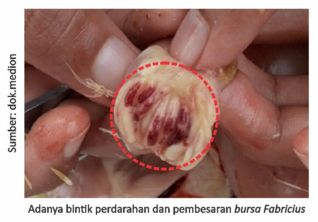
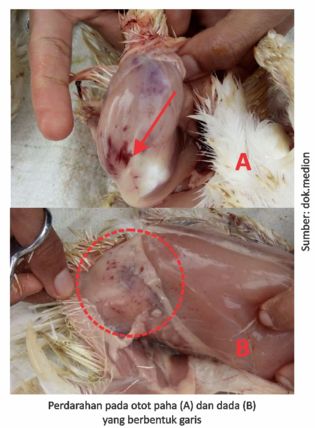
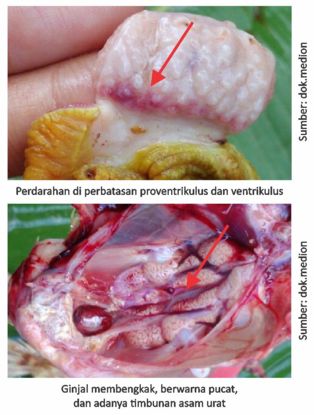
In a relatively short time (approximately 5 hours post-infection orally), the virus can be detected in macrophage and lymphoid cells in tissues caecum, small intestine (duodenum and jejunum), and liver. From the liver, the virus will enter the bloodstream (viremia) and reach the main target organs, namely bursa Fabrisius to perform replication. Furthermore, after replicating in the bursa, the virus will spread again quickly via the bloodstream towards the spleen to hide. In this phase the chicken will experience depression and severe fever followed by bleeding in several other organs such as the thigh muscles, chest muscles, and proventriculus. The severity of the attack on these organs further depends on the strain and malignancy of the virus that attacks, the immune status of the chicken, the age of the chicken when infected, and the presence or absence of other stress factors that are affecting the chicken.
Isolates of vvIBD strains that are more commonly found by the Medion R&D team and the average attack age at > 3 weeks are also supported by symptoms and changes in anatomical pathology that are clearly visible so that they are included in clinical Gumboro disease. For its own form of attack, Gumboro disease in the field generally shows clinical symptoms and typical anatomical pathological changes. Clinical symptoms that often appear in the form of white diarrhea, dull feathers, trembling and chickens appear lethargic. The mortality rate also varies between 20-30% in broilers and 30-40% in laying hens.
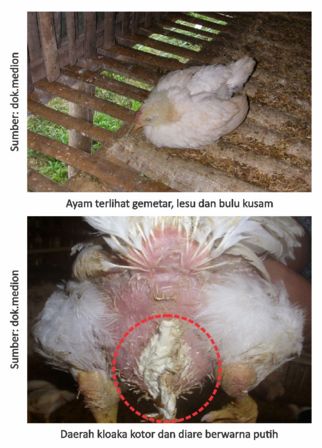
In surgical carcasses found more enlargement and inflammation of bursa Fabrisius, then followed by an enlarged spleen and bleeding lines in the chest muscles as well as the thighs. Inflammation of the border of the proventikulus and ventricle is also found. There is also swelling of the kidneys with uric acid deposits (white color, red).
How's The Control ?
Efforts to prevent Gumboro cases are a combination of optimal management and vaccination accuracy. Therefore, some measures that can be applied so that Gumboro does not target again in farm we are among others:
1. Optimize cage preparation time
To eliminate the Gumboro virus before attacking chickens can be optimized during the preparation of the cage. Disinfect the cage well and correctly starting from the drop litter and food from the farm. Gumboro Virus is very sensitive to disinfectants containing formalin (Formades and Sporades) and iodine (Neo Antisep and Antisep). Place to eat and drink washed thoroughly and then disinfected with Neo Antisep or Sporades. While the empty cage can use Formades for disinfection of the entire enclosure building after cleaning and washing.
2. Take control of Gumboro vector
In Gumboro vector control, first mow the grass and bushes that grow in the home environment regularly. Perform insect control (Franky fleas, black beetles, etc.) that become periodic vectors of Gumboro virus, especially during cage control. When empty the cage can do fogging the cage as a whole. Meanwhile, when there are chickens, when a crowd of Franky fleas is found in certain locations, it can be sprayed Delatrin, liquid insecticide for killing black beetles, Franky ticks and other ectoparasites (fleas, mites, ticks).
Also note the wind speed, if the wind in the cage environment is calm (
3. Gumboro vaccination program evaluation
In Gumboro vaccination, farmers also need to at least evaluate the vaccination program that has been carried out. In the preparation of Gumboro vaccination program since the beginning of maintenance there are 3 things that we must pay attention to :
a) Level dan keseragaman antibodi maternal
Determining the age of Gumboro vaccination can be helped by measuring maternal antibodies that chicks have. The trick is to take blood samples (serum, red) from a group of unvaccinated chicks between the ages of 1-4 days, then do a serology test (ELISA). From this maternal antibody titer data can be calculated the estimated age of Gumboro vaccination and vaccine type selection. In fact monitor maternal antibodies have not been routinely performed and may not have been performed at all. This constraint occurs because farmers do not understand the benefits of monitor maternal antibodies. MediLab (Medion Laboratory) provides maternal Gumboro antibody titer testing services by ELISA method, the test results will be equipped with an analysis to estimate the age of the first Gumboro vaccination.
If the Gumboro vaccination program is carried out when maternal antibodies are still high, it will cause the vaccine that we give cannot work optimally because the vaccine virus has not reached the target organ bursa Fabrisius, but already neutralized by maternal antibodies. Therefore, the timing of administering the Gumboro vaccine needs to be well calculated. Do not get the vaccine given prematurely or precisely after the chicken has lost protection from maternal antibodies. In broilers, Gumboro vaccination is enough to be carried out 1 time between the ages of 7-14, while in laying hens, the Gumboro vaccination program is carried out at least 2 times during the maintenance period. The first vaccination can be done at the age of 9-14 days and the second vaccination is given 1-2 weeks after the first vaccination.
B) Gumboro case history
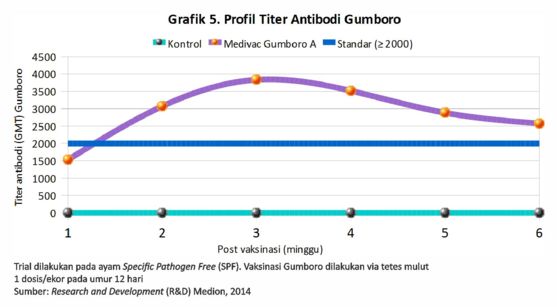
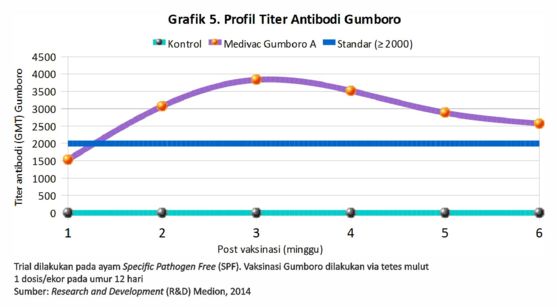
In addition to being based on maternal antibodies, it is also necessary to look at the history of Gumboro cases in previous maintenance periods. For example, an attack occurs at the age of 21 days, then Gumboro vaccination can be done no later than 2 weeks before the age of the disease attack at the age of 7 days. In the case of Gumboro that appears in chickens 5%), the vaccine type intermediate plus or Medivac Gumboro A be the right solution. With Medivac Gumboro A there will be a faster and optimal formation of immunity (the protective titer is formed less than 2 weeks and lasts up to 6 weeks post vaccination) so that chickens are protected earlier from Gumboro attacks (Chart 5). However, if Gumboro cases that appear in chickens aged > 21 days with a low mortality rate ( intermediate or Medivac Gumboro B.
C) accuracy of vaccination application
Aplikasi vaksinasi Gumboro juga mempunyai pengaruh besar dalam mendukung keberhasilan vaksinasi. Untuk mendapatkan hasil vaksinasi yang optimal, pastikan vaksinasi Gumboro diberikan dengan menggunakan metode cekok atau tetes mulut dan air minum. Aplikasi vaksinasi melalui metode cekok atau tetes mulut dapat diberikan pada umur < 7 hari, karena pada umur tersebut konsumsi air minum belum optimal, sedangkan jika melalui air minum dapat diberikan pada umur > 10 hari.
Application of vaccination through mouth drops or drinking water so that the vaccine can go to the target organ, namely bursa Fabrisius which is at the end of the digestive tract (cloaca, red). If the application is through drinking water, make sure the water quality is good, but if the drinking water quality is not good, add Medimilk 10g / 5L or Netrabil 5g / L drinking water to improve water quality, so as to extend the life of the vaccine virus to produce high immunity. In addition, pay attention to the ratio of drinking water given so that the chickens get a uniform dose of vaccine.
4. Multivitamins
Weather factors and poor maintenance management practices (high ammonia, rough treatment, etc.) can trigger stress. In this condition, chickens need anti-stress multivitamins such as Vita Stress or Fortevit, due to the content of vitamins C and E can increase the body's resistance and cope with stress. Give anyway Imustim 3 days before and 3 days after vaccination as an immunostimulant to help the work of the immune organs that have been formed.
Gumboro Handling
As we know, there is no cure for Gumboro disease. What we can do is reduce the death rate. In the case of pure Gumboro or single can be given 2-5% sugar water and vitamins (Fortevit or Vita Stress) to provide energy and improve body condition. Give Gumbonal 1g / L of drinking water for 3-5 days to reduce the symptoms of kidney swelling.
Because there are still many cases of Gumboro followed by secondary infections such as CRD, coccidiosis, colibacillosis, etc. that must first be treated remains Gumboro then secondary infection. If Gumboro attack causes swelling of the kidneys, then use antibiotics other than aminoglycosides and sulfonamides such as Neo Meditril, Proxan-S, or Therapy.
All aspects and stages of maintenance are instrumental in determining the success of Gumboro prevention. The combination of hard work with the right management that will deliver the farmers successful chicken farming. Greetings.