From October to December 2023, several regions of Indonesia are expected to have entered the rainy season (BMKG, 2023). One of the challenges in the rainy season is that there is an increase in environmental humidity. High humidity of the environment can provoke the appearance of a disease such as coccidiosis.
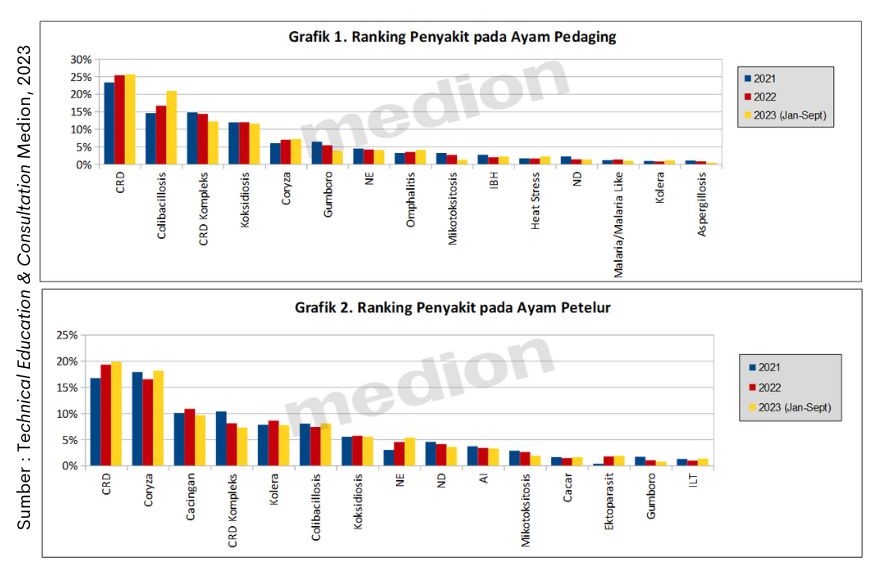
Based on data collected by the team Technical Education & Consultation (TEC) Medion from 2021-2023, coccidiosis ranked fourth in broiler diseases and seventh in laying hens (Charts 1 and 2). Therefore, caution is needed against the emergence of coccidiosis, especially during the rainy season has arrived.
Causes Of Coccidiosis
Koksidiosis disebabkan oleh protozoa Eimeria sp. which attacks the digestive tract, especially the small intestine and cecum (appendix). There are 1800 species of Eimeria that attack various types of livestock, but only 7 species that cause pain in chickens are E. tenella, E. necatric, E. acervulina, E. maxima, E. brunetti, E. mythic, and E. praecoc.
Life cycle of Eimeria sp. consists of two stages, namely :
- Exogenous stage (outside the chicken's body)
Chickens infected with coccidiosis produce oocysts that will come out with feces. Oocysts will sporulate in the environment and become infective within 24-72 hours.
- Endogenous stage (in the body of chickens)
Oocyst it is located in the ventricle (gizzard) and sporozoites it will be produced by sporocyst, next sporozoites penetrates the cell in the intestinal mucosa and begins its reproductive cycle. There are two stages of development. Beginning with the asexual phase, sporozoites forming schizogony and produce merogony. Then proceed to the sexual phase, where microgametes and macrogametes will be formed that produce zygotes. The zygote will be encased in a layer of protective wall so called oocyst. This cycle lasts 4-6 days depending on the species Eimeria.
Predisposing Factors
The following factors provoke the appearance of coccidiosis disease, namely:
- High cage density
Cases of coccidiosis can affect chickens at any age. In broilers, cases most often occur at the age of 2-3 weeks. While in laying hens, cases most often occur at the age of 0-8 weeks. One of the reasons is the high density of cages. The more chickens and chickens gain weight, the more feces the chicken excretes. It is not worth the amount litter in the cage, so litter quickly damp and wet. Condition litter damp and wet ones will not be able to absorb feces, so there will be a buildup of feces and cause an increase in ammonia in the cage.
- High enclosure humidity
High humidity of the enclosure causes litter easy to damp. On the cage closed house, the conditions of the cage are easier to organize. But for the cage open house still very affected by weather changes.
- Quality litter
Oocyst sporulation can last about 48 hours at a temperature of 25-28°C or longer depending on temperature, humidity, and oxygen availability. If the temperature in the cage is low and the humidity is high or the conditions litter very humid, sporulated oocysts can persist in the environment for months. Therefore, it is very important to maintain quality litter to keep it dry.
- Amount of contamination oocyst
Amount of contamination oocyst may affect the severity of the disease and the spread of the disease. According To Swayne et al. (2014), ingesti oocyst those with a sporulation of 103, 10, 10, or 10 resulted in mild to severe coccidiosis with a lesion score of 1.1 (ingestion of 103 oocyst) and 4.0 (ingestion 10⁶ oocyst).
- Suboptimal cage cleaning and rest
Cages with a history of coccidiosis are at risk of becoming a source of infection for the next period if the cleaning and rest of the cage is less than optimal. This is because oocyst resistant to disinfectants. However oocyst will die in extreme temperature conditions such as high temperatures > 55° C or freezing conditions.
Clinical symptoms and anatomical changes
Clinical symptoms and anatomical changes due to coccidiosis depend on the type Eimeria who attacked. In general, chickens affected by coccidiosis show symptoms of drowsiness, drooping wings, decreased appetite and anemia.
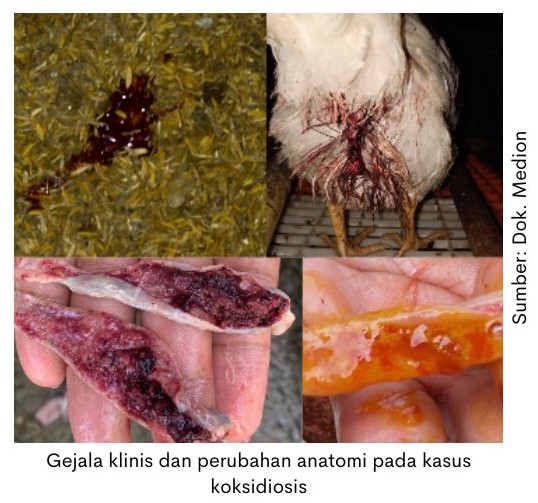
Infection E. tenella causes chickens to have bloody, red or orange stools in litter or under the cage. Infection E. maxima causes reddish viscous feces mixed with blood spots.
Anatomical changes observed, in E. tenella causes the cecum to enlarge 2-3 times, the thickened walls are dark in color, and there are blood clots in the lumen of the cecum. While changes due to Eimeria others are in the form of thickening of the intestinal wall (can be accompanied by inflammation, pus, up to bleeding) and the presence of white dots on the surface of the intestine. However, if you only look at the clinical symptoms and changes in anatomical pathology will be difficult to distinguish each species Eimeria who attacked. Laboratory tests are needed to distinguish them.
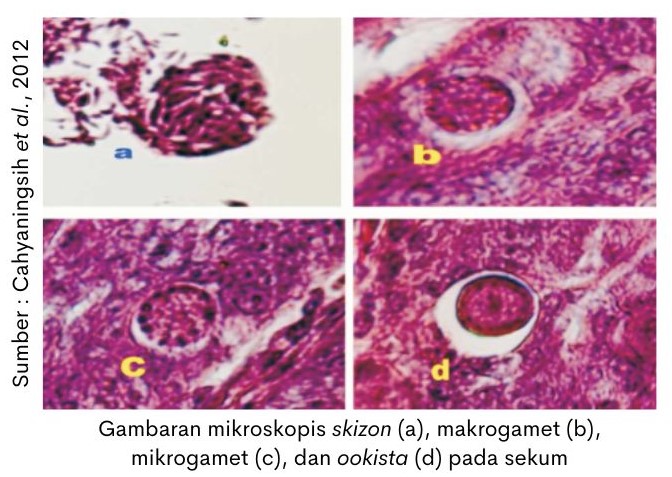
Microscopic changes in histopathological examination is found oocyst, schizon, macrogametes, and microgametes in intestinal tissue.
The impact of coccidiosis on the health of chickens
The impact on chickens infected with coccidiosis is stunted growth, decreased efficiency of ration use, and mortality that can reach 80-90%.
Coccidiosis disease also has an immunosuppressive effect (suppresses the development of immunity), by the following mechanisms :
- Coccidiosis damages the intestinal mucosa, the process of digestion and absorption of nutrients is not optimal, resulting in nutritional deficiencies that affect weight growth and antibody formation.
- Payer’s patches and caeca tonsil which is an immune organ in the digestive tract is damaged so that chickens are susceptible to disease.
- There is a lymphoid tissue that produces antibodies (IgA) along the intestinal mucosa. Damage to the intestinal mucosa will decrease the amount of IgA that serves to protect the intestinal mucosa from other diseases.
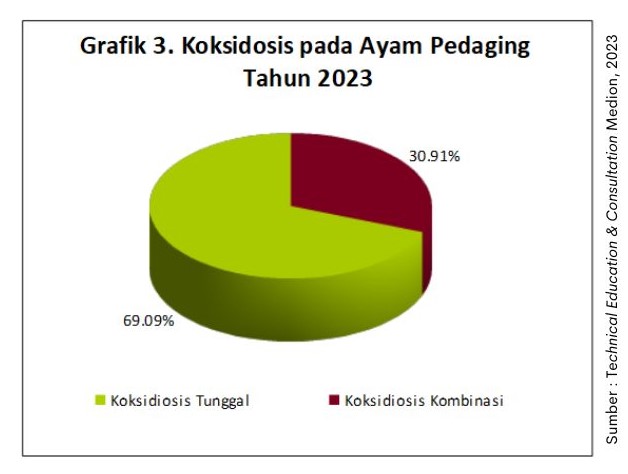
The presence of immunosuppressive mechanisms causes chickens infected with coccidiosis to be susceptible to infection with other diseases. Based on data collected by the Medion field team, in 2023 single cases of coccidiosis in broilers were 69.09% while cases of combined coccidiosis with other diseases were 30.91% (graph 3).
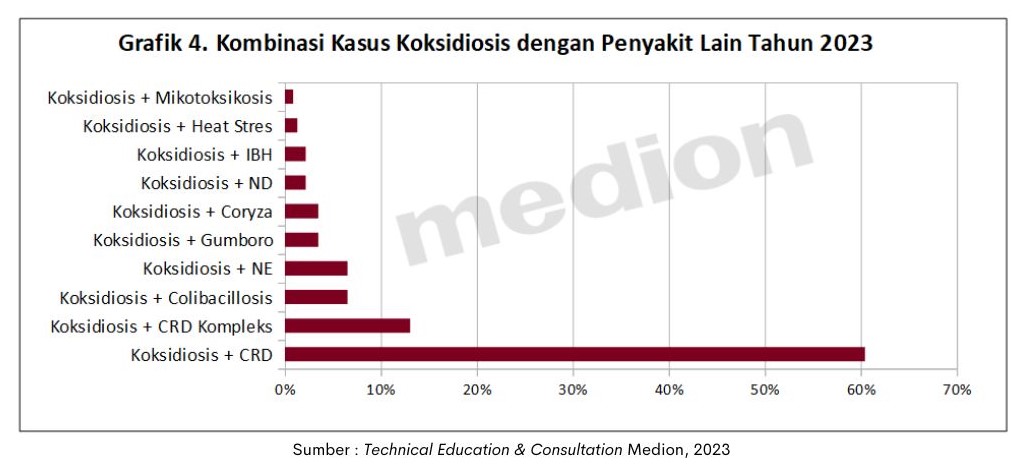
Coccidiosis can combine with bacterial and viral diseases. Cases of coccidiosis in broilers in 2023 most often combine with CRD (graph 4).
When the humidity of the enclosure is high, the density is high, litter wet, as well as poor air circulation in the cage can cause respiratory problems due to high ammonia. High ammonia can irritate the respiratory tract causing rupture of cilia and inflammation in the respiratory tract. This condition predisposes to CRD disease. If the water quality is not good, for example there is bacterial contamination E. Coli infection, then Colibacillosis disease can accompany into a complex CRD. Bacteria E. Coli infection is an opportunistic pathogen. Pathogenic bacteria will be easier to develop if the mucosa of the respiratory tract and digestive tract damage occurs.
In addition, other bacteria that easily develop when damage occurs in the intestinal mucosa are Clostridium perfringens causes of NE disease. Factors causing the emergence of NE disease are caused by a less hygienic environment such as damp litter, stress, climate change from dry to rainy, inadequate sanitation and disinfection. Changes in the viscosity of intestinal contents (abrupt changes in the composition of the ration, rations with excess protein and energy content), as well as the presence of infection with other diseases such as coccidiosis, IBH, Gumboro) also affect the appearance of this disease.
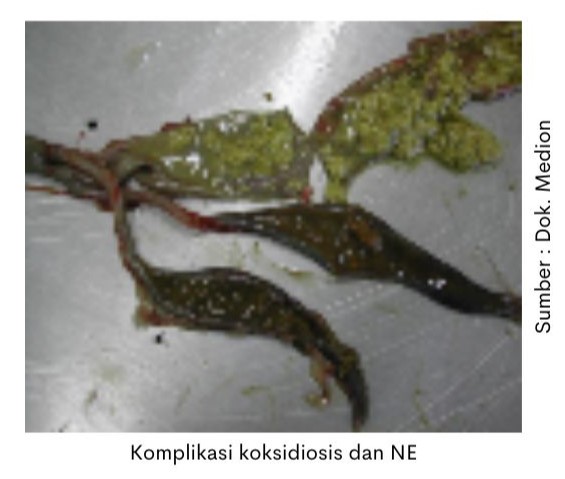
Increase in the number of bacterial populations Clostridium perfringens produces toxins. It is this toxin that causes the occurrence of necrosis of the intestinal mucosa. So, if there is a case of coccidiosis combined with NE, it causes more severe intestinal changes, which has an impact on the absorption of nutrients that are increasingly disturbed.
Prevention
Farmers need to anticipate cases of coccidiosis, especially when entering the rainy season. Here are some steps that can be done, namely :
a. Cage preparation
Cage preparation is an important stage in starting a new rearing cycle.
- Starting from the removal of feces, litter, leftover feed, and all organic waste from the enclosure area. Don't let there be a pile of feces or litter inside the enclosure area as it can be a source of diseases from previous periods.
- Inspection and repair of leaking and perforated roofs, curtains, cages and drinking water places. These leaks can cause increased humidity in the cage, especially during the rainy season.
- Also make sure all areas of the cage including the cage cracks are washed. Do not allow the remains of feces from the previous period to remain in the cage. Use high pressure water and detergent. After washing is complete, disinfection with disinfectants can be carried out.
- The most important thing in breaking the cycle of coccidiosis disease is to do Liming. Liming is done by flushing the lime solution over the entire surface of the cage. The need for a lime solution for a 100 m2 Cage is 20 kg of quicklime and 500 ml Formades in 100 liters of water. Oocyst it will not be damaged by disinfection alone, which is why a Liming process is necessary. Lime is an active ingredient that is alkaline. When dissolved into water or wet media, it will produce high heat so that it can kill oocyst.
- Do a cage break of at least 14 days, starting after the cage cleaning and disinfection process is complete. It is necessary to break the life cycle of the seedling until it does not find a chicken as a host for growing.
b. Cage density setting
Pay attention to the density of the cage so that the area of the cage matches the capacity. Cage density standards in cages open house is 15 kg/m2 or equivalent to 6-8 broilers and 12-14 laying hens grower (pullet) per its m2. As for the cage closed house the density of the cage can increase up to 2x, that is, it reaches 25-30 kg per m2 of it.
c. Management litter
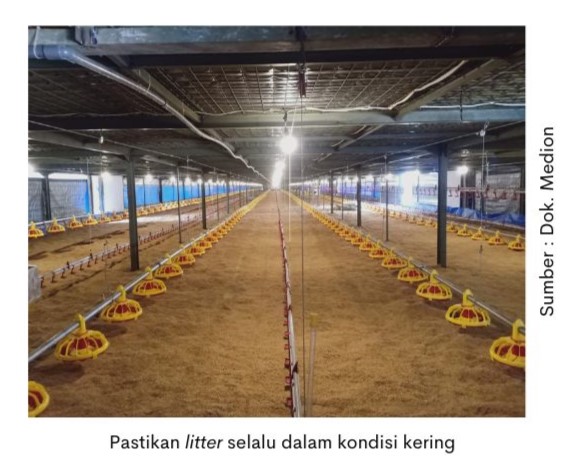
Litter must be maintained in order to remain dry because humid conditions are a comfortable place for oocyst. Handling strategy litter when a case of coccidiosis occurs, namely :
- Use litter with an initial thickness of about 8-12 cm for postal cages and 5-8 cm for stage cages.
- On time brooding period,, back and forth litter once every 3-4 days from the age of 4 days to the age of 14 days.Immediately replace the wet and clumped litter, if the amount of litter those that coagulate a little, can be sorted out and removed from the cage. But if there are many, it is better to stack with litter the new one.
- Make sure the air ventilation system is good to keep the cage moist. This is necessary so that litter it is not easy to damp, air circulation is smooth, there is enough oxygen, as well as the release of metabolic gas and ammonia.
d. Ration management
Give a ration with a protein and salt content corresponding to the needs of chickens. In the self-mixing feed system, make sure the protein and salt levels are not excessive, because it can cause wet dropping, litter quickly get wet, as well as increased ammonia.
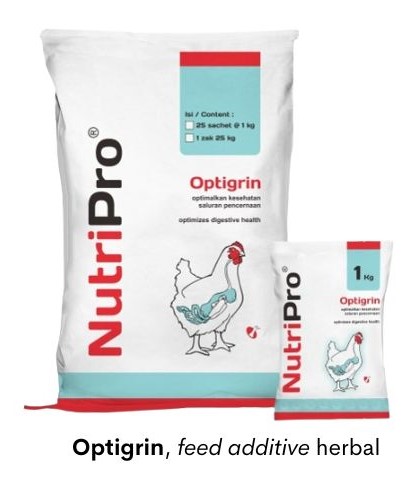
Medion also has products Optigrin, feed additive herbs that can be added to the feed to maintain intestinal health. Optigrin contains extracts Origanum vulgare and Andrographis paniculata which can improve the performance of chickens, increase the body's resistance to disease, and reduce mortality in chickens. Optigrin works by suppressing pathogenic bacteria by damaging bacterial cell membranes, protecting the intestines and inhibiting the growth of protozoa such as Eimeria sp. in the intestine, it works as an antioxidant that counteracts free radicals, and increases the body's resistance. Therefore, Optigrin can be used for prevention against pathogenic bacteria and coccidiosis.
e. Vaccination
The chicken pox vaccine (breederthe chicken (layerthe use of vaccines live oocysts by Method spray cabinet in chickens aged 1 day or through rations for chickens aged 4 days.
Severe
If the chicken is already sick, the following treatment can be done :
- Chicken selection. Sick chickens should be isolated to minimize transmission to other chickens. For chickens whose condition is severe can be-culling.
- If possible, remove feces mixed with blood that is on litter to avoid other chickens pecking at it. The red color of the feces will attract the attention of other chickens and can cause the transmission of coccidiosis.
- Pay attention to the condition litter/ husk, do not get damp or wet, when wet can be added a new husk and can be done sowing lime on the husk or feces are wet and moist.
- In broilers with age cases >25 days, it should be considered for harvesting.
- Administration of anticoxidic drugs. There are several types of antikoksidia products, including :
- Groups Sulfonamide. This anticoxidia works by breaking the life cycle Eimeria sp. by disrupting the process of asexual reproduction Eimeria. Sporozoites will be eradicated so that it cannot reproduce itself. Therefore, the administration of anticoxidia of the group sulfonamide it should be administered by a 3-2-3 System (3 days given anticoxidia – 2 days stopped – 3 days given anticoxidia). Examples of Medion products from the group Sulfonamide namely Coxy, Anticancer, and Koksidex. In addition to anti-oxidants, drugs from the group sulfonamide like Coxy it also acts as an antibiotic, so it can be used to treat bacterial diseases such as cholera. What needs to be considered is, if there is a condition of swollen kidneys (a combination of infection with other diseases) sulfonamide class drugs should not be used because it can aggravate the condition.
- Groups Thiamine antagonists. Antikoksidia this group works by interfering with the process of asexual reproduction of Eimeria sp. just like the groups sulfonamide. Examples of Medion products from this group are Therapy, Koksidex, and Amprosid. As well as anti-oxidants, Therapy can also be used for treatment against bacterial diseases at a dose of 0.2 grams/kg bw administered for 5-7 consecutive days.
- Groups Triazinetrione. These anticoxidia work effectively to disrupt mitochondrial function by inhibiting the activity of enzymes in the respiratory chain of cells, causing death at all stages of development Eimeria sp. (sexual and asexual reproduction). Examples of Medion products are Toltradex. In poultry, Toltradex can be given at a dose of 0.14 ml / kgBB given for 2 consecutive days.
- Anti-oxidant herbs. Medion has developed herbal antikoksidia products that are Fithera which can be used as an antibacterial or anti-oxidant. For the treatment of coccidia, a dose of 0.2 ml/kgBB can be used for 7 consecutive days, while for the treatment of bacteria, a dose of 0.4 ml/kgbb can be used for 7 consecutive days.
The procedures for administering antikoksidia that need to be considered are :
- Do not give anticoxidants at the same time as products containing B vitamins or amino acids because B vitamins are nutrients Eimeria sp., so their use will aggravate the infection.
- Multivitamins such as Fortevit and Vita Stress can be done after treatment. Vitamin A can accelerate the regeneration of the epithelium of the intestinal mucosa, while vitamin K can reduce bleeding and accelerate wound healing.
By implementing the above strategies, it is expected that farmers can control coccidiosis, especially in the rainy season that will come soon. May be useful. Thank you.