Pertanyaan dari Bapak Bayo Regar – by email
What are the signs of broilers affected by mycotoxicosis? How to deal with it?
Answer
Mycotoxicosis is a disease caused by toxins from fungi or commonly known mycotoxins. Fungi that grow on feed will metabolize and produce secondary metabolites called mycotoxins. There are several genera of fungi that commonly grow on feed such as Aspergillus, Fusarium and Penicillium.
Fungi easily grow in a variety of places such as soil, decaying organic matter and grains. Moreover, the climatic conditions in tropical countries with high levels of humidity, rainfall and temperature will greatly support the growth of mycotoxin-producing fungi. In the feed there are several conditions that can cause the fungus to grow easily, such as:
- The condition of feed ingredients with water content above 14%, especially those that are hygroscopic (easily absorb water molecules from the environment/air)
- The broken bones (broken seed) and stored for a long time
- Feed piles that are in direct contact with the floor and walls of the cage
- Warehouses where feedstuffs are stored are damp and poorly ventilated.
Symptoms and impact of Mycotoxicosis
It is well known that fungi can produce many types of mycotoxins and some of them often cause health problems in poultry. Some of these mycotoxins are aflatoxin, okratoxin, fumonisin, trichotechenes T-2 toxin, deoxynivalenol) and zearalenone.
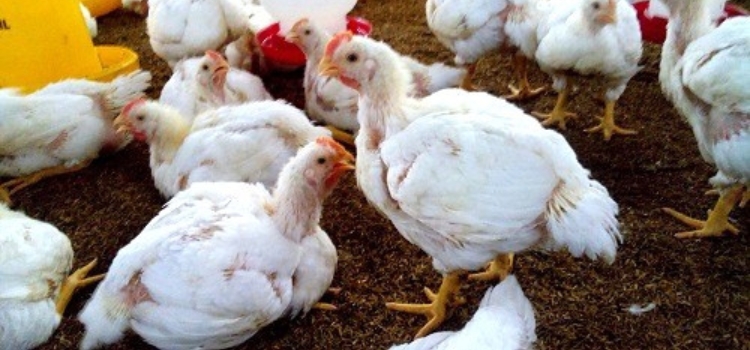
Chickens suffering from mycotoxicosis may show symptoms such as low appetite and stunted growth. In addition, it was found that plaque or ulcer on the palate caused by one of the mycotoxins, toxin T-2. When the anatomical pathology examination will be seen pale and fragile heart, bleeding in the thigh muscles and erosion of the ventricles due to aflatoxin.
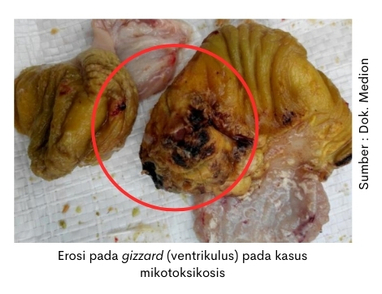
The impact of mycotoxicosis cases is often not realized by farmers, but the loss in terms of feed efficiency becomes greater which leads to losses. Actually, the effect of toxicity (poisoning) of mycotoxins depends on the intensity and time of intoxication (spread of toxins).
However, it should also be noted that mycotoxins are accumulative in the body so that the more levels of mycotoxins are ingested, the more severe the impact will be.
A decreased immune system is also one of the effects of mycotoxicosis because the disease is immunosuppressive. Further impact of this immunosuppressive is increased chicken mortality, easy chicken disease, vaccination failure, and increased colonization of pathogenic bacteria in the digestive tract of chickens. Mycotoxicosis can trigger the occurrence of various diseases, such as bacterial/viral infections, malabsorption syndrome and fatty liver syndrome.
Handling and Prevention
Mycotoxins are chemicals that are very stable and can survive for a long time even though the fungus that produces them has died. Even against heat treatment when processing feed, mycotoxins can in no way be degraded or destroyed. Here are some efforts that can be done when it is known that there are mycotoxins that contaminate the feed :
- Selects and discards feed contaminated with mold in large quantities. If the contaminated feed is small, it can be mixed with uncontaminated feed and added toxin.
- Usage toxin (mycotoxins binder) such as Freetox G which is mixed on the feed. This effort is an effective solution to bind mycotoxins firmly while in the digestive tract, so that mycotoxins are not “active " and eventually come out together with feces.
- There are no specific drugs for the treatment of mycotoxicosis. Give vitamins high concentrate like Fortevit, Top Mix HC or Mix Plus to repair damaged body tissues.
Prevention that can be done in order to minimize the growth of fungi in the feed is :
- Try to keep the moisture content in raw materials or feed below 14%. Dry immediately or use a special dryer for raw materials with a moisture content still above 14%.
- Add also mold inhibitor (Fungitox) to inhibit the growth of mycotoxin-producing fungi.
- Apply storage system first in first out (FIFO) or first expired first out (FEFO).
- Condition the feed shed that is well ventilated, gets enough sunlight and a place that is not damp. If necessary, add a blower in the warehouse to help circulate air.
- Use pallet as a food storage base. Try that the feed does not stick to the walls. Leave a distance of at least 50 cm from the walls of the barn.