Bapak Salim Ahmad
e-mail : irfanforever646@gmail.com
Is it okay if the vaccine via drinking water such as Gumboro vaccine is given at a dose that is more than the recommended rules? Are there positive and negative effects?
Answer:
Dear. Mr. Salim Ahmad, thank you for your question. If the vaccine is given at a dose of 2 times or double doses from the recommended ones actually do not negatively affect chickens. The disadvantage of vaccination with an excess dose is the ability to stimulate the formation of antibodies will not be significantly different from a single dose of vaccination so that the expenditure is greater.
So, for vaccine administration through drinking water, the vaccine dose can be given 1.5-2 times the dose. It is intended that each chicken get 1 full dose because the consumption of chicken drinking water can be different from each other. Do the vaccination according to the recommended dose by paying attention to the following things:
- Condition of chickens when vaccinated. Chickens that are stressed or in the incubation period of disease, especially immunosuppressive diseases such as Gumboro, Marek, mycotoxicosis due to which the formed immunity will not be optimal.
- The vaccination procedure must be carried out correctly and appropriately starting from the handling of the vaccine when taken to the cage to the application of the vaccine to chickens. Things that need to be considered in the implementation of vaccination through drinking water, among others:
- Before being given drinking water containing the vaccine, chickens are allowed to drink for 2-3 hours, depending on the weather. If the day is hot, the chicken is fasted to drink enough for 1 hour.
- In order for the results of vaccination through drinking water to be optimal, vaccination should be done in the morning, because it is the peak time for chickens to move and consume drinking water. The stress level of chickens in the morning is also relatively small, because the environmental weather conditions are still relatively comfortable (not too hot).
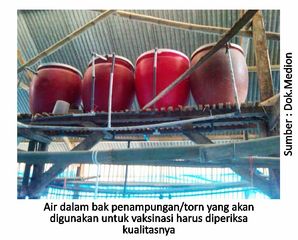
- The drinking water used must be free of chlorine (chlorine) other disinfectants or metals (do not use a canister).
- Because the active Gumboro vaccine has a limited time of 2 hours to run out, the amount of drinking water used must be in accordance with the needs of drinking water during the vaccination time. For 15-30 minutes before mixing the vaccine, drinking water can be added Medimilk 20-30 grams per 10 liters of water or Netrabil 5 grams per 1 liter of water. Medimilk and Netrabil it is useful to keep the vaccine working well during administration.
- Before vaccination, clean the chicken drinking place at least 2 times a day, done by washing TMA before replacing the chicken drink water. As for the automatic chicken drinking place by cleaning the dish TMAO using a clean cloth wipe dipped on Medisep before being used to administer the vaccine. Periodically at least 1 Week, remove and clean the filter contained in TMAO by the way in-flushing (spray with pressurized water) to remove any deposits / mucus that may be in the filter TMAO.
- Drain torn water and flushing water pipes for removal biofilm attached along the water installation channels, especially if using TMAO and Nipple drinker.
- Place the drinking water containing the vaccine in a shady place, do not expose it to heat and direct sunlight.
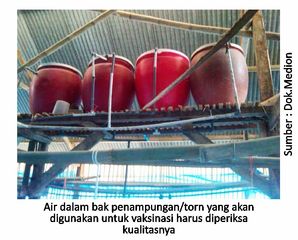
- In order for the potential vaccine to work optimally when water quality is problematic or to ensure that the water used as a solvent is safe (good), then stop using disinfectants through drinking water 48 hours before and after vaccination and need to be given stabilizer (stabilizer) so that the water quality is good when used.
- Take a multivitamin (Vita Stress) and immunostimulants (Imustim) to maintain stamina remains excellent and helps improve the immune system.
- Good maintenance practices will affect the chickens that live in it and will indirectly affect the response of chickens to the results of vaccination.
- Vaccinators or cage operators must regularly walk around to make sure all chickens can access and get the vaccine according to the dose.