Various kinds of challenges poultry world can not be separated from the name of the disease. Both infectious and non-infectious diseases can visit anytime and anywhere. Especially if it is supported by several predisposing factors such as stressful conditions due to environmental changes.
Predictions El Nino-Southern Oscillation (ENSO) indicates the existence of a potential La Nina phenomenon by the end of 2024. In general, La Nina tends to cause wetter conditions in Indonesia. According to BMKG, the peak of the rainy season will occur in November 2024 to February 2025.
Where during the rainy season the risk of disease tends to be higher. Damp cage conditions, decreased water quality and stagnant water around the cage can be a medium for the development of vectors and seedlings of diseases. One of the diseases that always appear until now is Avian Influenza (AI).
Field Facts
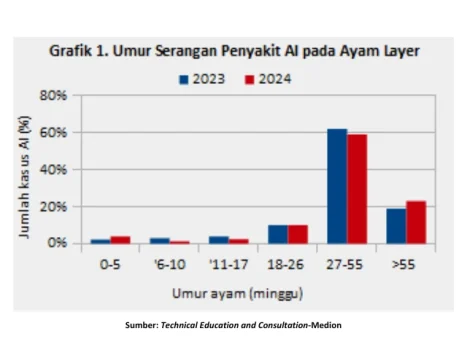
AI disease can affect all types of poultry at all ages. Based on data from Medion Disease Incidence in 2023-2024, the incidence of AI disease most often affects chickens layer production period. As shown in Graph 1, 62% of AI cases in 2023 and 59% of AI cases in 2024 occurred during peak production. This occurs as a result of high internal stress on the chicken's body in producing maximum eggs.
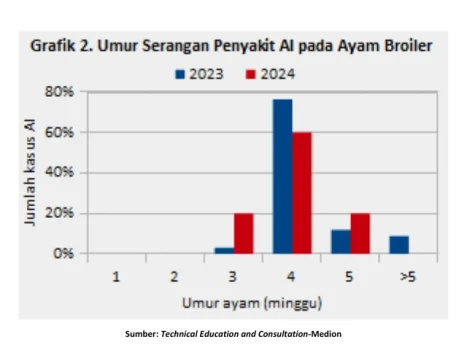
Especially if it is supported by external stressors such as biosecurity practices and poor management that can make it easier for AI diseases to infect. The stress condition is immunosuppressant, so it affects the antibody titer level. In boiler chickens, cases of AI were dominated at 4 weeks of age (graph 2) but were also found at 3 and above 4 weeks of age.
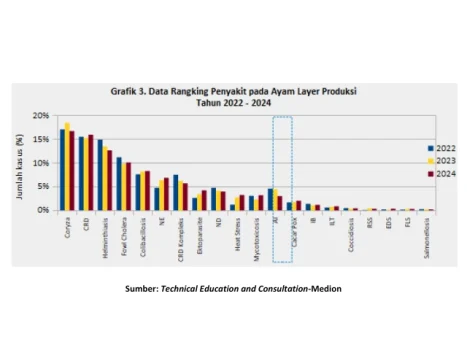
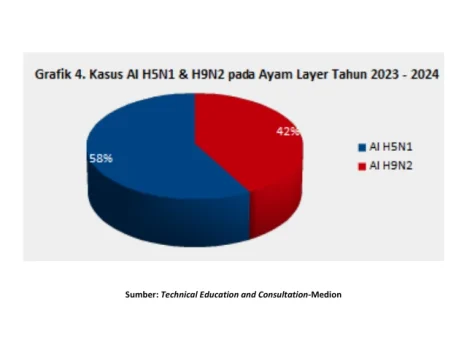
Based on graph 3, AI disease in chickens layer the production period ranks second in the category of viral diseases (caused by viruses) since 2023-2024 nationally. From the results of Molecular Biology tests with the method Polymerase Chain Reaction (PCR) during 2023-2024, positive cases of AI H5N1 are higher than cases of H9N2 as shown in Graph 4.
AI disease is known as one of the diseases that are immunosupressant (suppress the immune system), making it easier for other disease agents to infect chickens. The following are data on the incidence of single AI disease or combination with other diseases.
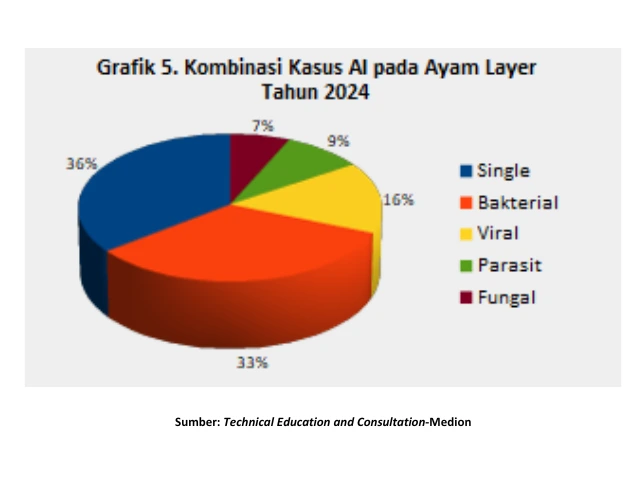
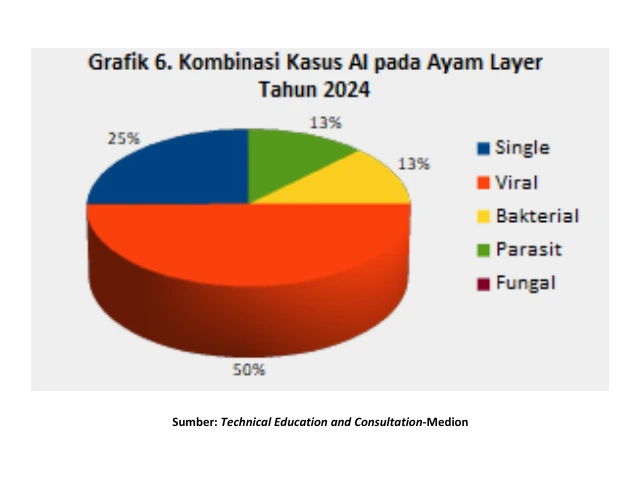
Based on AI case data set in farm layer and broiler in Indonesia during 2024 (graphs 5 and 6), single AI cases are 36% and 25%. The rest are cases of AI in combination (co-infection) with other disease agents. The highest cases of AI co-infection along with bacterial and viral diseases both in chickens layer or broiler. Penyakit bakterial tersebut antara lain CRD, CRD kompleks, Colibacillosis, Coryza, NE. In co-infection with viral diseases, among others, ND, IB and EDS. The remaining cases of AI co-infection with parasitic diseases (worms, coccidiosis), fungal diseases (Candidiasis, Aspergillosis) and non-infectious diseases such as Mycotoxicosis, heat stress and others
Sejarah Penyakit Avian Influenza
The east coast of Australia is home to the largest number of migratory birds from Australia to Australia (East Asian Australian Fly Way) or vice versa. This has the potential to carry and spread the AI virus in the countries it travels through including Indonesia. Because wild birds are a natural reservoir of the AI virus.
Since its initial discovery in Indonesia at the end of 2003, until now the incidence of AI cases is still often found in poultry farms such as chicken broiler, layer, breeder, males, joper, ducks, quail and other poultry. In 2003, H5N1 was discovered clade 2.1 later in 2012 found AI H5N1 clade 2.3.2.1 c. Then in 2016 found AI H9N2 and the last time found AI H5N1 clade 2.1.
In 2019 and 2021, the AI H5N1 virus clade 2.3.2.1 C mutations (changes in important protein characteristics in AI, namely Hemagglutinin and Neuraminidase) from time to time. Furthermore, in 2022 or 2 years ago the AI H5N1 virus was found clade 2.3.4.4 b first time in Indonesia.
Genetic character of the amino acids HA and NA of clade found at that time was very different from clade-clade before. AI H5N1 clade 2.3.4.4 b was first found on commercial duck farms in South Kalimantan that had not been vaccinated against AI. Similarly, the implementation of management and biosecurity is still low.
The characteristics of AI viruses that are easy to mutate must always be watched out for by farmers. Due to changes or mutations in the AI virus, both mutations in the HA and NA proteins can have an impact on the risk of vaccination failure. To anticipate this, Medion continues to actively perform monitor and surveillance of cases leading to AI disease from various regions in Indonesia.
Avian Influenza Terkini
Until now the AI virus circulating in Indonesia is the H5N1 and H9N2 subtypes. Based on its malignancy, AI H5N1 is called High Pathogenic Avian Influenza (HPAI) because it has high malignancy. H9N2 is called Low Pathogenic Avian Influenza (LPAI) because it has low malignancy.
AI H5N1 circulating in Indonesia currently consists of 2 clade the different ones are 2.3.2.1 c and 2.3.4.4 b which have only appeared since 2022. Menurut data Surveilans Medion, AI H5N1 clade 2.3.2.1 c is currently the most dominant found. While AI H9N2 circulating in Indonesia found only one clade that is h9.4.2.5. AI H9N2 is genetically still the same since it was first discovered in Indonesia.
Results of analysis of amino acid homology between clade AI H5N1 found in Indonesia showed a considerable genetic distance. Based on genetic analysis and homology of amino acids HA and NA (clade 2.3.2.1 c and 2.3.4.4 b), percent homology showed low or substandard values. There should be a good standard of Homology, which is ≥95% between the clades. However, the percentage of Ha homology showed a value of 88.5-88.77%, while the NA homology of 86.05-87.21%.
The tree of life (phylogenetic treeantar) clade AI H5N1 in both HA and NA amino acids also showed differences. It can be concluded that between clade H5N1 cannot provide optimal protection. Including the second inter clade The H5N1 AIS found today are clades 2.3.2.1 c and 2.3.4.4 b.
Although genetically and amino acid homology (HA and NA) between clade AI H5N1 differs significantly. However, changes in clinical symptoms and anatomical pathologies found in chickens affected by AI H5N1 clade 2.3.2.1 c and 2.3.4.4 b are very similar. Difficult to distinguish between the two clade if only on the basis of clinical symptoms and changes in anatomical pathology. To distinguish between clade this requires supporting diagnostics, namely laboratory tests. Hemagglutinin Inhibition (HI) Test could be an alternative. But it will be more accurate if the test is continued until the stage of Molecular Biology with the method Polymerase Chain Reaction (PCR) and sequencing.
AI attack prevention strategies
The AI prevention strategy that needs to be done on farms is to conduct a proper and optimal vaccination program combined with strict sanitation and biosecurity. Here's the explanation :
1. The right vaccination Program
A. Healthy chickens before vaccination
Make sure the chicken is healthy when it will be vaccinated against AI so that the antibody titer formed is more optimal.
B. The vaccines used
To form optimal immunity, use vaccines that are homologous to field viruses. Medivac AI H5N1 2.3 also Medivac AI H5N1 & H9N2 there are several vaccine options as the right solution in controlling AI in the field. Apart from the content, the right vaccine is also judged by its physical quality. The physical quality of the vaccine must be in good condition, which means that the seal is intact, the dosage form has not changed, the vaccine has not expired, and the label is still properly installed.
C. Timely vaccination
Do the vaccination according to the case history in farm and the age of chickens that are susceptible to AI. Genesis AI in chicken broiler can not be separated from the fall of maternal AI antibodies. At the age of 3 weeks, maternal antibody titers are no longer protective so that age is the most vulnerable time for chickens to be attacked by AI. In addition, because of the field data, AI used to infect chickens broiler age > 3 weeks, then the first AI vaccination in chickens broiler it should be done 4 or 10 days old.
On chicken layer vaccination is recommended 3 times before entering the egg production period and at least 2 times after passing the peak of production. In order to determine the timing of vaccination more precisely, can be helped by doing monitor antibodies on a regular basis. Vaccination can not only suppress the potential for Disease, if there is an AI attack, chickens are relatively more resistant than without vaccination. Vaccination can also suppress shedding virus so that AI virus contamination in the field can be suppressed.
d. Proper vaccination application method
In addition to having the right vaccine, the AI vaccination application must also be done appropriately. This includes the preparation of equipment (syringes), thawing (the rise of vaccines) , handling (holding and controlling) chicken, how to inject, dose of vaccine, and handling of vaccine bottles.
2. Monitoring titer
Antibody titer Monitoring is carried out routinely to assist farmers in monitoring the health status of their poultry. In general, the implementation of serological tests aims to determine the age of the first vaccination, monitor the results of vaccination, help diagnose disease attacks, and create a baseline titer (baseline titer).
3. Sanitation and biosecurity
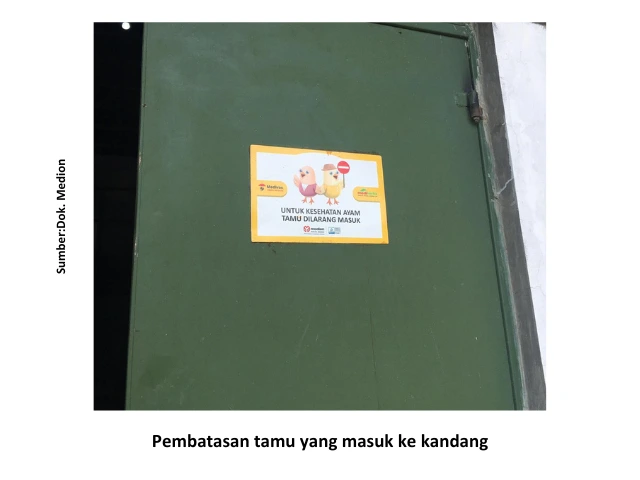
- Maximize the application of 3 biosecurity zones, namely the red zone, yellow zone, and green zone. Limit the traffic of people / vehicles coming in and out of the cage. If entering the enclosure, disinfect both vehicles and personnel, especially if coming from an infected farm enclosure. It is possible that feces contaminated with AI viruses are carried through vehicle wheels / footwear.
- Avoid visiting the bird market before entering the farm area. Live bird market (LBM) or live poultry market is one of the potential sources of disease transmission, especially the AI virus.
- Limit contact between commercial poultry and free-range chickens, waterfowl or wild animals in the vicinity of the housing environment.
- Make a cage visit that starts from a new young chicken coop to an old chicken coop.
- Footwear should be routinely brushed because the infiltration / spraying of disinfectants alone is not able to penetrate the virus contained on the sidelines of footwear
- Perform cage and equipment sanitation (cage cleaned, washed and sprayed) with Neo Antisep or Medisep. When it is happening outbreak then spraying is carried out daily.
- The drinking place is washed every 2 times a day. A glass of water that has been washed in Medisep for at least 30 minutes, every 4 days. Speed up or rewind the disinfection schedule if the day coincides with the vaccination schedule.
- Spray an active lime solution on all interior parts of the poultry house, including the floor, pillars, and outer walls. Allow it to dry completely.
- If using litter / husk, make changes, additions and back and forth periodically so that conditions litter keep it dry. Give Ammotrol via drinking water to keep chicken feces dry and control ammonia levels in the cage.
- When the cage is empty, thorough cleaning should be done to every part of the cage. Between the cage, and the bottom of the stage cage should also not be separated from the cleaning. After all the equipment is removed, the cage is cleaned with detergent and brushed, then sprayed with high pressure water.
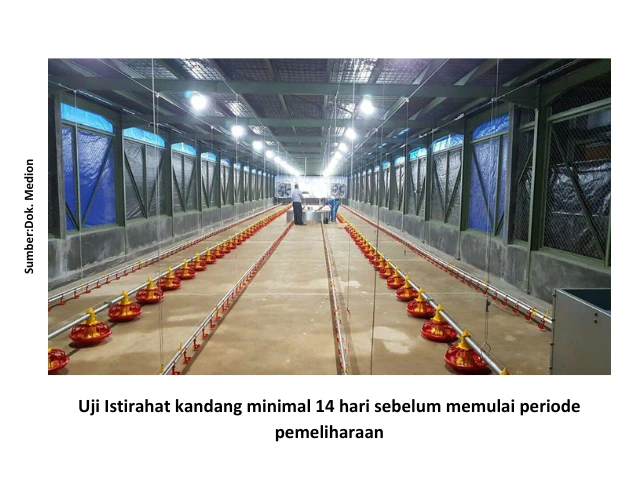
- Create a comfortable atmosphere for chickens, such as the number of chickens in the cage is not too dense, enough cage ventilation and if possible can be done system “all in all out"and the implementation of a minimum of two weeks of cage rest since the cage was cleaned.
- Drinking water sanitation by using Desinsep to suppress disease transmission through drinking water. Do it anyway flushing to clean moss or biofilm (with Bioflush) attached to the water pipe. Check the quality of farm drinking water regularly, at least during the change of season.
- The quality of the feed must be maintained until it is consumed by chickens. Make sure that the moisture content in the feed is no more than 14%. Add Fungitox to inhibit the growth of fungi and overcome mycotoxins.
- Perform routine Control (2 weeks or 1 month) to conduct a biosecurity audit by filling form checklist.
4. Supplementation
In addition, it is necessary to suppress stressful conditions and other effects of immunosuppressants by administering supplementation. Give multivitamins (Vita Stress or Kumavit) to increase chicken endurance. In addition to vitamins, the addition of premix Mix Plus is also important to supplement the nutritional needs of the ration, so that the metabolic process of poultry body defense can run optimally.
Give herbal immunostimulants such as Imustim to help boost the immune system work. The administration of Imustim before and after vaccination works by accelerating the increase in the antibody titer of the vaccination result.
Proper treatment of AI disease
If a farm detects an AI disease, things can be done to minimize the outbreak:
For handling cages that have not been attacked by AI
- Revaccination of chickens that are still healthy using Medivac AI. The decision to revaccinate the cages that have not been affected by AI depends on the level of virus malignancy, morbidity and mortality that occurs at the location of the farm.
- Do Cage spray to reduce the number of viruses in the field
- Disinfection of drinking water to prevent disease transmission through drinking water
- Scatter lime on the road area around the cage
- Limit traffic employees from sick chicken coops are not allowed to enter or pass through healthy chicken coops.
For chickens in cages that have been attacked AI
- Give immunostimulants to chickens still healthy or attacked by LPAI Imustim to increase the stamina of the chicken. Imustim will help increase the body's resistance optimally so that the healing process will be faster.
- If there is a secondary infection of a bacterial disease or parasitic disease, carry out treatment according to the secondary infection.
Animal husbandry Environmental Management
- Immediately remove dead poultry carcasses in the cage. Destroy with a burial method that must be located in a farm environment and at least 20 meters from the cage. Sprinkle the top surface of the chicken excavation using active lime. Workers wear masks, gloves and boots. Insert the chicken carcass into the hole and then spray the disinfectant using Antisep or Neo Antisep.
- Spray the cage that still contains chickens with a disinfectant such as Antisep or Neo Antisep, and on an empty cage can use Sporades or Formades
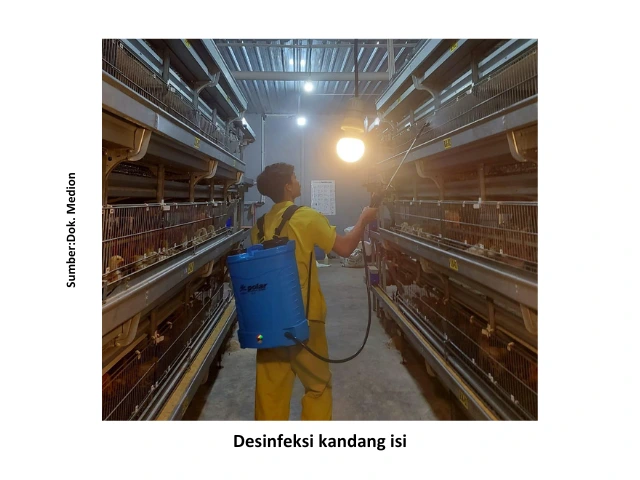
- Do enough cage rest then disinfect the cage again before starting chick in again. The purpose of the cage break is to control/break the life cycle of disease seeds in the cage after washing and disinfection process. For seedlings that have long endurance in an environment such as the AI virus requires a longer cage rest period of 4 weeks or even more.
- Maintain the quality of drinking water given to livestock. Job descriptions: responsible for the maintenance and maintenance of the building. responsible for the maintenance and maintenance of the building. responsible for the maintenance Medion Laboratories routinely. Water in a pot of boiling water (Desinsep).
We can still work on disease control measures ranging from maintenance management, biosecurity, to chicken health concerns. It is expected that cases of AI diseases can be avoided and productivity can be achieved optimally. May be useful.