A quality ration should have nutrient levels that match the needs of chickens in each period of their development, including mineral content. If they are not suitable, cases of nutritional deficiency can arise. If chickens are found to be deficient in minerals, then one solution given is to add feed supplements. The important thing to note when we do mineral supplementation is to know the needs, types and uses and techniques of administration.
Modern Chickens Require Higher Minerals
A Mineral is an inorganic compound that makes up 4% of the chicken's body. Its availability must be supplied from the outside (through rations), since the chicken's body can not produce it. Broadly speaking, minerals are divided into two groups, namely macro and micro minerals. Makro mineral terdiri atas kalsium (Ca), fosfor (P), magnesium (Mg), sulfur (S), kalium (K), natrium (Na), dan klorida (Cl).
Sedangkan mineral-mineral yang terdapat dalam tubuh dengan jumlah lebih kecil yang kebutuhannya <100 mg/kg ransum, disebut mikro mineral. Mineral mikro atau trace mineral, namely minerals that are needed in small amounts but are very useful in supporting various processes in the body. Contoh mineral tersebut antara lain mangan (Mn), zinc/seng (Zn), iron/ iron (Fe), iodine (I), copper/ copper( Cu), selenium (Se) and cobalt (Co).
In chicken rations, mineral needs are not dominant and usually only around 5-8% of the total ration. But what needs to be underlined is that the mineral needs of modern chickens today are much higher when compared to the needs of ancient chickens.
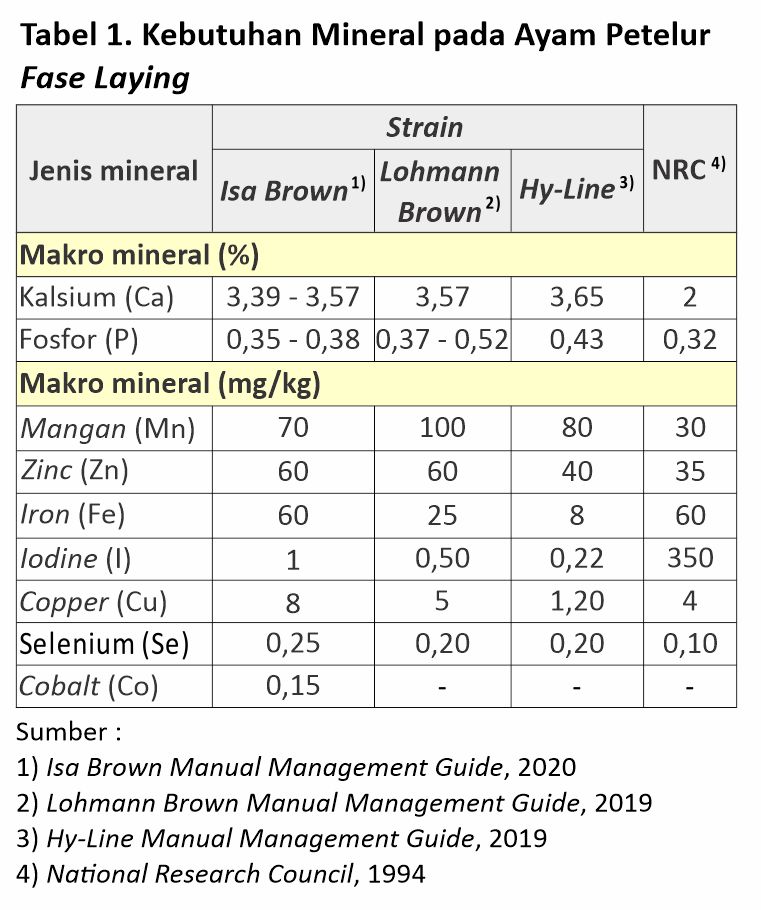
The genetic improvements that exist today make laying hens lay more eggs. In order for this target to be achieved, the chicken must carry out the metabolic process faster. It is this condition that causes the need for the mineral to increase, since it takes an active part in various metabolic processes of the body such as precursors enzymes, hormones and ion transport. Mineral needs in chickens layer especially in the production phase can be seen in Table 1.
Although modern chickens have so many advantages from improving their genetic potential, they are more easily stressed. Stressed chickens need a high amount and intake of minerals as well. Likewise with chickens that experience stress on their body's defense system (immunosuppression).
Modern chickens are also more sensitive to the quality of the ration. The digestive tract is very sensitive to levels of mycotoxins, crude fiber, anti-nutrients and seeds of disease. That is why at the time of surgery, it is difficult to find chickens with a truly “perfect”condition of the gastrointestinal tract. Digestive tract problems in the end will decrease the absorption of minerals. And it is in this condition that chickens often have a mineral deficiency.
Sources Of Microelements
Feed raw materials there are mineral sources derived from organic (natural) and inorganic materials. Which belongs to organic materials include shellfish and bone meal. And, for example, in the case of non-organic compounds (limestone), dicalcium phosphate (DCP) and mono calcium phosphate (MCP).
Rock flourlimestone)
Stone flour is made from grinding limestone. The color varies from blackish, blue, to white. Stones that are white to blue usually contain high Ca. While Stones that are dark blue to blackish contain minerals iron (Fe) and magnesium (Mg) are high. Rock flour has a Ca content of about 38% and can be digested well by chickens.
Dicalcium phosphate (DCP)
DCP is a supplement that is widely used as a source of mineral P for laying hens. Generally, DCP is in the form of white powder or granules, up to grayish white and does not have a specific odor. DCP is a material that has been purified so that the absorption of Ca and P is easy and gives better results than other mineral sources.
Monocalcium phosphate (MCP)
MCP is one of The Feed Ingredients of Ca and P mineral sources processed like DCP but its P mineral content is higher than DCP.
Shellfish flour
Shellfish is a mineral source material, especially Ca, which comes from the skin of marine animals (shells) that have undergone the grinding process. Carbonate content (CaCO₃) in shellfish flour is higher than in bone meal, which is about 35%.
Bone meal
Bone meal is a waste of bone grinding that has been extracted gelatin or collagen. Bone meal in the form of Brown flakes with a rough texture and a characteristic beef-like aroma. Bone meal is used as one of the feed ingredients for Ca and P mineral sources, as well as other micro minerals. The Ca content in bone meal is about 24%.
Importance Of Micro Minerals
Formerly minerals were only underestimated. But it turns out that today the genetic potential of chickens is achieved, one of which is determined by the fulfillment of the need for minerals in the ration. From the data collected by the team Technical Education and Consultation Medion, cases of mineral deficiency themselves are found almost every year. Numerically reported cases account for 0.2% of the total cases of chicken diseases (cases of viral, bacterial, fungal and mycotoxin diseases).
To overcome and prevent cases of deficiency trace mineral, supplementation trace mineral absolutely necessary. As already explained earlier that the need trace mineral this will increase as the condition of the chicken decreases due to environmental influences. Not only that, there are rarely laboratory testing services related to detecting the content trace mineral this requires that breeders remain vigilant so supplementation is necessary.
Basically, mineral supplementation can be done by farmers in the form of adding a single mineral or all in the form of adding premixes. In the premix, in addition to minerals, there are also other nutrients such as amino acids and various multivitamins. One solution to meet the needs of micro minerals is the addition of Endomix with a dose250-500 g per ton of feed.
Endomix is feed supplement which contains various types trace mineral. Endomix having content zinc higher (in accordance with the needs of modern chickens) so that the performance and efficiency of the maintenance of laying hens is more optimal.
Mixing minerals in the ration
Please note together that in the addition of feed raw materials mineral sources (especially Ca) we must pay attention to the particle size. The larger the particle size of the mineral, the longer its presence in the body will be so that it will be released slowly (slow release). Process slow release this is very important especially at the time of formation of the eggshell which takes 20 hours in the uterus.
In the field, mineral resources such as rock flour or shellfish have 2 kinds of preparations, namely powder preparations (mash) and coarse grain (grit). These two preparations should be given to the ration of chickens in a ratio of 65-70% in the form of grit and the rest (30-35%) in the form of flour (mash).
Grit generally given every day in laying hens starting pre phase-layer to reject as an effort to prevent deficiencies. In addition to serving as a source of Ca and P, grit the food and beverages are also served in the dining room (gizzard) so that the efficiency of feed utilization increases. According to Keshavarz (2001), rock flour with larger particle size will stay longer stay in gizzard. This condition will cause the release of Ca slowly so that the supply of Ca minerals for kerabang is more guaranteed.
What then about dosage forms mash? Stone flour and shells in the form mash will be absorbed more quickly and will be used to re-equip the bones taken calcium for the formation of shells.
When there is a case of thin scallops or crippled chickens that are severe enough, the addition of stone flour can be one solution. Even more so if it is combined with phosphorus and vitamin D₂ as contained in Mineral Feed Supplement A.
The other provisions related to the provision of this mineral include:
- Size grit the good thing is about 2-5 mm because the size that is too large can actually interfere with the digestive process.
- It should also be borne in mind that the absorption of Ca and P by the chicken's body is affected by the adequacy of vitamin D. In addition to the gift grit, it is necessary to add also such vitamins as Strong Egg or Egg Stimulant as a source of vitamin D supplements.
- In mixing mineral supplements such as Endomix it is worth making sure that all the ingredients are homogeneously mixed in the ration. Mixing mineral supplements should begin by mixing them into rations in small amounts, then moving to larger amounts and so on, until finally the entire ration is mixed with the mineral supplement.
From the discussion above, it can be concluded that minerals are very beneficial in supporting chicken productivity. The use of mineral supplementation should not only be done when chickens begin to show symptoms of deficiency. But it would be better to start from the very beginning of rearing to prevent insufficient intake of mineral rations into the body of chickens. Greetings.