Bapak Hendri
Cianjur-West Java
How is the lighting arranged in laying hens?
Answer :
Dear. Mr. Hendri, thank you for the question. Lighting, both natural (sunlight) and artificial (lights) will stimulate the hormone follicle stimulating hormone (FSH) and luteinizing hormone (LH) each to ripen and release egg cells from the ovaries or ovaries. Light can also stimulate the production of thyroxine hormone that plays a role in metabolism to increase growth.
The main principles of lighting in laying hens is not to add lighting during this phase pullet and does not reduce lighting during the production phase. The principle is implemented through the following settings :
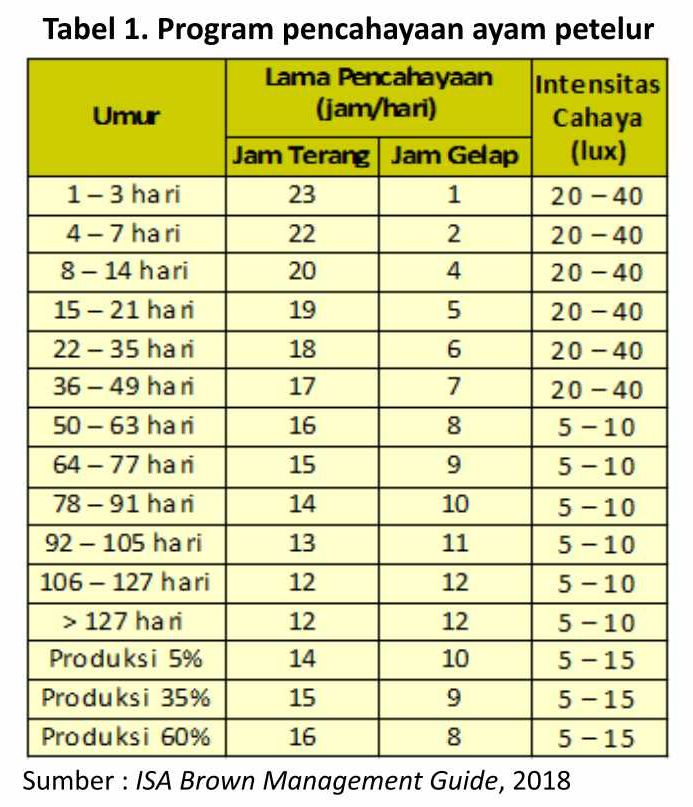
- Lighting time and intensity
- Time starter (0-6 weeks)
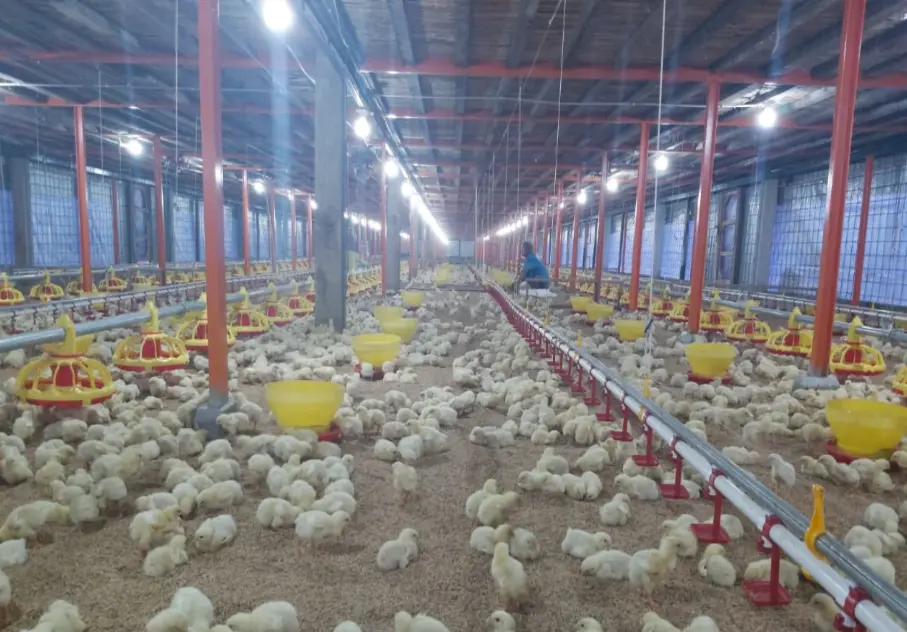
Chickens are provided with lighting of the highest intensity (20-40 lux) and the longest time, especially when brooding period, (21-24 hours). The goal is to make it easier for chicks to recognize the place of ration and drinking water, thereby stimulating feeding activity and spurring growth. - Time grower (7-18 weeks)
Light is given in the shortest time (slowly reduced to 12 hours per day or only comes from sunlight) with the lowest intensity (5-10 lux). It aims to prevent premature sexual maturity (early egg laying) and body weight that exceeds the standards that trigger the occurrence prolapse. - Time layer (>18 – 90 weeks)
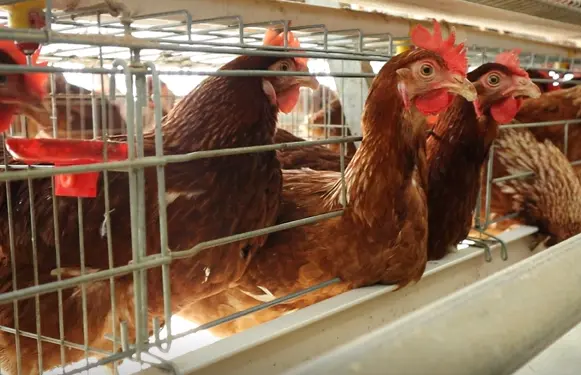
Light is given a maximum of 16 hours with an intensity of 5-15 lux. The provisions related to the addition of light at this time, among others:- Make sure the chicken's weight has reached the standard when starting the addition of light.
- The addition of lighting duration is done gradually, increasing ½ hour every week counting when the chicken first lays eggs, until finally reaching 16 hours.
- Do not reduce the length of exposure when chickens produce eggs, especially during the critical period (early production to peak production), namely at the age of 18-26 weeks.
- Number of lamps
The number of lamps required to obtain the desired light intensity can be calculated by the following formula :
N = {intensity (lux) x enclosure area}
{Lumen x F-utilisasi x F-depresi}
Instructions:
N: number of lamps
Intensity : lux desired
Cage area: Length x Width (m2)
Lumen: luminous value flux (usually printed on the packaging of the lamp)
F-utilization: utilization factor (0.65)
F-depression: light shrinkage factor (0.9)
Examples :
Laying hens 50 meters long and 5 meters wide want to be illuminated 15 lux with a 15 watt incandescent lamp. In the packaging lights printed description luminous fluxits 1030 lm. Then the number of lamps needed in the cage is :
N = {15 x (50 x 5)} = 7 lampu
{1030 x 0.65 x 0.9}
- Lamp distance and distribution
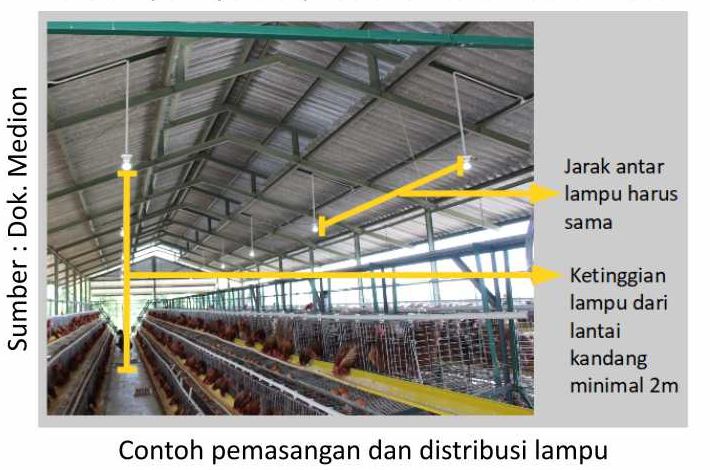
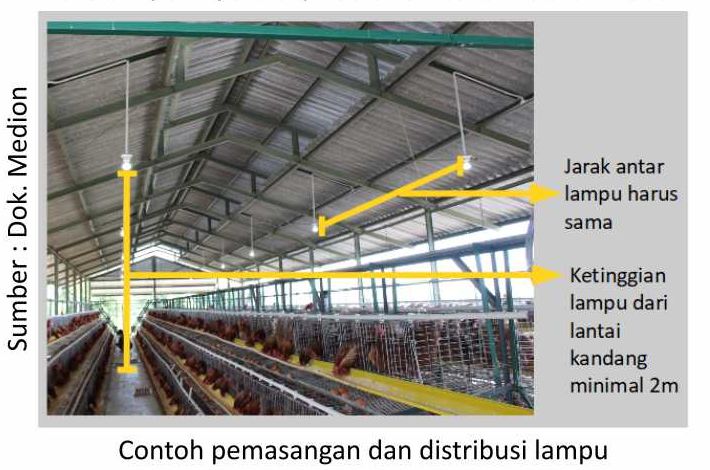
Lights can be installed in the middle or on the left and right sides with the distance between the lights made the same. Meanwhile, the distance or height from the floor of the cage is recommended 2 meters. Make sure the lights are spread evenly throughout the room, because the uneven distribution of lights can cause light stimulation between chickens to be unequal and have an impact on egg production in one cage that is not uniform. - Lamp color
In poultry, the light of blue-green lamps is able to stimulate weight gain and good uniformity, so it is suitable for laying hens of the growth phase. Meanwhile, the red-orange color light is important to stimulate sexual maturity and egg production, so it is suitable for laying hens of the production phase. Red-orange light penetrates the chicken's skull into the hypothalamus 50 times more strongly than blue and green light. The hypothalamus is an important part of the brain to regulate the production of hormones FSH and LH for egg production.