Ibu Rina
Sukabumi-West Java
Why do my laying hens have watery eyes? How is it handled?
Answer:
Dear. Rina, thank you for the question. Symptoms of watery eyes can be caused by several things, including:
- High ammonia levels high levels of ammonia in the cage, both caused litter damp or feces with high uric acid content will directly interfere with the work of the respiratory system of chickens. There are several ways that can be used to detect ammonia levels in cages, including by using an ammonia indicator device, namely an ammonia Meter. Laying the device must be at the right height, for example, 10 cm from the floor or equivalent to the height of the chicken's head. If it is too close to the floor, the measured ammonia will be too concentrated, while if it is too high it will be less effective because ammonia tends to have been carried by a gust of wind/ambient air. In addition, the easiest way to determine the high level of ammonia in the cage is by the sense of smell. To make sure that is by sitting squatting and head approaching the height of the chicken. Ammonia is a strong smelling gas. If with this position there is a pungent smell of feces, then the ammonia level can be said to be excessive. If the ammonia content in the cage is excessive, ammonia gas will dissolve in the eye fluid and produce ammonium hydroxide (NH4OH), which is a component of alkaline compounds that are able to irritate and cause conjunctivitis (inflammation of the conjunctiva of the eye) and will cause watery eyes.
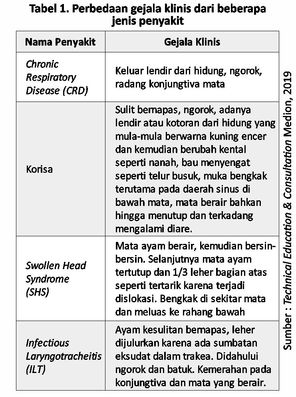
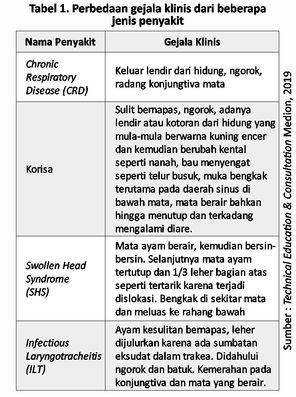
- Diseases of the respiratory system various diseases of the respiratory system that give symptoms of watery eyes, including Chronic Respiratory Disease (CRD), Korisa, Swollen Head Syndrome (SHS) and Infectious Laryngotracheitis (ILT).
- Reaction post vaccination reaction post vaccination arises mainly from the use of active vaccines such as vaccines Infectious Laryngotracheitis (ILT). ILT vaccine has a target respiratory organs, so the reaction post vaccinations that appear are usually mild respiratory distress and watery eyes. The reaction will normally disappear within 5-7 days. Severity or lightness of the reaction post vaccination depends on the health status of chickens and housing conditions. If at the time of vaccination, the health status of chickens and housing conditions are good, then the reaction post emerging vaccinations are very mild or even absent. Conversely, if at the time of vaccination the housing conditions are uncomfortable (dust and ammonia are high), the chickens are stressed, sick, or in the incubation period of respiratory infections (have been infected but have not shown clinical symptoms), then the reaction post vaccinations will appear superfluous.
So that these symptoms do not get worse and do not cause infection with other diseases, prevention efforts can be made including :
- Ensure smooth air circulation, low dust and ammonia levels. Partial dredge litter which agglutinates or adds litter new to keep it dry so that it suppresses ammonia production. When replacing or removing litter, do it gradually so that the chicken is not stressed. At the same time can be added a sprinkling of lime to absorb moisture in litter. Reduce ammonia levels in cages by spraying Ammotrol in feces, simply sprayed into feces or dissolved in drinking water, and can be given together/mixed with vitamins or antibiotics.
- Adjust the ventilation of the cage through the management of open and close the curtains, the addition of exhaust fan and setting the density and distance of the cage.
- Disinfection of cages containing chickens using Medisep. Advance or reverse the disinfection schedule if it coincides with the vaccination schedule.
- The cage is washed, cleaned and sprayed with Neo Antisep, Formades or Sporades, as well as prevent stray animals from entering the cage.
- If the cause is a virus or bacteria and the symptoms of the disease are still mild, revaccination can be done on chickens that have not been infected.
- Take a multivitamin (Fortevit) and immunostimulants (Imustim) to increase stamina and strengthen the immune system.
- When there is a reaction post vaccination, make sure that all chickens in one cage are vaccinated on the same day with a full dose so that the formed immunity is optimal and does not occur rolling reaction. Avoid active ND or active IB vaccination at 1-2 weeks before ILT vaccination as it will cause a reaction post more serious vaccinations.
- Giving antibiotics can treat chickens that have a reaction post vaccination or bacterial infection. Give antibiotics such as Neo Meditril or Ampicol to prevent further infection.