CPC. Muttaqin – By Email
My poultry was attacked by the ND AI virus because they wanted to eat last night but in the morning some died suddenly. I want to ask, how many weeks can the ND and AI viruses last long in a home environment? How to deal with it?
Answer:
Thank you Mr. Muttaqin for the question submitted. Disease Newcastle Disease (ND) and Avian Influenza (AI) is still a major threat in the chicken farming business in Indonesia. Nationally, ND and AI diseases top the ranking of virus cases that chickens layer. Based On A Graph Of Disease Layer National 2023-2025, Newcastle Disease (ND) and Avian Influenza (AI) shows a relatively consistent incidence rate and is in the middle prevalence category, with a percentage of about 4-5% in 2023, declining in 2024 and 2025, which indicates that the disease is still endemic in chickens layer in Indonesia, although various control efforts have been made. On the other hand, on the graph of the rank of diseases Broiler Management Nationwide showed a very low and stable prevalence during the period, with an incidence rate below 1%. Both of these diseases cause high mortality, decreased production performance and economic losses for farmers.
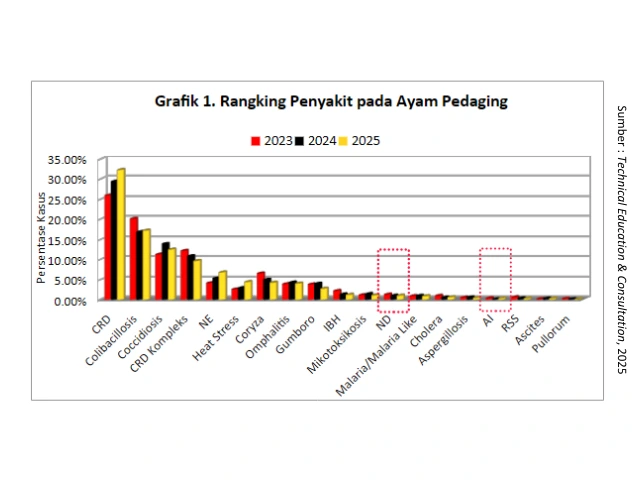
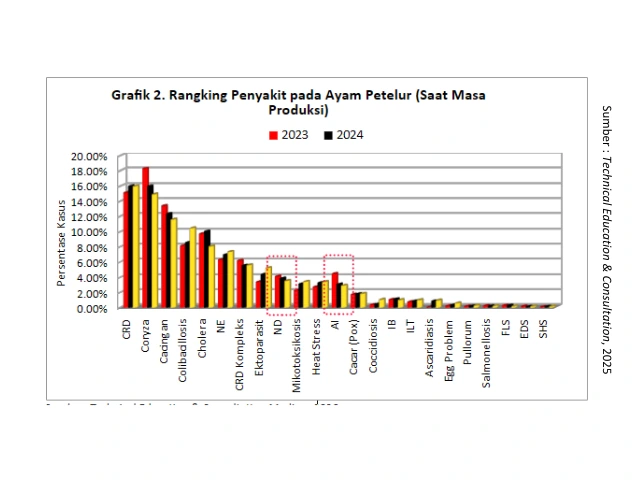
Graph 1. Chicken Disease Ranking Layer and Broiler Management Period 2023-November 2025
Avian Influenza (AI)
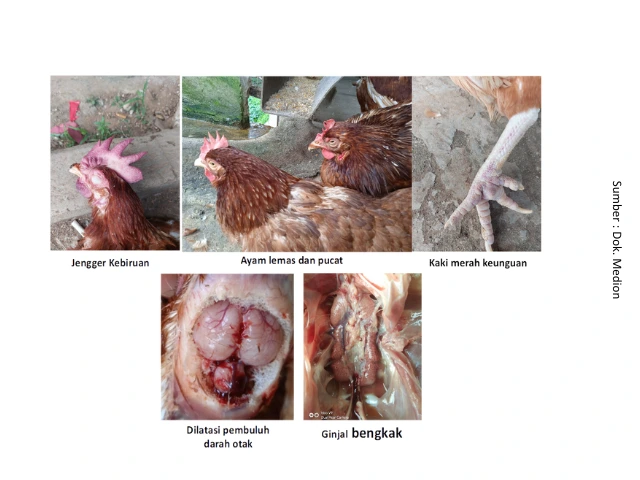
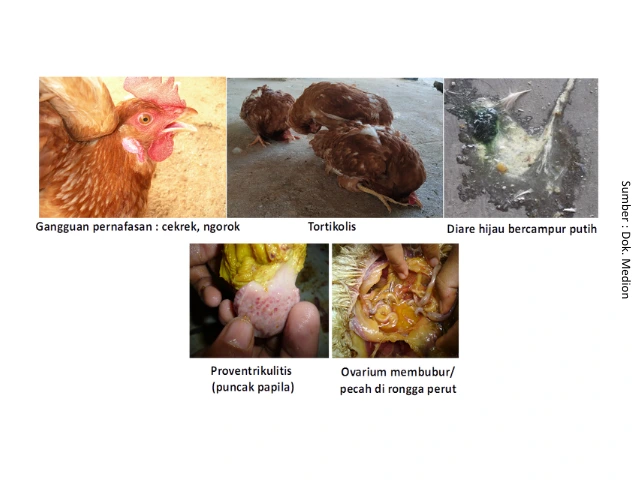
Avian Influenza (AI) or often called bird flu, caused by viruses from the family orthomyxoviridae, the virus has a sheath-coated RNA genome (enveloped single-stranded RNA) that allows rapid infection of the tissues of the respiratory and digestive tracts of poultry. Based on the degree of malignancy, AI viruses are distinguished into Low Pathogenic Avian Influenza Virus (LPAI) and Highly Pathogenic Avian Influenza Virus (HPAI) (WOAH., 2019). Low Pathogenic Avian Influenza Virus (LPAI) generally has a low mortality rate (death) and only cause mild symptoms or no symptoms in poultry, because the replication (multiplication) of the virus is limited to the trachea and small intestine tissue, but if LPAI attacked by other bacterial or viral diseases can simultaneously aggravate the condition of chickens and increase mortality. HPAI is able to penetrate the barriers of the respiratory and digestive tract, spread systemically through the bloodstream, as well as cause extensive tissue damage. Currently, on the farm layer generally, vaccination is carried out 2-3 times before the production period and at least 1 time during the production period. Meanwhile, on the farm broiler, vaccination Avian Influenza (AI) is still very rarely done. Chickens that have not been vaccinated have a high mortality rate, reaching ≥75% within 10 days or even 90-100% within 48 hours of the onset of clinical symptoms (Simancas-Racines et al., 2023). Symptoms and changes in the organs that can be caused AI in the form of Combs and bluish legs, the condition of the chicken is weak and pale, ptechiae (bleeding) in the heart and abdominal fat, dilated blood vessels of the brain and ovaries, inflammation of the proventriculus, swollen kidneys.
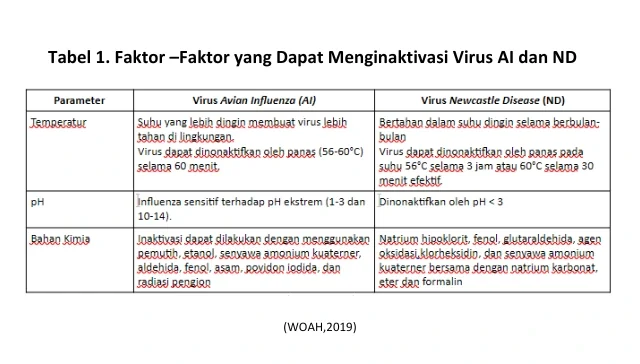
The AI Virus can be transmitted through secretions and body fluids, such as saliva, mucus, and urine, which can contaminate water sources, feed, workers ' clothing and footwear, cages, equipment, and production machinery. The resistance of this virus depends on the physical and temperature conditions in the home environment. Avian influenza viruses can survive up to 200 days in the body fluids of infected birds, 4 days in feces at Body Temperature, 35 days in feces at temperatures below 4°C, and about 5 weeks in an infected poultry house environment. The Virus can survive in carrion, meat and eggs (especially at low temperatures) (Simancas-Racines et al., 2023). On other surfaces such as plastic or enclosure equipment, viral particles can persist for up to more than 14 days, although the ability to infect decreases with time and higher temperatures. At low temperatures (about 4 °C) the virus remains infectious longer than at room temperature or higher et al., 2022).
Newcastle Disease (ND)
Newcastle disease (D) due to Newcastle disease virus (NDV), diklasifikasikan sebagai Avian orthoavulavirus 1, dari genus Orthoavulavirus, subfamili Avulavirinae dan famili Paramyxoviridae. This is an RNA virus (enveloped), a negative single-stranded that is capable of infecting diverse species of poultry, including broilers, laying hens, free-range birds, and wild birds (Tamiru et al., 2025). The Virus has a variety of pathotype (based on the degree of malignancy), namely asymptomatic, lentogenic (low), mesogenic (medium), and velogenic (high). The disease affects primarily the respiratory system, gastrointestinal tract, and nervous system, with clinical symptoms including dyspnea (shortness of breath), cough, lethargy, diarrhea, and neurological symptoms such as torticollis. Organ changes can be inflammation of the larynx, trachea, proventriculus, payer patch, tonsil caeca, egg yolk and ovary undergo bulging or rupture in the abdominal cavity (Getabalew et al., 2019).
The ND Virus can be transmitted through direct contact with infected bird droppings, mainly through the digestive and respiratory pathways, feed, water, cage equipment, clothing, boots, sacks, egg trays/crates, etc. The presence of chicken feces (feces) makes the ND virus will last longer, such as in contaminated egg shells. The presence of mechanical vectors (animals that can transmit diseases without the disease agent undergoing changes or multiplying in them) such as fleas, rats, insects and dogs can also transmit the virus by attaching to the body surface of the vector and being transferred when in direct contact with food or a new host (Dimitrov et al., 2019). Virus Newcastle Disease (NDV) has a high survival rate in a variety of environmental conditions with a long resistance that is strongly influenced by temperature and the medium in which the virus is located. NDV can survive on chicken carcasses 98-134 days at a temperature of 1.1–1.7°C, and even more than 300 days at a temperature of -15.5°C. In the egg shell it is active for up to 24 hours, in feces for up to 24 hours, and in liquid at a temperature of 1.1–1.7°C it can last 203 days as well as at 0°C for up to 161 days. In a poultry house environment, NDV can last 7 days in summer and 30 days in winter, and 53 days in litter cage. In soil, NDV is able to survive 25 days at 37°C and up to 538 days at -26°C (Kinde et al., 2004).
Factors that can inactivate AI and ND viruses
Disinfectants work by damaging important viral structures so that they are no longer able to infect cells. Quaternary Ammonium Compounds (QACs) is a disinfectant that acts actively on the cell membrane of microorganisms. Its hydrophobic properties make QACs very effective in inactivating viruses that have a lipid layer, including ND and AI viruses (Gerba., 2015). Medion disinfectant products containing class Ammonium quartener (QUAT) Medisep and Zaldes which is not corrosive so it is safe to use to disinfect the cage and can be mixed into drinking water according to the dosage. Other types of disinfectants that can be used are oxidizing agentAntisep and Neo Antisep) and Aldehyde (Sporades). Sporades used for disinfection especially when empty cage. Nd/AI indicated farms need to be sprayed / disinfected every day during the disease. Furthermore, disinfection can be rotated 2-3x a week.
Dimitrov, K. M., C. Abolnik, C. L. Afonso, et al.(2019)Updated Unified Phylogenetic Classification System and Revised Nomenclature for NDV Infection, Genetics and Evolution 74: 103917.
Gerba, Charles P. Quaternary Ammonium Biocides: Efficacy in Application. 2015. Applied and Environmental Microbiology.
Getabalew M, Alemneh T, Akeberegn D, Getahun D, Zewdie D. Epidemiology, Diagnosis & Prevention of Newcastle Disease in Poultry. Am J Biomed Sci & Res. 2019 – 3(1). AJBSR. MS.ID.000632. DOI: 10.34297/AJBSR.2019.03.000632. DOI: 10.34297/AJBSR.2019.03.000632.
Kinde, Hailu, William Utterback, Ken Takeshita, and Michael McFarland. Survival of Exotic Newcastle Disease Virus in Commercial Poultry Environment Following Removal of Infected Chickens. 2004. AVIAN DISEASES 48:669–674, 2004
Meng, Jian, Qun Zhang,MinMad, Huahong Shia, Guimei He.Persistence of avian influenza virus (H9N2) on plastic surface. 2022. Science of the Total Environment. http://dx.doi.org/10.1016/j.scitotenv.2022.155355.
Simancas-Racines, A., Cadena-Ullauri, S.; Guevara-Ramírez, P.; Zambrano, A.K.; Simancas-Racines, D. Avian Influenza: Strategies to Manage an Outbreak. Pathogens 2023, 12, 610. https://doi.org/10.3390/pathogens12040610.
Tamiru, Yobsan, Abde Aliyi, Demesa Negessu. Isolation and Molecular Detection of Newcastle Disease Virus From Outbreak Cases in Selected Areas of Northern and Western Oromia, Ethiopia. 2025. Ethiopia. Veterinary Medicine and Science. https://doi.org/10.1002/vms3.70729.
WOAH, Marie Bucko and Samantha Gieger (2019)Newcastle Disease (Avian Paramyxovirus Serotype 1).
WOAH, Marie Bucko and Samantha Gieger (2019) Low Pathogenicity Avian Influenza.