In recent years, Indonesia's livestock sector is being rocked by various problems such as falling commodity prices and soaring feed prices. In addition, our farms are also plagued by outbreaks of various diseases. Diseases that are currently endemic are in the form of new diseases (emerging diseases) and there are also diseases that have previously been in Indonesia and then declared free but then reappear (re-emerging diseases).
In the chicken farming sector, farmers are currently being overshadowed by the re-outbreak of avian Influenza (AI). Where in 2022 the government has reported the occurrence of an outbreak of AI disease to the World Organization for Animal Health (WOAH). The reported outbreak is the emergence of AI subtype H5N1 clade 2.3.4.4 b which has never been found in Indonesia before.
Seperti dilansir dalam laman resmi WOAH, wabah AI subtype H5N1 clade 2.3.4.4b yang dilaporkan pemerintah kita telah menyebabkan kasus kematian tinggi pada peternakan itik di Provinsi Kalimantan Selatan (Sumber: https://wahis.woah.org/). Pelaporan wabah tersebut tentu menjadikan kewaspadaan kita bersama terhadap adanya penyebaran di wilayah lain di Indonesia.
The occurrence of outbreaks of various diseases in the livestock sector both pigs, ruminants, and chickens is a concern and our collective responsibility as Indonesian livestock people. We must improve and contribute actively to help succeed in tackling and eradicating these diseases.
Then, we as chicken farmers, what can we do so that the chickens we keep can avoid disease, both emerging and re-emerging diseases? One of the disease prevention strategies is to combine the following 3 prevention efforts: vaccination programs, biosecurity implementation, and supportive programs to increase the immune system of chickens by giving multivitamins or immunostimulants.
In addition to disease prevention, the application of biosecurity is also absolutely carried out by chicken farmers to obtain a Veterinary Control Number (NKV) certificate. NKV certificate is a certificate as a valid written proof that the hygiene-sanitation requirements have been fulfilled as the basic eligibility for food safety guarantees of animal origin in animal origin food business units.
The procedure for obtaining NKV certificate is contained in the regulation of the Minister of Agriculture number 11 of 2020 on certification of Veterinary Control Number of Animal Product Business Units and is valid for 5 years. In the regulation, it is stated that one of the technical requirements for submitting NKV certificates is that the infrastructure has met the requirements of Hygiene and sanitation, the application of biosecurity, and animal welfare.
A. Understanding and principles of biosecurity
Biosecurity comes from two words, bio = life, and security = protection. Biosecurity can be defined as the protection of living things. In the livestock sector, biosecurity plays an important role to protect chickens from outside the body. This protection will complement the protection from within the body played by the chicken's immune system.
The thing to remember is that as long as the chicken is alive, the causative agent of the disease will always try to infect the chicken. So, that's where the important role of biosecurity will be needed. The principle of applying biosecurity in a farm has three objectives :
- Prevent disease agents from entering
- Prevent disease agents from growing and developing
- Prevent disease agents from spreading
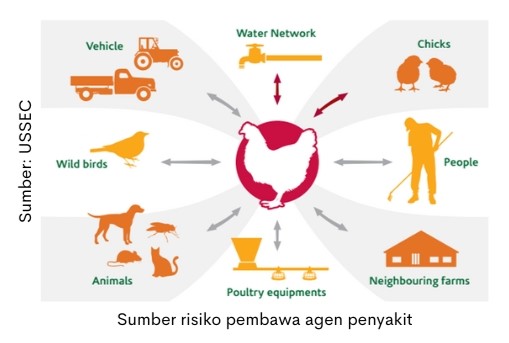
Then, from where the causative agent of the disease can enter the farm? The entry of the causative agent of the disease can come from various sources of risk, that is, everything that can act as a carrier of the causative agent of the disease. Sources of risk consist of people, objects and animals.
B. Biosecurity Level
In its application, the level of biosecurity we are familiar with 3 basic concepts as follows :
1. Conceptual biosecurity
Conceptual biosecurity is the first level of biosecurity and is the basis of all Disease Control Programs. Conceptual biosecurity includes choosing the right location, determining the distance to other settlements or chicken farms, easy access to transportation and resources, limiting contact with other farm animals or wild animals that can play a role in suppressing the chain of disease transmission.
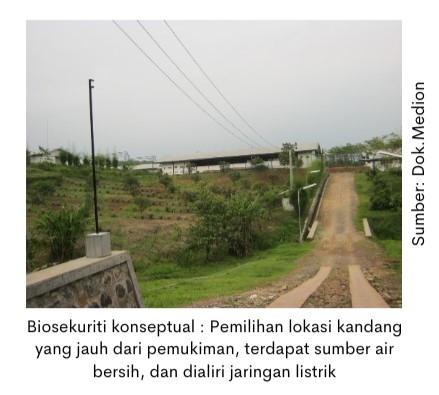
Choosing the right cage location is the initial foundation for building a good farm. Of course, it requires several considerations such as temperature and humidity conditions suitable for keeping chickens, topography and soil texture and water sources. In addition, the area of land for livestock must be adjusted to the scale of the business to be built.
The need for transportation access and electrical installation is also one of the considerations for choosing the location of the farm by thinking about the distance from residential areas. As required the distance between the chicken farm and the settlement of at least 500 m – 1 km.
2. Structural biosecurity
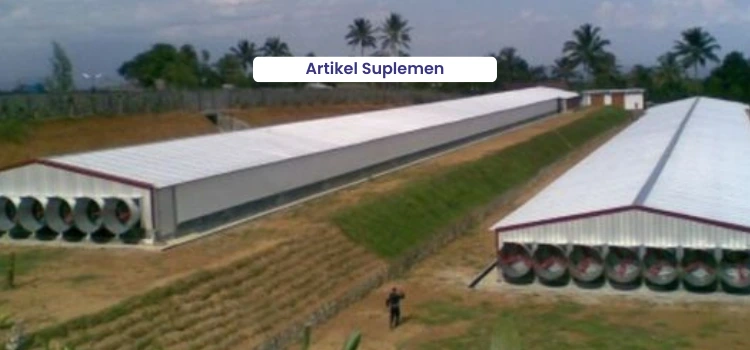
Structural biosecurity is the second level of biosecurity. Structural biosecurity is related to the determination of the layout of buildings and cage structures, the creation of sewage drains, the provision of decontamination equipment, as well as the construction of storage rooms up to changing rooms. Ideally in a farm, there are cages, guard posts, parking lots, feed storage warehouses, employee mess, and other supporting buildings.
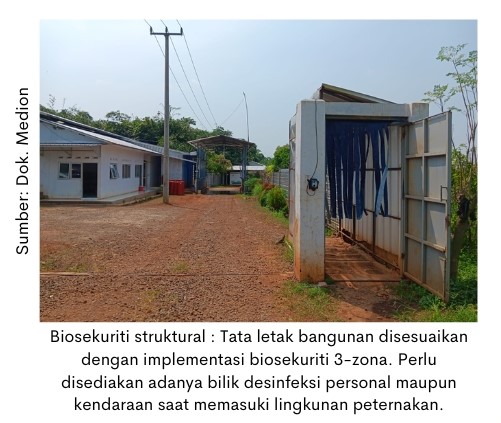
Determination of the location or position of the cage and supporting buildings should be done properly so that the distribution flow of livestock, personal (human), feed and equipment can run effectively. The chicken coop should also be longitudinal to the west-east so that the intensity of sunlight entering the cage is not excessive and prevents stress on livestock. If the cage to be built is more than one, then the distance between the cages should ideally be at least 1x the width of the cage.
3. Operational biosecurity
Operational biosecurity is a procedure or protocol that is carried out at all times or routinely on farms to prevent the entry or spread of diseases. An example of the application of operational biosecurity is the implementation of good maintenance management accompanied by operational standards and procedures (SOP) in every livestock rearing activity, as well as SOP for livestock, equipment, and human traffic. According to the Food and Agriculture Organization (FAO), in the implementation of operational biosecurity, there are 3 elements of biosecurity, namely isolation, traffic regulation and sanitation (cleaning and disinfection).
C. Biosecurity Elements
Biosecurity elements are the implementation of operational biosecurity levels and some are supported by structural biosecurity levels. In practice, the implementation of biosecurity elements must always be carried out in an orderly manner in accordance with the applicable SOP in each farm.
Then who is obliged to comply and do the biosecurity SOP? The answer is all parties or stakeholders involved in the farm, ranging from owners, cage officers, veterinary medical personnel, feed or drug suppliers, and guests who visit without exception.
Biosecurity elements can be divided into three as follows:
1. Insulation
This biosecurity element in the form of isolation is intended to limit the contact of livestock with sources of risk (people, objects, animals) that become the entrance of disease agents into the farm. Examples of implementation of isolation measures are
- Application of all-in-all-out rearing management, for example in broiler rearing. The point is that broilers that we keep in one cage location should have a uniform age, so that the maintenance period will be the same and then harvested in the same time.
- Separation of the location of the farm according to the type of livestock. For example, if we are going to build a dairy cow shed, it should not be mixed with other livestock, such as pigs or chickens. Similarly, when we will keep laying hens, should be in the cage environment we do not keep other birds such as Ducks, ducks, or chickens. Where the presence of other types of livestock in one farm location can increase the risk of disease spread between livestock species.
- Cattle are grouped by age (young or old) and there is a clear boundary between them.
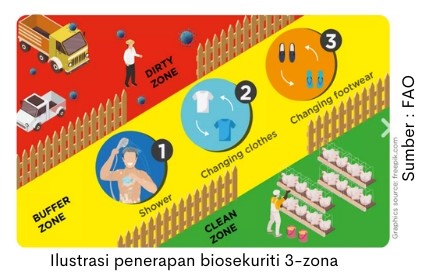
In order for this isolation action to work well, we can implement it in the implementation of 3-zone biosecurity. The goal is to prevent the source of the risk of bringing disease agents into contact with our livestock with layered protection from the red zone (dirty area), yellow zone (buffer area/buffer), and green zone (clean area).
The application of 3-zone biosecurity can actually be started from the first level of biosecurity or conceptual Biosecurity, which begins with the selection of cage locations far from residential areas. Then the second level or structural Biosecurity, which is the design or layout of the farm that will be built. Such as the layout of the building and the existence of a special room/disinfection booth that can be placed at each entry access between zones.
Implement biosecurity 3-zone with the creation of SOP and rules or actions that can and should not be done in each zone.
2. Traffic Regulation
The purpose of traffic regulation is our effort to keep contact between livestock and the source of the risk of transmission of animal diseases. This traffic control also restricts people and objects from entering the farm. If the person or object is indeed required to enter the farm environment, there must be an SOP and it needs to be ensured that the person or object complies with biosecurity directives.
Examples of the implementation of traffic regulation on farms :
- Installation of a perimeter fence. Then a warning was added at the front gate “other than those concerned, entry is prohibited!”.
- The route of travel of people, goods, or livestock products is also made SOP so that it can be in the same direction from chickens with younger ages to chickens with older ages. It is also expected to reduce the potential spread of disease from chickens that have been kept long enough (old) to young chickens.
- For example, in the maintenance of laying hens of various ages in one farm location (multi age), should be separated each cage with the operator or person in charge of each cage, livestock production facilities respectively, so that no farm equipment used simultaneously.
3. Sanitation (cleaning and disinfection)
Sanitation is one of the biosecurity activities that have been done by many farmers. Sanitation activities consist of two things, namely regular cleaning and disinfection of equipment and workers in and out of cages.
The simplest sanitation process that can be done by farmers is to change special footwear for the cage, use special clothes to work in the cage, brushing and dipping footwear in disinfectant tubs, and spray clothes with disinfectant.
a. Cleaning
Cleaning, washing and spraying cages and cage equipment using disinfectants after harvest/reject. When the cage conditions are dirty, the concentration of disease seeds is still high and the chance of livestock in the next period of disease will be greater.
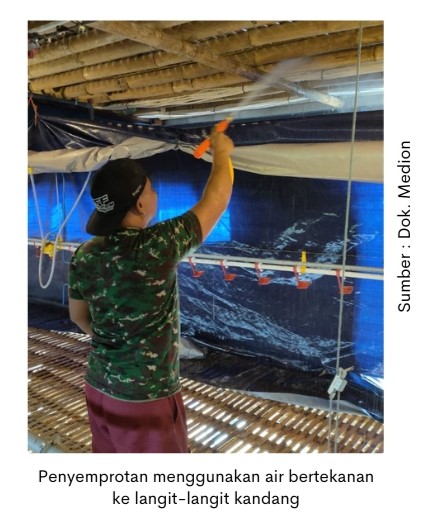
Cleaning consists of dry cleaning and wet cleaning. Dry cleaning includes sweeping, brushing, dredging using a shovel with the aim of removing organic material on the floor, walls, or ceiling of the cage.
While when doing wet cleaning we use water and detergent. Then again spraying is done using pressurized water.
b. Disinfection
Disinfection aims to kill disease agents by using disinfectants. Disinfection activities that are not carried out optimally will cause the purpose of cleaning and preparing the cage in reducing disease seedlings to be in vain.
We should regularly disinfect the cage during the maintenance period. Routine disinfection activities are expected to help suppress disease agents in the cage. So that our livestock does not contract diseases.
The use of disinfectants should not be arbitrary because it must consider several factors such as the type of disinfectant used, organic matter, pH and hardness of the solvent, contact time, and dose of use.
There are several things that must be considered related to the use of disinfectants, namely:
- Types of disinfectants
The selection of disinfectant is adjusted to the spectrum of action or resistance of the disease agent to the disinfectant.
The choice of disinfectant is also seen from the conditions of maintenance. For example, in the preparation of the cage when the cage is empty and there is no chicken then it can use such Formades or Sporades.
As for the disinfection of cage equipment, you can use Medisep. For disinfection of drinking water can be used Desinsep.
- Proper dosage and mode of administration
The dose of disinfectant should be adjusted to the rules of use listed on the product etiquette or packaging. How to spray disinfectant application (spray) should be done until the surface is wet by disinfectant.
- Use quality water
The pH level of the water should be neutral or 5-8, and the water is not hard (the content of ions Ca2⁺ and Mg2⁺ little) so that the disinfectant works optimally. High pH levels (α 8) can affect the effectiveness of disinfectants, especially the iodine group (WHO, 2018).
- Contact time
Shortly after application, the disinfectant begins to degrade so that its effectiveness gradually decreases. As a result, the shorter the contact time required to eradicate microbes, the more efficient the disinfectant. QUATS disinfectants and oxidizing agents are known to have a relatively short contact time (10-30 minutes) compared to phenols so that they have faster killing power.
D. Application of biosecurity in Animal Husbandry
The successful implementation of biosecurity in cages is due to the commitment of all parties to run it. Some important things in implementing biosecurity in chicken farms, including :
1. Making daily activity schedule
In order to facilitate traffic control risk sources of people (workers), goods (feed, eggs, and others), and animals (chickens) can be done by making a schedule of daily activities.
2. Biosecurity SOP making
Operational biosecurity implementation is by making biosecurity SOP which is agreed and implemented by all parties without exception. To make it easy to remember, understand, and implement it can be made posters of Appeals/ regulations placed in each biosecurity zone.
3. Employee training and mentoring
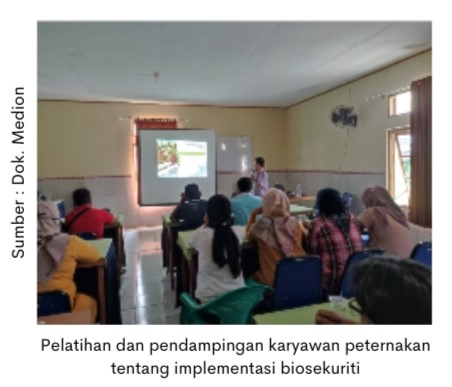
The SOP that has been prepared needs to be socialized and given training to all parties involved in animal husbandry activities. Socialization and training can be conducted by farm managers, related agencies or external parties who are competent in the field of biosecurity.
After the SOP is carried out, there needs to be regular assistance so that the implementation of biosecurity can run consistently in accordance with the initial commitment.
4. Biosecurity supervision / Audit
The purpose of supervision is to ensure that biosecurity is carried out and complied with by all parties in a routine and responsible manner. For this reason, it is necessary to appoint a person who is responsible for overseeing the implementation of biosecurity in the cage. In addition to the presence of Supervisors, it is also expected that all parties can remind each other and report if there are other people who violate biosecurity rules.
The implementation of biosecurity also needs to be audited by other independent parties. So that if there are corrective findings from the audit team, biosecurity can be improved and improved again.
5. Penerapan reward and punishment
Farm management needs to provide rewards or rewards (bonuses/incentives) to employees who run biosecurity rigorously and consistently. This reward will be a motivation for other employees to be more proactive in implementing biosecurity SOP.
On the other hand, there is also a punishment for those who violate the biosecurity SOP. So that it can be a lesson for all parties not to violate the SOP that has been agreed upon.
The many benefits of implementing biosecurity should be able to increase the spirit for farmers to continue to be consistent in implementing it. If we understand, the application of biosecurity in a strict, disciplined, and consistent manner, can definitely have a positive impact on the health and performance of livestock so that farmers will benefit. The thing that needs to be emphasized is that the application of biosecurity is not limited only to chicken farms but can be implemented on all types of livestock that we maintain. May be useful.