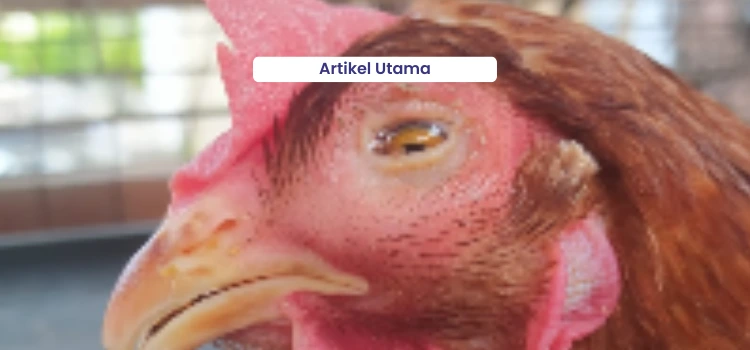
Infectious Coryza or simply called coryza is a bacterial disease that never leaves the top 5 ranking of diseases in chickens. layer or broilerThis disease attacks the respiratory system in chickens. Like other respiratory diseases, this disease tends to increase during the rainy season and seasonal changes. Many farmers complain about coryza because it significantly impacts chicken performance. Coryza incidence is also quite frequent and recurrent in the field. Therefore, understanding the development of cases in the field is an added advantage when managing coryza cases in the field. farm.
Field Case Updates
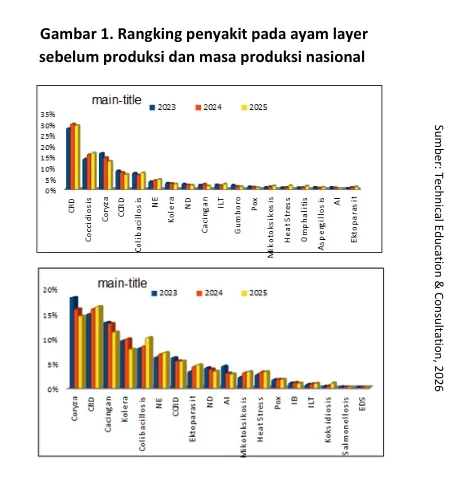
On the ranking of chicken diseases layer nationally in the last 3 years (Figure 1), coryza ranked 3rd in layer before production and ranked second in the production layer. This indicates a very high coryza threat in the field. Losses due to coryza indirectly affect egg production. Egg production can decrease by up to 40%.
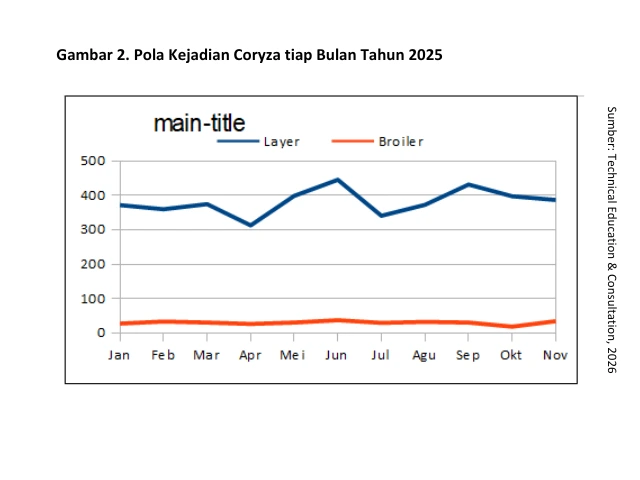
The pattern of coryza incidence in 2025 can be seen in Graph 2. This coryza incidence is based on clinical symptoms and anatomical pathology collected by the Medion field team. The graph shows an increase in coryza incidence in chickens. layer in June during the peak of the dry season and in September during the start of the rainy season. The incidence of coryza during the peak of the dry season can increase due to rising environmental temperatures coupled with issue A wet dry season in 2025 will also cause humidity to remain high. This high temperature and humidity are predisposing factors to an increase in disease vectors, including coryza. Meanwhile, in chickens, broiler The pattern of coryza incidence does not vary significantly from month to month. Coryza incidence patterns from previous years can be used as a reference when developing health programs. They also serve as a reminder to be vigilant during certain months with a spike in coryza incidence.
Causes and Predisposition
Avibacterium paragallinarum is a Gram-negative bacterium that causes coryza. This coryza-causing agent was previously known as Haemophilus paragallinarum. These bacteria are encapsulated, do not form spores and reproduce by facultative anaerobic means. Av. Paragallinarum then differentiated based on the serovar using the Page and Kume methods. The Page method divides serovars Av. Paragallinarum from the results plate aglutiantion test which were then identified as serovars A, B and C. In more detail, the Kume method groups serovars Av. paragallinarum based on the HI test into A1, A2, A3, A4, B1, C1, C2, C3, and C4.
Each serogroup has a different cross-protection capability. In serogroup A, serovars A1, A2, and A3 have different cross-protection capabilities. cross strong protection, while serovars A1 and A4 have good cross-protection. Serovars C1, C2, and C3 in serogroup C have good cross-protection. Specifically, in cross-protection capabilities in groupings based on Kume, serovars C4 and B1 are only able to provide protection against homologous serovars (Disease of Poultry, 14th edition).
Teams Surveillance Analyst Medion is continuously mapping bacteria Av. paragallinarum This is the cause of coryza in Indonesia. Data from isolates collected from 2021 to 2025 indicates that they belong to serovars A1, B1, and C4. In 2025, serovar C4 was the dominant circulating strain in several regions in Indonesia, including Madiun, Probolinggo, Banyuwangi, Tangerang, Bogor, and Lampung.
Coryza infection is transmitted horizontally from sick chickens or carrier to healthy chickens. This transmission can occur directly or indirectly through intermediaries such as cage equipment. The bacteria enter through the nose and multiply in the infraorbital sinus. Exudate from the noses of chickens infected with coryza is the source of coryza transmission. From the bacteria entering the chicken's body to causing symptoms, it takes 1-3 days. On farms that implement a system of multiage The challenge will become even greater. This is related to the ability of the bacteria that cause coryza to infect young chickens 1-6 weeks after they are transferred to the grower pen.
Several cage conditions can be triggers (predisposing factors) for coryza. One such condition relates to ventilation management. During the rainy season, like now, the temperature in the cage will be low and humidity high. Air circulation is crucial. In high humidity conditions, damp husks/litter will emit a strong ammonia odor. Ammonia is irritating to the chicken's respiratory tract. Ammonia can damage the cilia, which act as the immune system in the respiratory tract. When cilia are damaged, infectious agents can easily enter through the respiratory tract.
Age Pattern of Attack
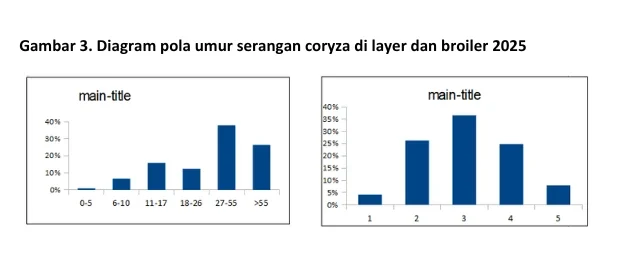
Coryza can affect all ages, both in chickens and in chickens. layer and broilers. Coryza attacks on chickens layer 2025 is the most phase layer 1, which ranges from 27 to 55 weeks of age. This is related to the chicken's goal at this stage, which is to extend production persistence. However, if the chicken's environment is not supported by supportive housing conditions, stress levels will increase and trigger disease infections, including coryza. Similarly, the age of onset of the disease in chickens is also affected. broiler The highest number occurs in the third week, when the chickens' size and weight are already large, resulting in increased feces production. This feces production is related to ammonia levels, which also increase at this age.
Common Clinical Symptoms and Anatomical Pathology
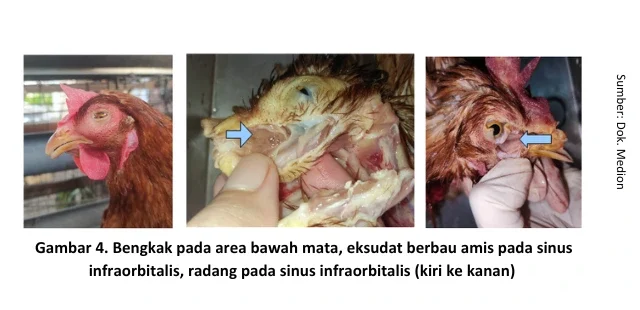
Coryza infection attacks the upper respiratory system, targeting the infraorbital sinuses. Infected infraorbital sinuses produce exudate with a watery to thick consistency. This exudate is also seen coming out of the nose. The exudate has a foul and fishy odor, which is characteristic of coryza. As a result, chickens experience difficulty breathing and appear to snore. As exudate production in these sinuses increases, it causes swelling under the eyes. The swelling can worsen, causing the eyes to close. Once the eyes begin to close, feed and water consumption decrease. This complicates the healing process, especially with treatment through drinking water.
Confirming the diagnosis by performing a dissection on the chicken and observing the anatomical changes will reveal conjunctivitis, laryngitis, and tracheitis. Additionally, exudate accumulation in the infraorbital sinus will be found. If secondary infection with colibacillosis is present, sinus congestion will be observed.
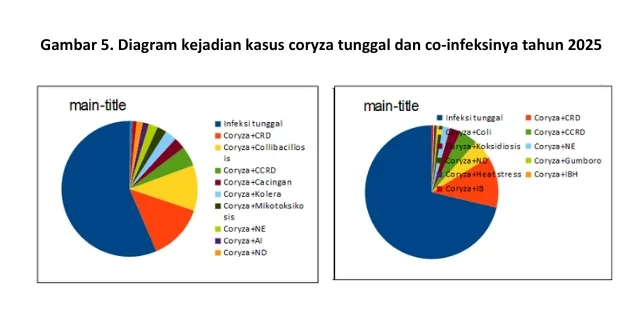
Coryza can infect alone or together with other infections as in Figure 5. The first rank of co-infection is good in chickens. layer or broiler is an infection with CRD followed by colibacillosis. This most commonly occurs with organ changes that can be observed are the presence of water sacculitis and inflammation both in the sinuses and in the eye area (panopthalmitis).
The changes in clinical symptoms and anatomical pathology seen in coryza infection are often confused with other diseases. In SHS, colibacillosis, wet pox, ILT and ORT (Ornythobacterium tracheale) also have similar changes. To confirm the diagnosis, if necessary, a laboratory test can be performed using PCR (Polymerase Chain Reaction).
Prevention Coryza
Coryza prevention efforts can be carried out with a combination of optimal maintenance management, implementation biosecurity Strict monitoring and proper vaccination are essential. Coryza is a disease that occurs frequently and repeatedly, making it difficult to cure. Vaccination can be used as a preventative measure by protecting the chicken's body by developing antibodies. Vaccination also helps reduce illness in chickens and makes them easier to treat when infected. challenge spacious.
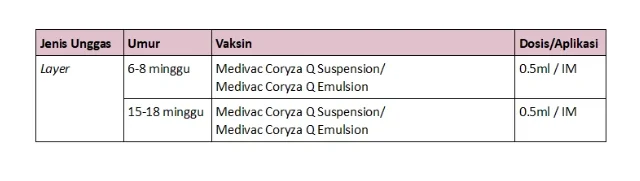
Coryza vaccination in layer chickens can be carried out at the age of 6-8 weeks and repeated at the age of 15-18 weeks with Medivac Coryza Q Suspension or with Medivac Coryza Q Emulsion. Meanwhile, in broilers, coryza vaccination can be given at the age of 7-14 days with Medivac Coryza Q Suspension with subcutaneous application.
Medivac Coryza Q Contains four isolates from serovars A1, B1, C2, and C4. These serovars correspond to the serovar groups currently found in Indonesia. Vaccination with homologous vaccines will provide optimal protection for chickens against the challenge of local coryza infections.
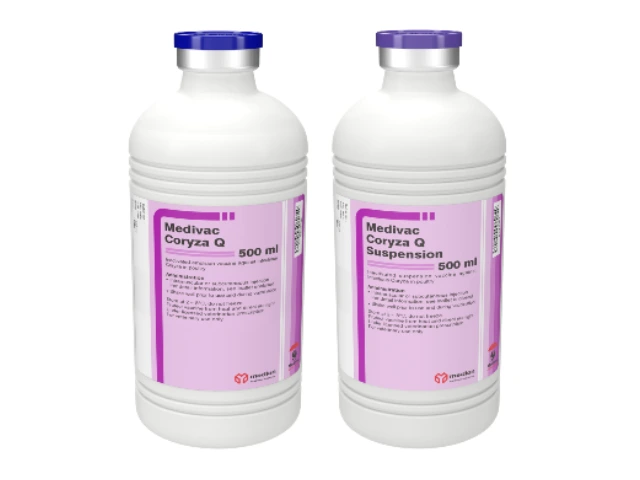
inactivated vaccine with homologous strains for coryza protection
Some critical points that need to be considered when applying the coryza vaccine, especially the emulsion, are:
- Thawing (The process of raising the vaccine temperature from 2-8°C to a temperature consistent with ambient temperature) is carried out correctly to minimize post-vaccination reactions. A sign that the vaccine is ready to use is when there is no condensation on the walls of the vial after being removed from the refrigerator.
- Appropriate injection site. Coryza vaccination can be administered intramuscularly in the chest, intramuscularly in the thigh, or subcutaneously in the neck in broilers.
- Make sure the injection equipment for vaccination is sterile.
Apart from carrying out vaccinations properly, preventive measures need to be taken to ensure that livestock farming is safe from cases. coryza among them:
- Consider implementing one-age, one-site rearing. However, if there are different ages on the farm, implement movement control for the cage operators, moving the chickens from young to older, and from healthy to sick.
- Avoid chickens from stressful conditions because it can reduce the body's resistance so that they are susceptible to infection or disease. coryza Relapse. In addition, control ammonia levels in the cage, as this can be a predisposing factor or trigger for disease. coryza. One of the products that can bind ammonia is Ammotrol by spraying it on the dirt or dissolving it in drinking water.
- Perform sanitation and disinfection with Medisep for maintenance cages and equipment.
- Regular drinking water sanitation with Desinsep to prevent the transmission of coryza through drinking water.
The following are also some handling efforts that can be carried out when a case is found. coryza:
- Isolate sick chickens, then select and cull chickens with severe conditions to minimize transmission.
- Give antibiotics such as Neo Meditril or Doctril according to the dosage and instructions for use by mixing it with drinking water. If the chicken experiences a decrease in appetite, it can be given an injectable antibiotic such as Gentamin, Medoxy LA, or Vet StrepIt's important to note that antibiotic treatment must be completed according to the prescribed duration, even if the chicken no longer shows any symptoms of illness. One important aspect of antibiotic treatment is to ensure the correct administration. rolling Antibiotics are administered by administering antibiotics from different classes every 3-4 treatment periods to prevent antibiotic resistance. Antibiotic resistance can cause bacteria to become insensitive to an antibiotic, requiring a larger dose to eradicate the bacteria. To determine whether certain bacteria are resistant to an antibiotic, an antibiotic sensitivity test can be performed. The results of this test can be used as a guide in selecting the appropriate antibiotic for treatment.
- Give multivitamins such as Vita Stress or Fortevit to improve the condition of the body of chickens.