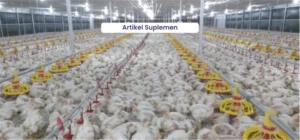
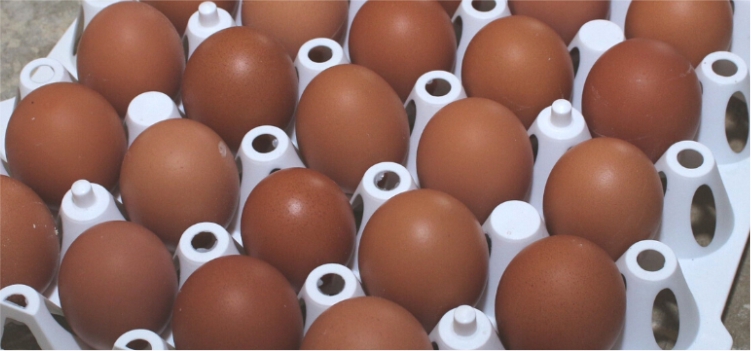
One of the foodstuffs in demand by the people of Indonesia is chicken eggs, besides the affordable price is also easy to get. Eggs have many benefits for human health, due to the completeness of their nutritional content. However, on the other hand, eggs are still high in cholesterol and low in omega 3 fatty acids. Efforts to increase omega 3 while lowering cholesterol can be done by engineering in the field of feed.
Chicken Eggs
Eggs are a source of animal protein that has a delicious taste, easy to digest and highly nutritious so popular with many people. So great are the benefits of eggs in human life that eggs are highly recommended for consumption by children who are in their infancy, pregnant and lactating mothers, people who are sick or in the process of healing, and elderly people.
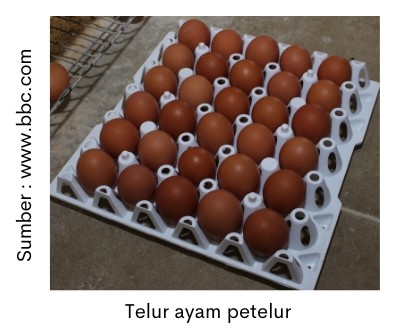
Eggs consumed by the people of Indonesia are generally derived from poultry farmed. The types of eggs that are widely consumed are chicken eggs, quail eggs and duck eggs. Chicken eggs are more widely used in everyday life because they are easy to process and use for human needs. daily life because it is easy to process and use for human needs.
Eggs are composed of three parts, namely egg shells, egg whites and egg yolks (Winarno, 2002). Based on the weight of chicken eggs, the egg part consists of yolk about 30-32%, egg white about 58-60%, and egg shells about 10-12%.
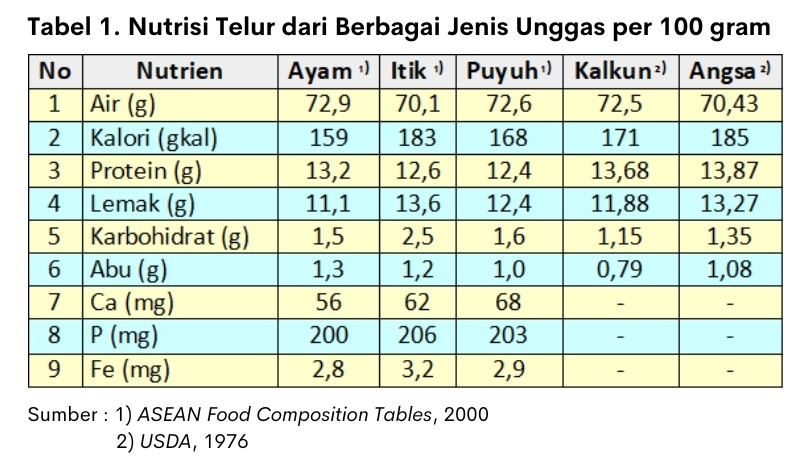
The protein content in chicken eggs is very similar to the content in goose eggs, quail eggs and other types of eggs. The table of nutritional content of eggs is shown in Table 1.
What Are Omega 3 Chicken Eggs?
Omega 3 chicken eggs contain compounds DHA and EPA 10 times higher than ordinary chicken eggs. Omega 3 eggs are commonly sold with premium labels. Omega 3 is one of the nutrients that we really need. DHA and EPA compounds themselves are essential fatty acid substances that are very beneficial to health including :
- Increases body endurance
- Serves as an antioxidant
- Prevention against stress
- Maintain skin freshness
- Prevention against stress
- Maintain skin freshness
- Increase appetite
- Helps toddler brain development
- Prevent coronary heart risk
- Preventing dementia
- Maintain eye health
Even so, the body cannot produce it on its own in sufficient quantities so it must be helped through food intake.
Omega 3 fatty acids itself consists of three types of fatty acids that have different functions and roles, namely:
- Eicosapentaenoic acid (EPA)
Serves to produce a chemical called eicosanoid. This compound plays a role in the maintenance of endurance. In addition, eicosanoid also able to control inflammation. EPA is also known to help relieve symptoms of depression.
- Docosahexaenoic acid (DHA)
It is one of the main components that contribute to Building 8% of the weight of the brain. No wonder this type of omega 3 is very necessary for a child's brain growth and development. While in the elderly, DHA compounds are able to prevent decreased function and brain damage such as dementia.
- Alpha-linolenic acid (ALA)
Omega 3 in its simplest form. In the body, a small part of the fatty acid ALA is converted to the form of EPA and DHA. Most of them are used as an energy source.
ALA is most abundant in vegetable sources, such as plant oils and seeds. While DHA and EPA are found in animal sources, such as salmon, tuna, and egg yolks.
Naturally, egg yolks already contain AHA and DHA. However, the levels are not so high that they cannot be categorized as a food source high in omega 3 such as salmon. Therefore, chicken egg producers get around this with feed engineering technology.
In Indonesia, the invention of feed engineering technology to enrich chicken eggs with omega 3 was first carried out by the Bogor Agricultural University (IPB) in 1995 and has been patented since 2009. In addition to through engineering technology, the chickens are also fed enriched with omega 3 supplements. So that the chickens can produce eggs with a high content of omega 3 fatty acids.
Regular eggs vs Omega 3 eggs
Many say, that omega 3 chicken eggs are better for health, than ordinary chicken eggs. This is due to the content of omega 3 fatty acids contained in it.
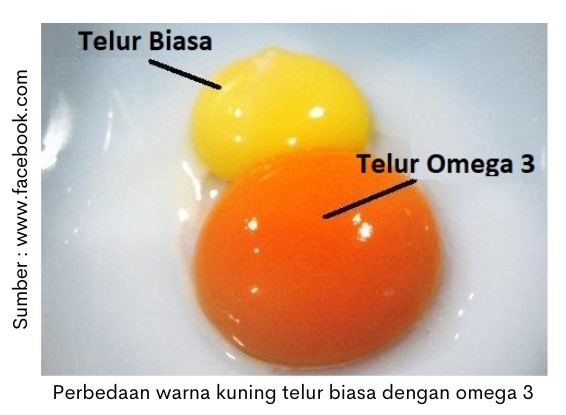
Besides of course enriched with additional omega 3, these eggs also have other differences from ordinary chicken eggs.
1. Components of EPA and DHA
- Common chicken egg : 40-50 mg
- Chicken egg omega 3 : 400 mg
The use of omega 3 supplements as much as 5% in laying hen feed is reported to increase the content docosahexaenoic acid (DHA) 10-fold and lower cholesterol levels low density lipoprotein (LDL) by 50% (Rossi et al., 1997; lrnan Rahayu et al., 1997).
2. Physical display
Omega 3 chicken egg yolk is more sturdy and not easily destroyed when separated from the white because it contains beta-carotene and is larger.
3. Yolk color
- Common chicken egg : light yellow/bright
- Omega 3 chicken egg : more intense in color, even close to Orange
4. Cholesterol content
These special chicken eggs also contain 50% lower cholesterol than regular chicken eggs. Per 100 grams of omega 3 chicken eggs, cholesterol is only about 150 mg while ordinary eggs can reach 250-300 mg. For the record, the limit for cholesterol intake in adults is a maximum of 300 mg per day. This advantage makes omega 3 chicken eggs suitable as a protein source of choice for people who have high cholesterol or heart disease.
5. Price
Seeing the content of omega 3 eggs that are superior to ordinary eggs, it is not surprising that the price is also more expensive. The price of these eggs can be 3 times more expensive than ordinary chicken eggs on the market.
Sources of Omega 3 for chicken
Examples of feed raw materials sources of omega 3 from several studies that have been conducted are as follows :
1. Lemuru fishsardinella longiceps)
Various wastes have been used by researchers to engineer egg products. Among the environmentally friendly waste and still have good nutrition is oil obtained from waste boiling lemuru fish, which is a source of unsaturated fatty acids (PUFA) various wastes have been used by researchers to engineer egg products. Among the environmentally friendly waste and still have good nutrition is oil obtained from waste boiling lemuru fish, which is a source of unsaturated fatty acids (PUFA) omega 3, omega 6 and omega 9. In the manufacture of omega 3 supplements this waste tofu pulp is used as filler.
Lemuru fish oil contains omega 3 fatty acids 26-30% with energy of 9,560 kcal GE/kg (Estiasih, 1996). So it is possible to use as a raw material source of omega 3 in chicken feed. Lemuru fish oil is obtained from the rest of the canning process, where the waste oil has no economic value. Lemuru fish oil waste cloudy with a yellowish brown color contains 15.55% oleic acid and 26.29% omega 3 fatty acids.
In producing this omega 3 supplement, there are several stages that need to be done, namely:
- Drying
Tofu pulp waste is squeezed and sown with active microbes to improve its nutrition, then dried until the water content is reduced to 15%.
- Milling
I know what it is that has dried up. It is intended that the material is easily mixed with lemuru fish oil waste and is also easily consumed by chickens. This material will be filler.
- Mixing
Material filler which has been finely mixed with waste oil obtained from boiling lemuru fish in a ratio of 1 : 1.
Mixing is done with mixer until homogenized. The result of this mixing is an omega 3 supplement product.
2. Anchovy
In the research conducted by Andrew, anchovies from traditional Indonesian markets are added to the feed of laying hens. The initial stage of the study began with the extraction of anchovy oil and the determination of its dry weight.
Then, the anchovy extract was mixed in the laying hen feed. After three to four weeks, eggs from chickens fed with Feed with anchovy content are taken and analyzed. Andrew explained that the omega 3 content in the treated eggs increased significantly up to 3 times from before, after the laying hens consumed anchovies for 24 days.
3. Earthworms, gold snails and red algae
- According to the research of students and lecturers of Hasanuddin University Makassar, one of the sources of omega 3 high for chicken feed mixture is earthworm (Lumbricus rubellus). According to Sulistiono (2007), it is known to contain omega 3, 6 and 9 acids.
- Other invertebrates rich in omega 3 fatty acids are conch mas (Pomacea canaliculata). Keong mas has a fairly good nutritional content, including minerals, protein, and unsaturated fatty acids. In addition, there are other food nutrients such as vitamin C, Zn, Cu, Mn, and iodine.
- The 3rd floor of the main building has a large gable roof, with a gable roof (Eucheumacottonii). Algae or seaweed Eucheumacottonii it is widely cultivated because it contains minerals, such as calcium, potassium, iron, magnesium, iodine, vitamin B6, vitamin B12, vitamin C, omega 3, omega 6, also antioxidants.
Some studies say the antioxidant content in Eucheuma is 550 times stronger than vitamin C, with higher protein than milk, and omega 3 and omega 6 content which is also higher than fish. According to Winarno (1996), in 100 grams of dried seaweed contains omega 3 fatty acids ranging from 128 to 1629 mg and omega 6 fatty acids ranging from 188 to 1704 mg. The three feed ingredients, namely earthworms, gold snails and red algae, are processed and used as additional feed ingredients for chickens.
To make it, these three ingredients must first be dried and turned into flour. After that, it is mixed with chicken feed with a ratio of 70% basal feed, 10% earthworm flour, 15% red algae flour and 5% Gold Snail flour. The analysis showed that chickens fed mixed feed produce eggs with omega 3 content reached 28.34 mg/L in every 0.25 g of egg yolk. Levels of omega 3 is much higher than chicken eggs that do not give supplementary feed, which only contains omega 3 of 7.11 mg/L in every 0.25 g of egg yolk.
Thus, I hope this article is useful. Greetings.