Questions from Mr. Surya
Bulukumba-South Sulawesi
How is the treatment and Prevention of Jembrana disease for the maintenance of cows in the garden?Answer: Jembrana is a disease in Balinese cattle caused by a Retrovirus, from the Lentivirus group and called Jembrana disease virus (JDV). Transmission of the disease can occur horizontally, that is, direct contact between sick cows and healthy ones through urine, tears or saliva. Transmission can also be through insect vectors such as Culicoides sp., mosquitoes and Tabanus rubidus.
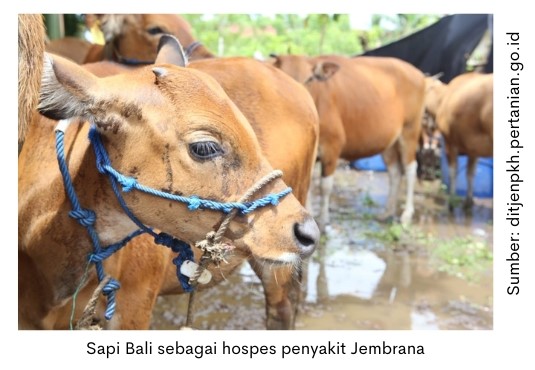
The incubation period of Jembrana disease ranges from 4-7 days. It usually begins with the appearance of fever up to 41-42°C. Other clinical symptoms that can appear are depression, decreased appetite, swelling of the lymph glands, inflammation of the mucous membranes of the mouth, hypersalivation, diarrhea mixed with blood and blood sweat. Atpregnancy can occur miscarriage at any age of pregnancy.
Prevention of Jembrana disease in extensive and semi-extensive maintenance is not easy, especially related to biosecurity. Including a fairly large umbaran area. Special attention is needed related to biosecurity such as disinfection of maintenance areas and restrictions on livestock areas. Farmers in the garden area, usually cows are stabled at night and then grazed during the day. The release of cows in pastures must still be considered because they can mix with other livestock. Of course, this is related to the risk of disease transmission.
Here are some efforts that can be done to prevent transmission of Jembrana disease:
- Restrictions on livestock traffic by not bringing cattle from areas of plague or endemic Jembrana disease.
- Cattle imported from outside the region, especially endemic areas should have been vaccinated or negative serological test results Jembrana. By adjusting the policy of the local veterinary authority (POV) service or official.
- Newly arrived cows need to be quarantined in advance for at least 14 days in the pen. Pay attention to their health status every day before combining with other healthy livestock. Disinfect the cage daily during quarantine with Medisep or Antisep. And continue spraying the cage with disinfectant every 3 days.
- Transmission of Jembrana disease can be through ectoparasite vectors. Immediately contact an animal health worker for treatment in livestock infected with ectoparasites with Wormectin Injection or Wormectin Plus Bolus and spray the cage with antiectoparasites Delatrin or Kututox Spray. Then spray insecticide on the cage regularly every week to control the vector.
- Increase endurance by giving vitamins Vita B Plex Bolus Extra Flavor and the addition of nutritious feed supplemented with minerals Mineral Feed Supplement S and premix Mix Plus Cattle Pro.
- Vaccination of the entire population according to the policy of the local service.
- Report immediately to the animal health officer if there is a suspicion of a case of Jembrana disease so that it can be followed up immediately.
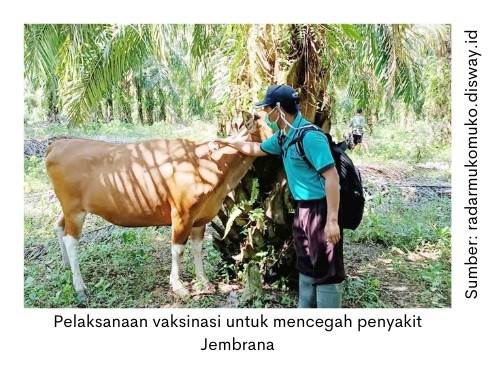
- Cows that show symptoms of the disease are not released from the pen in advance. To focus on treatment and not as a source of transmission. Separate sick cattle pens for immediate treatment. It also aims to prevent transmission by limiting the movement of livestock.
- Immediately contact an animal health worker to obtain treatment for livestock, such as:
- In addition, the use of anti-inflammatory, anti-inflammatory, fever-lowering agents to treat fever symptoms and inflammation in the body (Medipiron Injection)
- Administration of vitamins to increase endurance and accelerate healing with Injekvit B-Plex or ADE-Plex Inj
- Administration of antibiotics to overcome secondary infection with Medoxy-LA, G-Mox 15% LA Inj.
- Disinfect the cage every day to suppress the seeds of disease around the cage with Medisep/Antisep and control vectors around the cage, for example by spraying Antiectoparasites Delatrin.