Bawang merah (Allium cepa var. Aggregatum) is one of the vegetable commodities that are widely cultivated and have high economic value. Shallots are spices or flavoring dishes that are used daily and tend to be always needed. Another benefit of onions is as a traditional medicine.
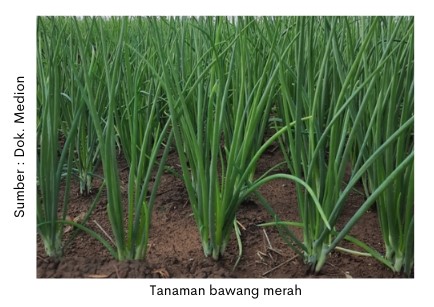
Shallots in Indonesia can be grown in the lowlands to high. However, for optimal growth, many plantings are carried out in Lowlands (0-450 MASL) with an air temperature of 25-32°C. Onions grown at high altitudes have a longer lifespan of 0.5 -1 months and less production. Onion plants need maximum sun exposure for good yields.
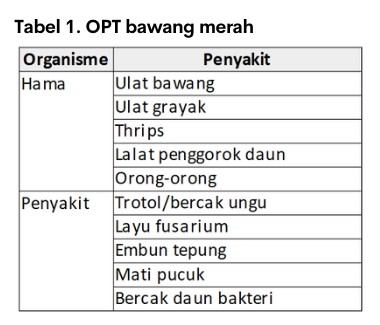
Although shallots include superior vegetable commodities of high economic value, in its cultivation is not spared from the constraints. One of them is the attack of plant pest organisms (OPT). The following pests that attack onion plants (Table 1).
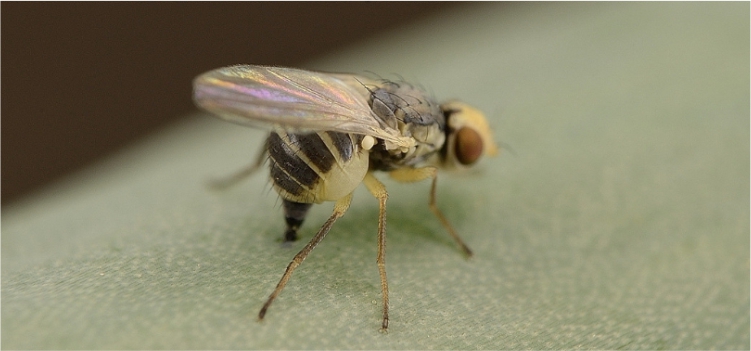
OPT on onion plants is one important factor that needs attention because it is very influential on crop yields. One of the pests that need to be watched out for is leaf slicer because it can cause crop loss of 30-100% (Vegetable Research Institute). Therefore, efforts are needed to provide protection to plants so that there is no loss of crops.
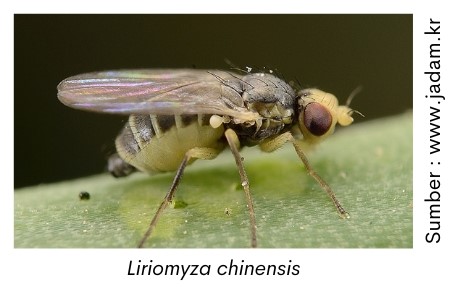
Liriomyza chinensis or leaf-slitting flies were first found attacking onion plants in Brebes in August 2000. The larvae of the Leaf slicer fly are the phase that inflicts damage on the onion. The Leaf slicer attacks plants from the age of 2 mst (weeks after planting) to the eve of harvest. Leaf slicer attacks can reduce crop yields and even crop failure during heavy attacks. High attacks of leaf-slitting pests occur in the dry season.
Leaf Slaters attack onion plants after planting until the harvest. damage the leaves of newly grown onion plants to old plants. In its life cycle, Liriomyza chinensis develops through several phases, namely eggs, larvae, pupae and imago or adult flies.
Leaf Slitting Life Cycle
Leaf Slaters attack onion plants after planting until the harvest. In its life cycle, the Leaf slicer develops through several phases, namely eggs, larvae, pupae and imago or adult flies.
1. Eggs
The eggs are clear white, measuring 0.28 mm x 0.15 mm. Fly eggs are laid in red onion leaves. Leaf slitting eggs lasts 2-4 days.
2. Larva
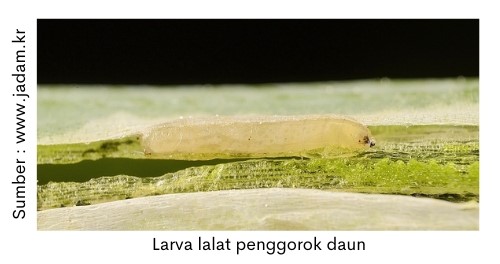
The larvae are yellowish white and slit the mesophyll tissue of the leaves and then stay in the Leaf cavity. Leaf-slitting larvae consist of 3 instars lasting 6-12 days. After the 3rd instar the larvae emerge from the leaves and fall to the ground forming pupae.
3. Pupa
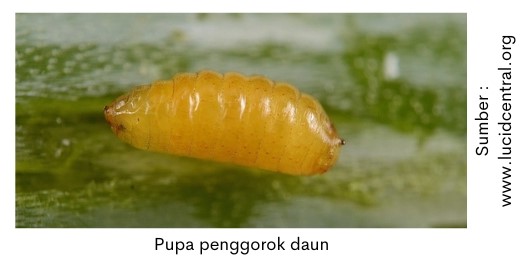
Leaf-slitting pupae are often found attached to the ground or the inside of leaf cavities. The golden yellow to yellowish brown leaf-slitting pupae are 2.5 mm in size. The duration of the pupa phase is 9-12 days and then the pupa comes out to become an adult insect (imago).
4. Imago / Adult Fly
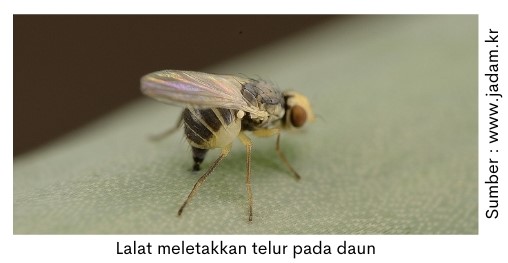
The female adult Imago or fly Liriomyza chinensis has a body length of 2.39 ° 0.02 mm and the male 2.00 ° 0.07 mm (Nawin 2003). The female Imago lives for 6 – 14 days and the male imago 3-9 days. The development of leaf Slaters from egg laying to hatching into larvae and developing into imago ranges from 18-22 days. Egg laying activity by imago generally occurs in the morning.
Symptoms Of Leaf Slicer Infestation
Although the plant seems to thrive onion farmers remain worried about pest attacks in this dry season. Including being aware of leaf slitting pests that can attack plants at any time. Because the pest can attack onion plants and reduce crop yields.
Symptoms of damage by the attack of the leek slicer, namely:
- Holes in the form of white spots due to puncture of the ovipositor for laying eggs.
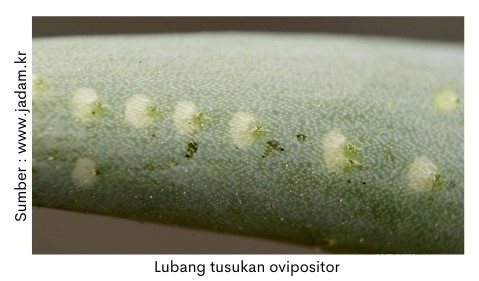
- The newly hatched larvae go directly into the Leaf cavity and then slit the leaves from the inside (on mesophyll tissue).
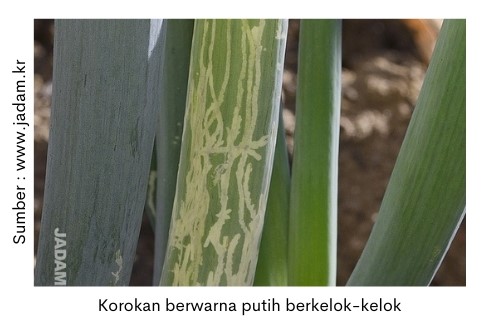
- Korokan winding White from top to bottom to the bulbs.
- In severe infestation, almost the entire leaf blade is full of korokan, so that it becomes dry and brown like a burn
Control Way
Leaf slitting pest control should be done to suppress the development of pests and not the reduction of production. Integrated control activities include observation of pest attacks, decision making, and control actions with regard to safety for humans and the environment. There are various ways to control pests, including technical, mechanical, biological, and chemical culture control (insecticides).
1. Technical culture
Conducting plant cultivation with certain techniques so as to make the conditions of the planting area less suitable for the development of pests.
- Clear the land and its surroundings of weeds and plant residues beforehand. Pests can live on other host plants.
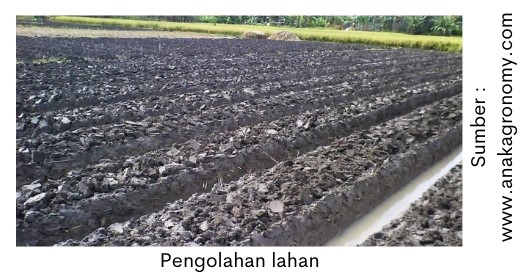
- Intensive tillage by turning the soil can kill larvae and pupae in the soil.
- Plant in unison to limit pest food sources.
- Balanced fertilization, excessive N fertilization can cause plants to become succulent and thin cell walls so easily attacked by pests.
- Crop rotation with non-onion crops to break the life cycle of pests.
2. Mechanical
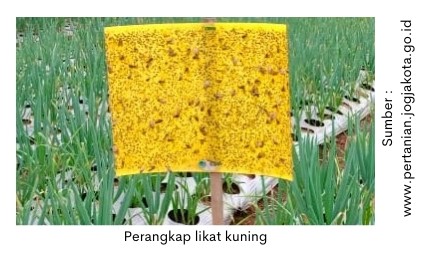
Control by means of pest collection by using yellow viscous. The yellow viscous trap is installed after the onion crop has sprouted. Fruit flies are attracted by bright colors such as yellow, in the presence of glue, the Flies will be trapped and cannot lay their eggs on the leaves. It takes a yellow viscous trap of 40 pieces / ha.
3. Biological / Natural Enemies
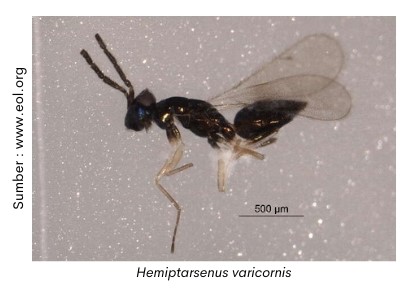
Control using natural enemies of pests, so as to suppress the proliferation of leaf slitting pests. One of the natural enemies of leaf Slaters is Hemiptarsenus varicornis which is a parasitoid of leaf slitter larvae. Intercropping between chickpea and onion plants can increase the population of Hemiptarsenus varicornis.
4. Chemical / Insecticide
Chemical or pesticide control is the most widely used method. The use of pesticides has advantages, among others, the most effective, efficient, practical, and quickly visible control results. However, the use of pesticides needs to be done appropriately. The selection of products used must be appropriate so that the target pests can be controlled effectively.
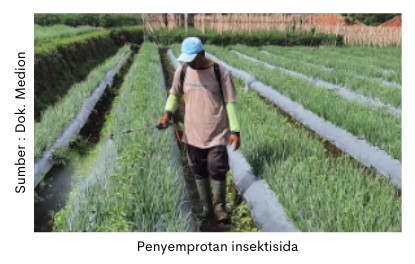
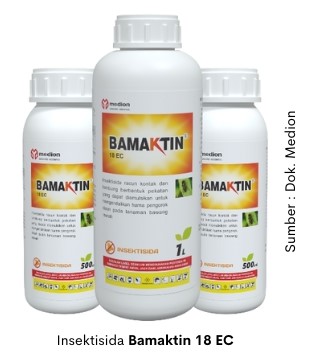
Control of leaf slitting can be using insecticides with active ingredients abamectin, emamectin benzoate, dimethoate,siromazine. Bamaktin 18 EC is one of the insecticides that will soon be launching with the active ingredient abamectin which is effective for controlling leaf slitting in onion plants. Bamaktin 18 EC has a contact, gastric and translaminar mode of action. The workings of translaminar make insecticide active ingredients can penetrate into the Leaf cuticle to the leaf tissue underneath.