As a business, we will definitely try to keep our livestock always healthy. Preventing disease seeds from entering the body of livestock by vaccination is the best way that can be done
It should be our common concern that the success of vaccination is not only determined by the quality of the products we use, but there are other factors that also take an important part, namely the accuracy of vaccination techniques and methods. This review is what we present in the main article of this edition of info Medion.
Chicken Body Fortress
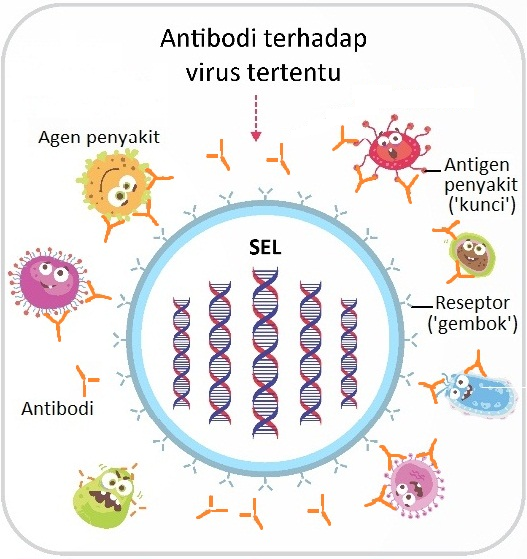
Basically every living thing, including chickens, has a natural defense system in its body. Chickens have 2 Body defense systems, namely primary defense (non-specific) and secondary defense (specific). Primary defense is the defense that first reacts if the seeds of the disease come into contact with the body. This defense is supported by the anatomical structure of the body, and involves physical processes (for example, the movement of vibrating feathers in the respiratory tract, coughing reactions, etc.), chemical (pH regulation and enzymes), and biological (antibodies). While the secondary defense is divided into 2, namely the sedentary immune system played by macrophages, and the mobile immune system (cellular and humoral immunity/antibodies).
If the chicken is sick or shows symptoms of illness, it is a sign that the seeds of the disease have managed to penetrate the chicken fortress. Although outside the chicken body there are still two fortifications such as the farm environment and the environment of the cage, but if the number of seeds that managed to penetrate the previous fort is very much and the level of malignancy is high, then it is possible that the fortress inside the chicken body will lose.
Why is vaccination so important? Vaccination is the act of administering vaccines or controlled artificial infections to stimulate the formation of protective and uniform antibodies, according to the type of vaccine given. Its function is to stimulate the formation of immunity (antibodies) in the body of livestock so as to prevent disease infection. In principle, the vaccination is given first before the occurrence of a field infection.
Currently, the disease has spread to almost all regions, both viral and bacterial diseases. Therefore, preventive measures with this vaccination are very necessary. With various considerations such as :
- Viral diseases cannot be cured by administering drugs.
- Best control by providing immunity to chickens.
- The presence of bacterial diseases that if already attacked difficult to eradicate completely so easily reappear (eg korisa).
- As well as health costs for prevention are cheaper when compared to the cost of treatment/already occurred cases of the disease.
Vaccinations in the field
The discussion about poultry vaccination will indeed be endless, the facts on the ground show that the 4m factor includes material (chicken and vaccines), methods, Mileu/ the environment, and people play an important role in achieving successful vaccination.
Salah satu pendukung keberhasilan vaksinasi tersebut salah satunya yaitu metode vaksinasi, mencakup program dan teknik vaksinasi. Saat terjadinya kegagalan vaksinasi maka perlu kita analisis secara lebih cermat. Seperti ketika munculnya penyakit yang terjadi pada <7 hari post vaccination, the possibility could be due to improper selection of the vaccination application or other errors. Here's the discussion:
1. The implementation of vaccinations does not match the schedule or program created
The accuracy of the vaccination schedule should not be forgotten from this part of the evaluation. Vaccinations that are too frequent or too late are equally at risk. Too frequent frequency of vaccinations can cause stress in chickens. A late vaccination schedule, it is feared that when there is an attack from the field, the body does not yet have antibodies capable of counteracting it. As a result, outbreak it's also inevitable.
2. Preparation and handling of vaccines is not optimal
Sometimes during distribution and temporary storage, the temperature of the vaccine is not at 2-8°C which causes the vaccine to be damaged. Vaccines that are not used cooler box or ice flasks but with plastic or ordinary containers will not be able to maintain the temperature of the vaccine remains in the temperature of 2-8°C.
Process thawing or increasing the temperature of the vaccine gradually becomes a preparatory process before vaccination. If it is not done especially for inactivated vaccines appropriately and the vaccine temperature is still cold, there will be a difference range the temperature between the chicken's body and the temperature of the vaccine is far enough can cause stress due to sudden changes in temperature and the vaccine is not completely absorbed in the chicken's body. After thawingthe vaccine is re-introduced into marina cooler/cooler box with a temperature of 2-8°C can also decrease the potency of the vaccine. Because temperature fluctuations can affect the stability of the virus / vaccine adjuvant.
3. Defective or non-sterile vaccination equipment
The use of syringes, especially needles when injecting vaccinations that are not sterile or rusty, can cause inflammation of the injection site. Other examples of damage spare part syringes such as glass tubes or parts piston rod which is worn out can affect the accuracy / uniformity of the dose received by the chicken.
3. Incorrect dosage
Inappropriate doses of active and inactivated vaccines per tail will trigger non-uniformity of antibody formation, so that cases can occur rolling reaction namely reaction post prolonged vaccination.
4. Vaccination application does not match the target organ
Application of vaccine administration that is not in accordance with the target organ causes the vaccine given is not optimal in stimulating the formation of antibodies. For example, vaccines pox the vaccine contains microorganisms that target the immune system in the skin cells so that the administration must be through a wing prick, but the vaccination is done through drinking water. This will result in the vaccine content will not optimally reach the target immune organs.
5. Poor quality of water or solvent
For example, the pH of acid/alkaline water and hard water will be detrimental, especially for aplikasii via drinking water because it will affect the potential of vaccines in the formation of immunity. Water contaminated with chemicals such as disinfectants or heavy metals will also damage the virus in the vaccine.
6. Hasty and rude vaccination applications
The hasty injection method resulted in the vaccine not exactly 1 dose into the chicken's body, thus affecting the uniformity of the vaccine dose. Fatal consequences that may occur due to the rough way of vaccination include chickens being stressed so that high mortality after injection, twisted necks, abscesses (swelling) of the neck or paralysis of the legs.
Precise application for Optimal results
As discussed earlier, proper vaccination application greatly affects the accuracy of vaccine doses received by chickens so that they can produce protective and uniform antibody titers. Then, what considerations should be considered in determining the vaccination application?
In practice, the determination of the vaccination application can be adjusted to the type of vaccine to be used and the age of the chicken when giving the vaccination. Here's the explanation:
1. Types of vaccines used
Active vaccine preparations are freeze-dried. So that the application or use must be dissolved first using a solvent, can be a buffer solution, plain water (drinking) or aquades (Aqua Destilata sterile). After that, it can be given via eye/nose/mouth drops, drinking water, , or skewer the wings. The active vaccine can also be given by injection. The trick by first dissolved in aquades (Aqua Destilata sterile) in accordance with the recommended dosage. The vaccine of 1000 doses is dissolved in 500 ml of aquades, while the vaccine of 500 doses is dissolved in 250 ml of aquades and so on. While the inactivated vaccine application is only by injection / injection.
2. Chicken age at vaccination
The most commonly used or chosen vaccination method for active vaccines is by mass application through drinking water because it is practical and easy to do. Because this method will be more effective to apply to adult chickens. The amount of drinking water consumption in adult chickens is relatively optimal and vaccine absorption is systemic (circulated through the blood). Vaccination through drinking water can also be an alternative to repeat vaccination.
The first ND and IB vaccinations that are usually given to chicks do better when given via eye/nose drops. It aims to activate the harderian glands (immune organs) in the eye area, so that local immunity is formed in the area of the upper respiratory tract, which is the entrance to the attack of the ND and IB viruses. In addition, so that each chick gets 1 full dose because drinking water consumption has not been evenly distributed.
In determining the dose of active or inactivated vaccine injected can also adjust to the age of the chicken, for example 0.5 ml for adult chickens and 0.2 ml for chicks. Application by subcutaneous injection (under the skin of the back of the neck) in chicks and in adult chickens can be through intramuscular (penetrating the meat muscles of the right chicken breast or thigh muscles) or subcutaneous. Therefore, the age of the chicken can be a consideration in choosing the right and effective vaccination method.
Important things to note
The most important thing to consider when giving vaccinations is:
- The vaccine must be used up within 2 hours for the active vaccine and
- Vaccination is better to do away from heaters.
- Three days before and after vaccination, can be given vitamins such as Vita Stress or immunostimulants from natural ingredients such as Imustim to improve the functioning of the immune system and optimal body resistance.
Related to getting the right and uniform dose, several things must be considered in each vaccination application, including:
1. Eye, nose or mouth drops
Before use, the vaccine needs to be dissolved in a buffer solution to gradually raise the temperature/thawing and awaken infectious agents that are killed in a freeze-dried state.
When dripping the vaccine solution into the eye one drop each, wait until the vaccine really gets into the eye (chickens will blink their eyes many times) just released. If doing nasal drops, close one of the other nostrils at the time of Dripping the vaccine and remove it after the vaccine is inhaled. When using mouth drops, drip one drop of the vaccine solution through the mouth. Make sure until the vaccine is completely in the mouth until the chicken has a swallowing reflex. When vaccination, things to consider are how handling chickens for proper vaccination. Once hold a maximum of 3 chickens during vaccination.
2. Via drinking water
Some things to consider when vaccinating through drinking water, namely:
- Make sure the drinking water used to dissolve the vaccine is free of chlorine, disinfectants, or metals (iron, Ca, Mg, etc.) and has a neutral pH. To it, add Medimilk 10g / 5L or Netrabil 5g / L of drinking water 30 minutes before the vaccine is dissolved to improve the quality of the water, so as to keep the vaccine working well during administration. Stop using disinfectants through drinking water 48 hours before and after vaccination.
- Adjust the amount of drinking water as needed during the time of active vaccine use (2 hours). Estimated drinking water requirements can be seen in Table 2. But this is only as a general guide, drinking water consumption is also influenced by environmental weather conditions.
- Make sure the TMA is clean when vaccinating drinking water. Clean the cone plate and gallon drinker using a dry rag or cloth to minimize dirt from entering. On the use of nipple drinker and Automatic Chicken Drinking Station (TMAO), cleaning of water pipelines should also be considered. Do regular cleaning by flushing the water pipes, especially after or before treatment schedules, giving vitamins, disinfecting drinking water and especially when there is a vaccination schedule.
- In order for the results of vaccination through drinking water to be optimal, vaccination should be carried out in the morning, because it is the peak time for chickens to move and consume drinking water and environmental weather conditions are still relatively comfortable.
- Before being given drinking water containing the vaccine, chickens should first drink fasting for 1-2 hours, depending on the weather. If the conditions of the cage environment is very hot, fasting drink enough for 1 hour.
- Provide a place to drink in sufficient quantities and distribute evenly so that all chickens can drink together. Do not use drinkers from cans. The Operator must control / ensure during the vaccination process so that if the chicken cannot access the chicken drinking place (TMA) then it needs to be helped by getting closer to TMA. If using nipple drinker then make sure the vaccine solution reaches the end nipple and stimulate the chicken to drink by pressing nipple drinker. Put TMA contain the vaccine should be in a shaded place, do not expose to heat and direct sunlight.
3. Vaccination ,
The vaccines in a way , not using a buffer solution as a solvent, the buffer solution is used specifically for vaccination by eye, nose or mouth drops. The water is heated with boiling water (Aqua Destilata Sterile). It is also permissible to use ordinary water, only it must be ensured that the water has good quality, including not containing heavy metals, not hard (contains high levels of Ca, Mg), etc. Also, the water should not be contaminated with chlorine.
The entire contents of the vaccine vial are dissolved in the solvent until well mixed and put inside sprayer carefully. Should sprayer used only for vaccination. All doors and ventilation openings of the enclosure can be closed as well as the fans turned off. The ventilation of the cage is reopened and the fan is turned on again 20 – 30 minutes after the completion of spraying.
Vaccination , which is done on DOC will be more time-saving compared to conventional applications such as drip vaccination. Machine sprayer also usually equipped with automatic counters DOC boxes that have been vaccinated.
Injections/injections (subcutaneous or intramuscular)
- Some things to note are:
- Vaccination with inactivated vaccines, before vaccination should be-thawing by grasping and swiping into both hands until the vaccine does not dew.
- To make sure whether the vaccine is right under the skin or not, you can see the injection marks, then the vaccine injected will appear white under the skin.
- Do not pierce the needle too deeply to prevent the tissue under the muscle from being pierced.
- Vaccination by means of injections should be carried out with caution. Especially when handling chicken, pulling chicken legs, needle inclination angle
Wing stitch
Wing prick vaccination given for smallpox active vaccine/fowl pox or combination vaccination AE and fowl pox. Vaccination is carried out from the inside of the wing. The wings are stretched out and an awl needle is stuck into the thin folded part of the wings. Do not get on the veins, bones and veins of the wings. The vaccine should not touch other parts of the body except the vaccination site. Vaccination is declared successful if there is a lump-shaped inflammation with a diameter of 3-5 mm at the puncture site. These reactions will appear 3-7 days after vaccination and will resolve again in less than 3 weeks.
Vaccination methods that are carried out, especially during the application process, must also be supported by the ability of skilled implementers/operators and good environmental management. Of course it is related to the implementation of good governance and biosecurity strictly.
May be useful. Greetings.