Question from Mr. Rokas
Kediri-East Java
In the administration of antibiotics by injection or injection application for chickens after the first administration there has been no result, when can it be given again?
Answer :
Dear. Mr. Rokas, thank you for the question. Administration of antibiotics should be adjusted to the rules of use listed in the etiquette or leaflet. Based on the length of the effect of antibiotics in the body, antibiotics are divided into two, namely short acting and acting effect.
On antibiotics long acting, the product is specially formulated to produce the effect of slowly releasing the antibiotic at one injection so as to ensure the availability of the drug in the blood remains at the level of treatment over a long period of time. When antibiotics are included in the acting effect then the injection is done only once and if it still does not show results then it can be injected again 3 days later.
However, if antibiotics are included in antibiotics short acting then the administration of antibiotics is at least 3 days in a row. An example of a Medion injection antibiotic for chickens that includes antibiotics short acting among others Tinolin, Vet Strep, Gentamin, Kanamin, Neo Meditrile-I and Medoxy-L. While antibiotics are included in acting effect namely Medoxy-LA.
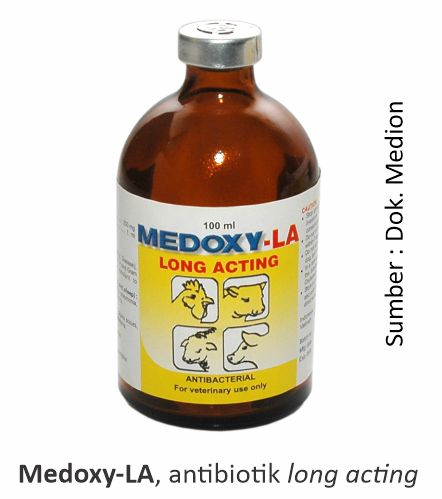
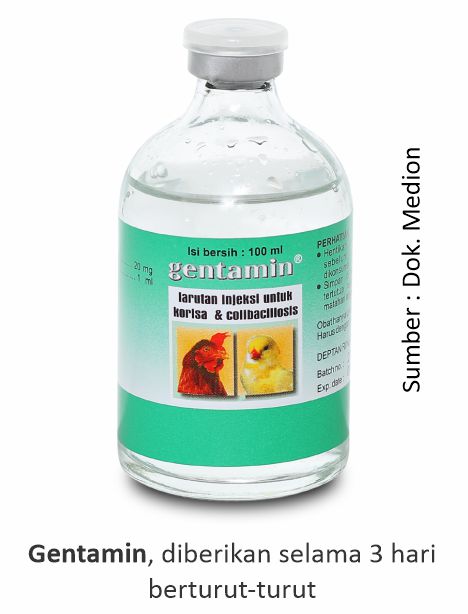
As an example for the treatment of Coryza with the use of antibiotics Gentamin then it can be given at a dose of 0.2–0.25 ml per kg of body weight for 3 consecutive days, if the results of treatment are not optimal then the administration can be continued until the 5th day. For example, to treat snoring chickens or chronic respiratory disease (CRD) using antibiotics Medoxy-LA then it can be administered at a dose of 0.25 ml per kg of body weight. The injection is enough to do 1 time. However, if the disease has lasted a long time or severe enough then the injection can be repeated after 3 days.
Incomplete treatment and improper dosing can lead to antibiotic resistance. Antibiotic resistance is a condition of increased resistance of bacteria to the action of certain antibiotics. As a result, bacteria become insensitive or resistant to one type of antibiotic.
In addition, antibiotic resistance can also be caused by improper selection of antibiotics, the use of antibiotics from the same group used continuously or from the bacteria themselves, for example due to bacteria having genetic mutations, enzymes and receptor changes in the body of the bacteria.
The right solution to overcome this resistance is treatment with the right dose, on time or duration of administration and by rolling antibiotics. Rolling antibiotics is using or giving antibiotics from different groups every interval of 3-4 treatment periods. For example, in the treatment of Coryza with Gentamin of the aminoglycoside group for 4 periods of treatment, then in-rolling with the Neo Meditrile-I from the fluoroquinolone group.
In supporting the success of disease treatment, the use of drugs needs to be supported by factors of cage management and application biosecurity that's good. Things to do include :
- Maintenance management improvements
One of the important predisposing factors (triggers) of the disease is poor maintenance management. For example, colibacillosis, the medium of transmission of this disease is feces, litter and drinking water. It could also be due to contamination of drinking water and equipment, as well as an increase in the population of flies (vector E. Coli infection) so that the cases increase or the treatment remains unsuccessful.
It's good to always pay attention to maintenance management properly. Perform regular stool cleaning at least once a week. Use Ammotrol to help reduce ammonia levels in the cage as well as help with stool drying. - Regular cleaning and disinfection of the cage using Neo Antisep. When there is an outbreak, disinfection can be carried out daily to kill the infectious agents of the disease.
- Perform drain cleaning to prevent growth biofilm (substances in waterways that can trigger bacterial growth).
- Give multivitamins Fortevit/Vita Stress or herbal Imustim to increase endurance and accelerate healing.