In agribusiness, livestock waste is the mainstay of meeting fertilizer needs. The potential waste generated from chicken farming is mainly in the form of chicken feces and unpleasant odors and waste water.
However, due to inadequate management, most of the livestock waste is still the main cause of environmental pollution. Then, what kind of action should be taken? Should it be sold immediately or can it be processed again?
Impact Of Chicken Faecal Waste
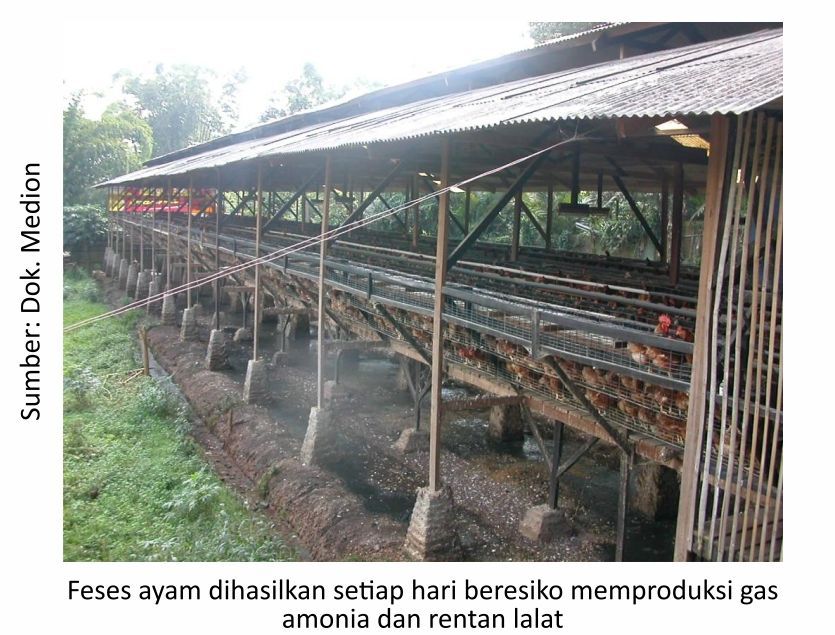
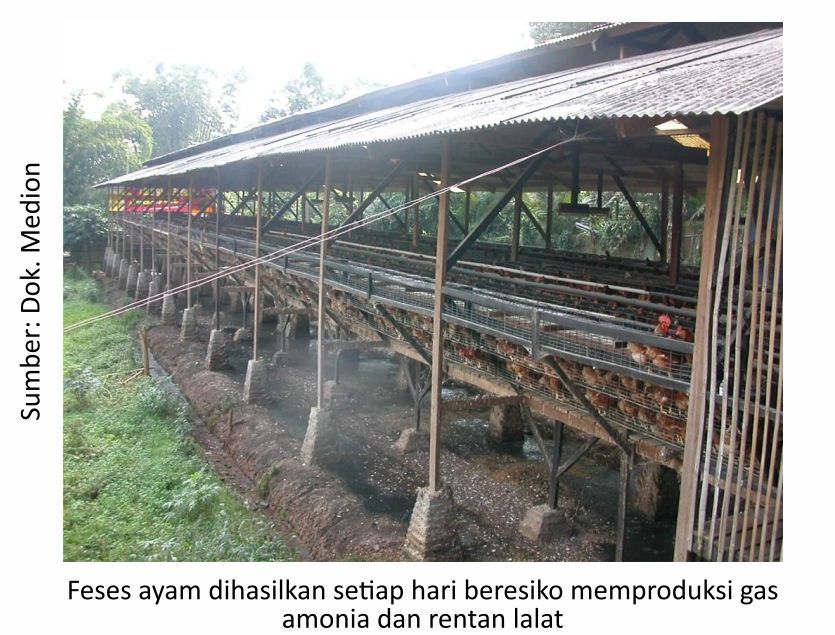
The negative impact caused by chicken farming mainly comes from feces which can cause odorous gases and trigger the arrival of flies. When there is accumulation of feces or storage, decomposition processes occur by microorganisms to form ammonia, nitrate, nitrite and sulfide gases. Gas-gas tersebutlah yang menyebabkan bau (Svensson, 1990; Pauzenga, 1991).
Compounds that cause this odor can be easily formed in anaerobic conditions such as piles of feces that are still wet. These compounds can be smelled easily even in very small concentrations. For ammonia, the lowest detectable level of odor is 5 ppm. At a level of 20 ppm, ammonia can cause ciliostasis (cessation of movement of cilia or vibrating feathers) and desiliosis (Cilia damage), and ultimately damage the respiratory tract mucosa is the first defense gate that chickens have. As a result, chickens are susceptible to respiratory diseases. In humans, ammonia can cause eye irritation as well as respiratory distress.
Some farms are even threatened with closure due to ammonia odor problems that trigger discomfort. The other is that it can trigger a lot of flies to come. On the one hand, in fact, the work of fly larvae is very instrumental in helping the process of decay and decomposition of feces. Even from one of the literature mentioned a number of 20 million fly larvae are able to decompose 1 ton of feces in one day (Rojo, 2011).
But on the other hand, the negative impact will appear when millions of larvae develop and transform into adult flies. Flies in farm the breed, which eventually disrupts the activities of chickens and cage operators causing wet feces and leaving black spots on the cage and poultry eggs (Dewi, 2006). Indirectly increasing cases of disease because flies act as mechanical and biological vectors of several disease seeds such as AI, salmonellosis, coccidiosis, tapeworm, and ND. Presence pulvilli (hairy toenails), labella (suction device) and a number of fine hairs on all parts of the body allows flies to act as a spreader of disease seeds (Levine, 1990).
Handling Of Chicken Faeces Waste
Good handling of livestock feces needs to be done so that it does not cause a pungent odor, feces are still dry and can be used as fertilizer. Some of the things that can be done include:
1. Keeping stools dry
Some things we need to pay attention to so that the stool remains dry and functions optimally include:
a. Addition of new husks
On the farm broiler, when the husk/litter there are already lumps due to feces or wet but there are few of them, then the husks can be sorted and removed from the cage. If you have a lot of wet or clumping husks, it is better to add new husks until the clumping is not visible.
b. Lime use
On chicken farms, lime can be used to clean the floor of the cage, dry, and reduce odors from chicken droppings. The main composition of limestone used is CaCO3 and MgCO3. The use of lime in chicken manure in addition to reducing ammonia contamination into the air, also the resulting fertilizer will contain nitrogen is quite high, because not much nitrogen is lost as ammonia.
c. Fly eradication
The next treatment is the eradication of adult flies by giving insecticides. To get rid of flies that have wandered a lot around piles of feces, insecticides can be used that are applied by the method , (verb) and verb, such as Delatrin and Flytox. It should be noted for the method spraying, when spraying is done carelessly, then not all flies die and over time they will become resistant to the insecticide.
Therefore, it is recommended spraying done in the evening because at that time the flies begin to rest and concentrated on certain places. While in the sow application, pay attention to the location points where ordinary flies perch in the hallway and bottom of the cage, so that the sow medicine can be placed in these locations.
2. Reduce the smell of ammonia in the cage
Breeders can suppress ammonia at the lowest possible level. Some actions that can be implemented to reduce or reduce ammonia levels in the chicken coop, some actions include:
a. Stool cleaning
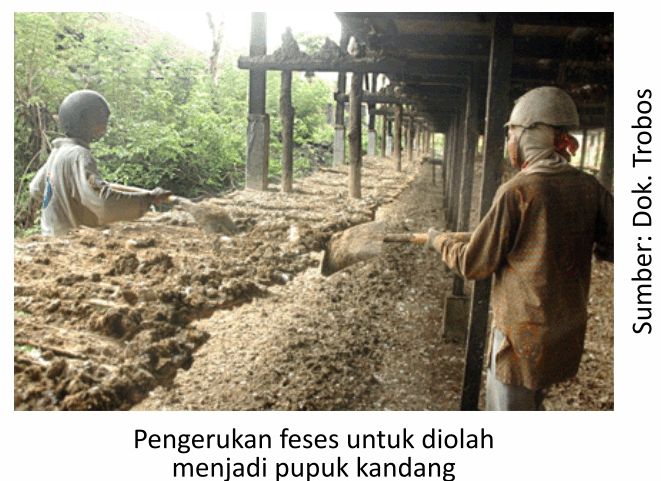
Lifting chicken feces under the cage periodically every 1-3 days. As for the postal cage every 1 Week. Make sure that the removal of feces is carried out in a perfectly clean manner to prevent no fly larvae/pupae remaining. Avoid storing sacks of feces near the cage because over time the fly larvae will develop in it so that one day the farmer must remove the sack of feces to be dried again. In addition, feces stacked under/next to the cage can be a source of disease transmission. In general, dry feces are more profitable for farmers than wet feces. dry feces are easy/light when dredged / cleaned. This will certainly ease the work of cage employees.
b. Use of ammonia binders
To reduce the concentration of ammonia gas that can reduce the quality by giving Ammotrol. Ammonia produced in the digestive tract and in the feces can be well bound so that it does not evaporate and pollute the air of the cage.
Utilization Of Chicken Feces Waste
Chicken feces, has long been used as fertilizer in agriculture. It has been proven that livestock feces are a suitable and good fertilizer for agricultural soil fertility.
1. Waste sieve
Cage feces that have been filtered or sifted, usually have a selling price per sack slightly higher than ordinary cage feces. The selling price ranges from Rp250-300/kg. So the process, coarse chicken feces are ground first and then sieved. the feces of this sieve cage can be directly used as fertilizer by being stocked in rice fields or fields because the structure is smoother.
2. Bokashi fertilizer
The next form of processed chicken fecal waste is bokashi fertilizer. Bokashi fertilizer is fertilizer compost made with way fermentation for about 1 Week. The waste of chicken feces used here should be pure chicken feces/husk content a little and not dried.
Keep in mind, control the fermentation temperature to a maximum of 45oC. When it exceeds this temperature, stir the mixture with a hoe so that the temperature drops. After 1 Week, open the burlap sack and dry the fertilizer for 3-4 days and the bokashi fertilizer is ready for use (epetani.pertanian.go.id). the selling price of bokashi fertilizer is an average of Rp1000 / kg.
3. Biogas
Biogas is formed from the decomposition of animal feces by microorganisms consisting of carbon dioxide (30-40%), hydrogen (1-5%), methane (50-70%), water vapor (0.3%), nitrogen (1-2%), and hydrogen sulfate (sediment). Methane Gas as the largest component can be used for cooking and brooding heater.
Chicken feces are known to have a high content of chemicals that require special attention when made biogas. Apart from that, chicken feces also contain more nitrogen so it can produce more methane gas. The main principle of making biogas is to use airtight biodigester tubes. For technical manufacturing, farmers can consult the relevant agencies, research institutions, or universities in their respective regions.
One of the benefits resulting from this biogas processing is that from one unit of biodigester processing feces derived from 1000 chickens, methane gas will be produced which can replace the use of 3-4 household gas cylinders of 12 kg size. Another benefit is that with this biodigester, the resulting organic fertilizer does not require any further processing, such as fermentation processes and so on. Waste biodigester the resulting is not at all tangible feces again, not smelly, and not hot so favored by farmers.
Ideally, this faecal waste management program is not only applied intra-farm (in one farm), but also includes intern-farm (between farms in one area) so that the control is integrated. For that, there is nothing wrong if you invite cooperation farm other adjacent to equally implement an integrated waste management program. Greetings.