Bapak Imam Rahmat
Kediri-East Java
I am a 2 week old breeder. During the rainy season, the feed consumed by Ducks quickly runs out and scrambles with each other. When I save it by reducing the amount of feed, after 2 days there are 1-2 Ducks look weak and then die one by one. Is this the impact of reduced feed? How is the solution handling?
Answer:
Dear. Father Faith, thank you for the question. In general, the reduction in the amount of feeding in Ducks can be one of the non-infectious factors that cause death. Especially if the reduction is quite drastic and far below the standards set so that Ducks who are accustomed to eating a lot will compete with each other for feed. It should be noted also that the Ducks, especially local ducks have the nature of stress to sudden changes in feed from the aspect of quality and quantity. Reduction of feed will cause stress in ducks and can result in decreased appetite and weakness. Lack of nutrients, especially vitamins and minerals such as vitamin A and D due to lack of feed intake can also cause growth disorders and decreased endurance.
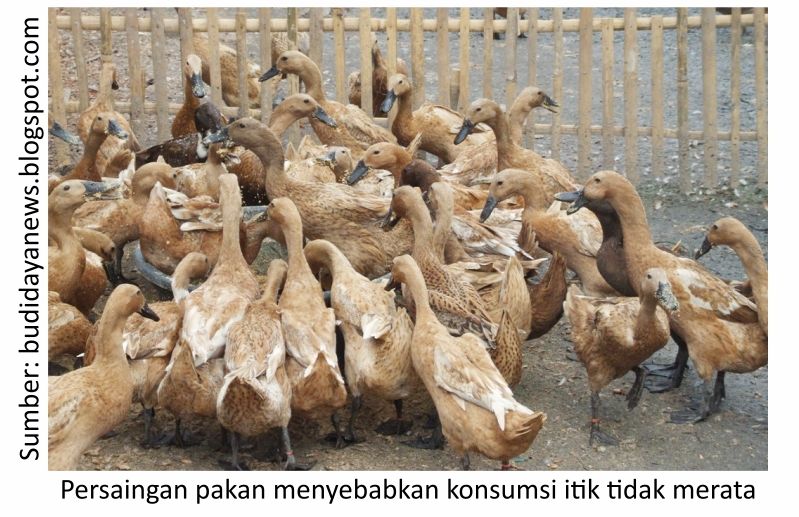
Death due to feed reduction does not occur immediately, usually marked first by lethargy, weakness, and empty cache because they do not get feed. To ensure the death of ducks it is good to do carcass surgery also to find out if there are diseases that attack to cause death.
Another non-infectious factor that can also be the cause of Duck Death is less than optimal cage management. Comfortable cages for ducks have a temperature of about 27-32°C with an air humidity of 60-65% (AgriFlo, 2012). If the cage conditions are comfortable for ducks, growth and productivity will be optimal.
If the consumption of feed or body weight in laying Ducks has exceeded the target, a good way to control feed is to withhold feed by not adding to the consumption/weight in accordance with the target. This is to give the digestive tract a chance to adapt so that there are no sudden changes in metabolism that can result in weakness and decreased appetite in Ducks. Meanwhile, to control the appetite of ducks can follow some of the following suggestions :
- First determine the target consumption or body weight that will be achieved in the following week. Each type of Duck has a specific target feed needs and body weight and become a reference for the success of maintenance.
- Set a daily consumption target for the week. Daily consumption can be withheld by not making additions with the condition that tomorrow's feed is equal to or more than today's feed (do not reduce).
- Do not reduce the feedstock, provide feedstock in accordance with the population and density of ducks
- Ducks can be made into small colonies to reduce the nature of competition or feed competition, a maximum of 30 heads/colony
Things you need to do to improve duck feed consumption patterns and prevent deaths from recurring, including:
- Feed control according to the standard so that feed intake and the weight of the duck is achieved so that the growth of the duck remains optimal. As has been explained that the body weight of the laying duck that has exceeded the target can be controlled by means of feed detention. The addition of feed does not need to be done until the consumption/weight is in accordance with the target. Examples of feeding standards for laying Ducks aged 0-8 weeks are as follows:
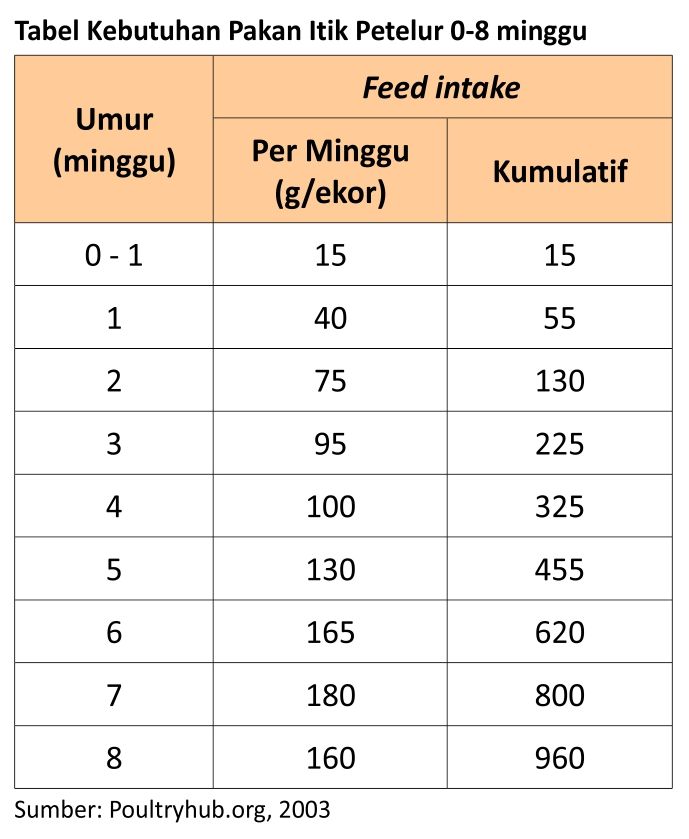
- Adjust the density in the cage. If the area of the cage is given more freely, it can guarantee that all Ducks get feed, drinking water, movement space and oxygen evenly. The standard density of ducks in cages is the age of 0-4 weeks about 20-25 heads/m2, age 5-8 weeks about 10-15 heads/m2, age 8-20 weeks about 7-8 heads/m2 and above the age of 20 weeks around 3-5 tail / m2.
- Multivitamins such as Vita Stress, Aminovit or Fortevit role to increase stamina and endurance. In addition to this, you can also add other ingredients (Mineral Feed Supplement A) and multivitamins (Egg Stimulant, Strong Egg or Turbo).