Bapak Wahyu Nugroho
Yogyakarta
How to prevent overheating (over heating) in a closed cage (closed house) chicken broiler?
Answer :
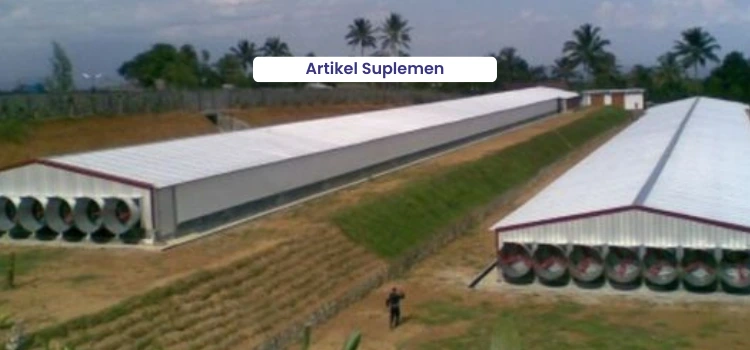
Dear. Mr. Wahyu, thank you for the question. Closed system enclosure or closed house is a cage system that is able to remove excess heat, excess water vapor, gases CO, CO2 dan NH3 which is in the cage, but still can provide oxygen for chickens.
Cage closed house it's too hot (over heating) influenced by setting temperature, humidity, and wind speed (wind chill).
- Settincheck the conformity between the tool and reality and also the flatness of the temperature distribution.
- HumidityHigh humidity will cause a high effective temperature (the temperature that the chicken's body feels).
- Wind speedthe wind flow that is too slow or too fast can be caused by uneven wind flow.The explanation is as follows :- Wind flow conditions are too slowGenerally, the wind flow conditions are too slow found on the left and right sides of the cage where in this area the wind flow is very slow so that the litter does not dry quickly, is easily damp, and the ammonia content is quite high.- Too fast wind flow conditionsIf the wind speed is too strong, it can be seen from the wind flow that focuses to litter/ husk so that ammonia and dust easily scatter in the cage.
Symptoms over heating generally occurs at the age of 21 days and over, when the chicken's body broiler it's getting bigger and producing its own heat. Different ages of chickens require different temperatures and tolerances to different wind speeds (eg DOC = still air, 1 Week = 0.5-1 meter / second).
It's a great way to warm up your body (wind chill) the speed of the wind (wind speed). Wind speed in the cage is influenced by many factors including :
- Fan : capacity, tightness belt, hygiene blade, motor engine power that decreases with age, uniformity between fans.
- Cage density: check for perforated side curtains or other holes (ceilings, building connections) in the cage that cause air to enter through the hole, not through inlet (cooling pad) on the front of the cage.
The mismatch of the two things above can cause turbulence so that the air flow and wind speed in the cage is not optimal. Airflow velocity in the enclosure closed house can be measured , conducted via wind meter.
Maximum wind speed in the cage is 3 meters / SEC. The higher the wind speed, the greater the effect of lowering the temperature felt by the chicken's body. The negative impact of high wind speed is to fly the dust from the base of the cage which triggers breathing disorders due to dirty air coming from dust. In addition, sthe effective temperature felt by chickens that is too low will result in reduced consumption of chicken feed. This condition can cause feed intake not achieved.
The wind speed is also affected by the cage curtain. Curtain cage on the cage closed house cover all sides of the cage so that the chickens are protected and to maintain the air temperature in the cage. This curtain will prevent direct wind exposure to the chicken's body.
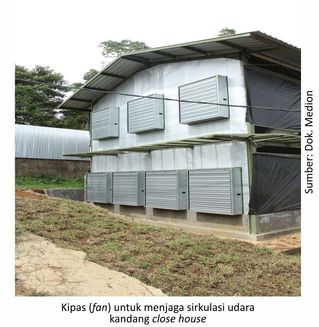
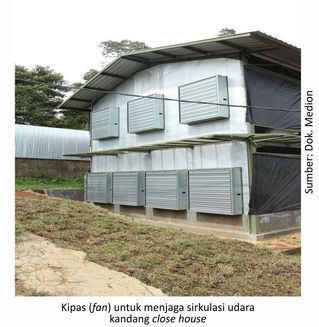
On the cage closed house, the ventilation and air circulation settings are regulated by the fan (fan). Fanfan) function mrelease hot air from the cage and create gusts of wind into the cage closed house.