Mr. Budiman – By Email
Molting occurs on my layer farm, especially in older chickens. Why does this happen, and is it a natural process or can it be manipulated? What impact does it have on chicken performance? Thank you.
Answer:
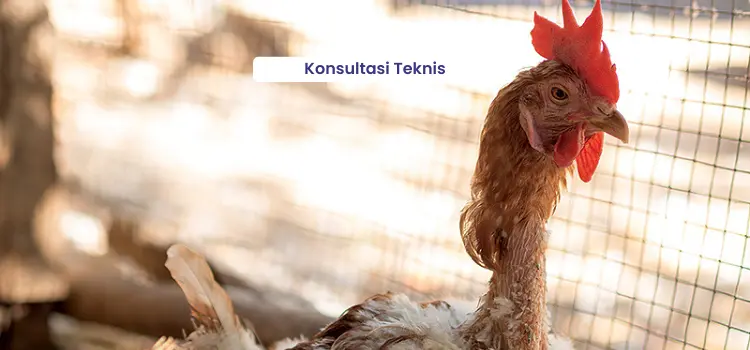
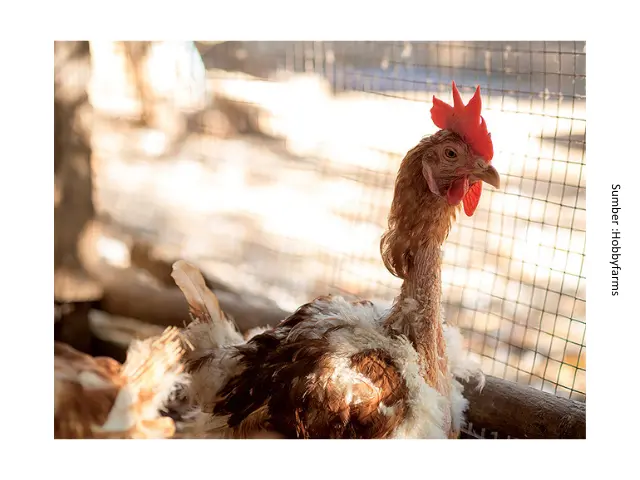
Thank you, Mr. Budiman, for your question. Molting, or feather loss, is a physiological process in chickens influenced by changes in hormone levels such as prolactin, gonadotropins, thyroxine, and ovarian steroid hormones. Naturally, feather loss occurs at the end of the egg-laying period due to increased prolactin levels in the chicken's body. High prolactin levels can inhibit the pituitary gland, thus decreasing the production of gonadotropin hormones, namely Follicle-Stimulating Hormone (FSH) and Luteinizing Hormone (LH), and preventing ovulation. As a result, egg production stops, and at the same time, the feather change process takes place. This process is common naturally in chickens that have been in production for a long time (approximately 90 weeks) and can last up to 4 months, although it can be shortened. However, feather loss can also occur in the early stages of production as a sign of severe stress in the chicken.
Molting in chickens is essentially a series of sequential feather replacement processes, starting from the head, then continuing to the neck, chest, back, wings, and tail. Wing feather loss does not occur simultaneously. The first feathers to fall out are the primary feathers located near the axial feathers, followed by the other feathers in sequence (Suprijatna et al., 2005). The primary purpose of molting is to give the chicken a rest period to restore its body condition to the initial egg-laying phase, while rejuvenating the ovarian and oviductal tissues.
Although it can occur naturally, some breeders implement forced molting. The development of forced molting methods is an effort to overcome various limitations of natural molting through targeted interventions in the poultry physiological cycle to increase egg productivity (Huo et al., 2020). This approach is implemented by inducing certain physiological stress conditions in a controlled manner, through regulating important factors such as the rearing environment, feed composition, lighting, and water availability (Attia et al., 1994; Bozkurt et al., 2016). Based on the method, forced molting is generally divided into two: fasting molting and non-fasting molting. Both are developed to ensure a uniform feather loss process within each flock and to speed up the molting duration. Here's an explanation:
– Fasting Molting
This is a conventional method applied based on the principle of fasting chickens for a specified period (Swanson and Bell, 1974b; Rolon et al., 1993), or until they reach a target body weight (BW) (Brake and Carey, 1983), with or without water restriction. This method is widely used due to its simplicity and practicality, as well as its satisfactory post-molting performance. Withholding feed, whether long-term or short-term, generally results in a 25% to 30% reduction in body weight. However, this practice can trigger severe stress in chickens, which then results in a weakened immune system and increased mortality rates. Furthermore, this condition also increases the chickens' susceptibility to Salmonella sp. infection (Ga et al., 2022). Therefore, the implementation of forced molting through the temporary withdrawal of feed and water has become a focus in the poultry industry, particularly with regard to animal welfare and food safety. The ideal molting method should be implemented with an approach that maintains animal health and well-being, without requiring fasting or causing excessive stress.
– Non-fasting Molting
This is an alternative method developed to induce molting in laying hens. This method applies the principle of not stopping feeding but rather modifying the nutrient content of the feed to create a specific nutritional imbalance, such as feed low in nutrients (protein, energy, Ca, and Na), feed high in Zn, and feed with high wheat content. Non-fasting molting is considered a good method to develop, this is because it causes less stress and produces good results. Referring to the Hy-Line Non-Fasting Molt Recommendation, the implementation of non-fasting molting follows a program divided before and during molting, with feed nutrient management.
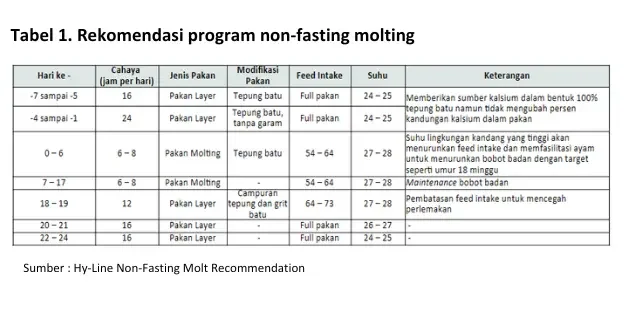
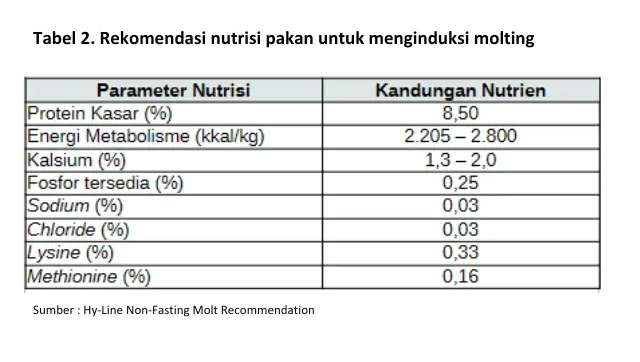
A decrease in nutritional content, such as protein and energy, will result in the chicken's needs for both basic survival and production not being met. This will result in drastic weight loss and further cessation of egg production. In addition to modifying the nutritional content (protein, energy, Ca, P, Na, and Cl), one option is to increase the Zn content in the feed.
Ga et al., (2022), in their research by increasing the Zn content in feed showed optimal results as an alternative method to induce molting. The results showed that the group given feed with +ZnO was more effective in triggering molting and increasing %HD and post-molting shell strength compared to the group given a special molting feed and wheat bran-based feed. The effect of Zn occurs quickly, where high levels of this mineral reduce feed palatability, resulting in decreased feed consumption, resembling a condition of complete feed withdrawal. Furthermore, high levels of Zn in feed can cause follicular atresia, which can then lead to cessation of egg production by disrupting the ovulation process in laying hens.
Impact Molting for Chicken
Some positive effects of molting on laying hens:
1. Increase egg production
During molting, follicles decrease significantly, with the majority undergoing atrophy and degeneration. This causes the hen to stop producing eggs and allows time for tissue repair. After molting, appropriate feeding will result in an increase in the number of primary follicles in the ovarian tissue, accompanied by a denser overall tissue structure. This allows the hen to lay eggs normally again.2. Improve lipid levels and ovarian function
Lipid content in laying hens decreases significantly after molting. Subsequently, during the recovery phase, serum lipid levels gradually increase, likely related to increased egg production. Triglycerides play a crucial role in providing energy to the body. Maintaining adequate triglyceride levels is essential for ovarian cells to obtain sufficient energy to support normal ovarian tissue function (Liu et al., 2024).
Smart Steps During Molting
In carrying out this program there are several things that must be prepared, including:
a) During force molting
- Make sure drinking water is always available.
- Provide multivitamins and amino acids to keep chickens healthy and in top condition to reduce mortality. Vita Stress during the molting process to help increase the stamina of the chicken's body and reduce the effects of stress caused.
b) After force molting
- After the forced molting program ends (more than 10 days), the chickens can be fed complete feed in normal portions. Their body weight will gradually increase again.
- To accelerate feather formation, you can give supplements containing amino acids, vitamins B complex, A, D, E and several important minerals. Aminovit, Strong Egg orMineral Feed Supplement A From the 11th day until the chicken enters the second culling period, it is known to accelerate feather formation, reduce the effects of stress experienced by the chicken, and accelerate the production of eggs with better quality.
- Sanitation of drinking places and rations is carried out by washing drinking places and rations and disinfecting them (Medisep) every day.
- Control the weight and try to ensure that the chicken is not too thin or too fat due to overeating.