The health of the digestive tract is very influential on the growth performance and productivity of chickens. The health condition of the gastrointestinal tract will later affect the process of digestion of the ration and absorption of nutrients. How important is it for us to pay attention to the digestive health of chickens? What will happen if the digestive tract of chickens is impaired? Here we will describe a discussion about the importance of maintaining the digestive health of chickens in order to achieve optimal productivity.
The Importance Of Maintaining A Healthy Digestive Tract
Digestive tract health and nutrition will later be related to each other. As we already know that the digestive tract is the organs that play a role in receiving rations, digesting, absorbing nutrients from rations, and removing the rest of the unabsorbed rations. The nutrient utilization of such rations can only be optimally achieved if the gastrointestinal tract is in good health.
The optimum condition of the gastrointestinal tract can be described as the intact state of its structure and function or simply the maximum condition of the digestive tract function in digesting and absorbing ration nutrients. It is the management and formulation of rations that can affect the effect of the work of the gastrointestinal tract. Some parameters that can be used to assess the proper functioning of the digestive tract of chickens:
- Good digestibility and absorption of dietary nutrients
- Minimal fecal odor
- Very low incidence of illness or mortality due to digestive disturbances
- Feed Convertion Ratio (FCR) (in line with standards)
Not only as a place of nutrient absorption, but the digestive tract needs to be considered for its health in maintaining the network working system gut-associated lymphoid tissue or GALT. The digestive tract along the small intestine and large intestine contains lymphoid tissue scattered within the epithelium, lamina propria, or in the form of plates peyer’s patches. GALT is part of the lymphoid tissue that functions as a site for mucosal immune responses to produce antibodies and receive mucosal immune response stimuli (Marsetyawan, 1993).
Overview Of The Chicken Digestive Tract
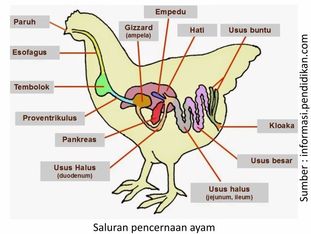
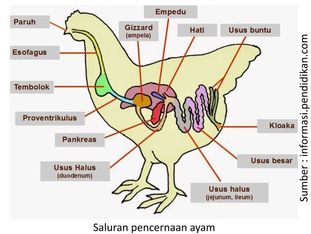
The digestive tract system in chickens starts from the beak and ends in the cloaca. Organs associated with the digestive system include the beak, esophagus, Gizzard (crop), proventriculus, Gizzard (gizzard), small intestine, appendix, colon, and cloaca. Other vital organs associated with the functioning of the digestive system are the liver and pancreas.
Each of these organs is inhabited naturally by a microflora consisting of bacteria, protozoa and fungi. But the part that is most inhabited by several types of bacteria is the intestinal tract. Healthy birds in general have a well-functioning intestinal tract characteristic. It is also fundamental in improving the efficiency of rations for basic needs and production. The most important characteristic of a well-functioning gut is the balance of the bacterial population in it. This balance is closely related to the intestinal tract when livestock are treated under stressful conditions such as bacterial infections, high ambient temperatures, ration turnover, and transportation (Genie et al, 1997).
The work of the digestive tract system in poultry breaks down the ration consumed into the most basic components (basic components) i.e. mechanically and chemically. The most important component (basic components) of the subsequent ration is absorbed (absorption) by the villi on the intestinal wall.
Poultry has a greater number of intestinal villi with a high ability to regenerate epithelial cells (48 to 96 hours), and a very rapid response to the presence of inflammation. This also makes poultry more sensitive to digestive tract dysfunction in the capacity of absorbing ration nutrients.
Some of the criteria for a healthy poultry digestive tract are long intestinal villi and the integrity of the digestive tract. Intestinal villi are finger-like formations in all parts of the intestine that function to absorb food juices (nutrients) that extend from the bottom of the intestine towards the lumen (cavity) of the intestine where food is digested and absorbed from there. In principle, the longer and/or wider villi will increase the area of nutrient absorption in the intestine so that the absorption of nutrients is more optimal.
Factors Causing Digestive Health Disorders
Many factors affect digestive health and performance in poultry including:
1. Primary immune system disorders in digestion
Damage to the intestinal mucosal tissue will cause the process of digestion and absorption of nutrients is not optimal. As a result, there is a nutritional deficiency so that the formation of antibodies is disturbed. The intestinal mucosa and caeca tonsil is part of the local immune system in the gastrointestinal tract. Damage to these two organs resulted in chickens more susceptible to infection with other diseases. Along the intestinal mucosal tissue there is antibody-producing lymphoid tissue (IgA), where the IgA will accumulate in the blood. Damage to the intestinal mucosa will result in the release of plasma and red blood cells so that the levels of IgA, as a defense in the surface layer of the intestine also decreased.
2. Presence of fungi and mycotoxin levels
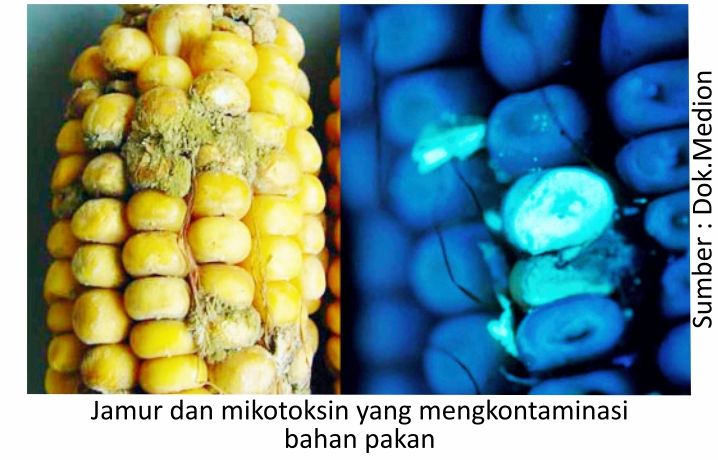
What is sometimes not observed is the frequent presence of fungi in the ration. Mushrooms in the ration can reduce nutrients so that the absorption of nutrients by chickens is not optimal. Mycotoxins produced from fungi will also irritate the digestive tract such as irritating gizzard- gizzards on chicken.
3. Ration and drinking water quality
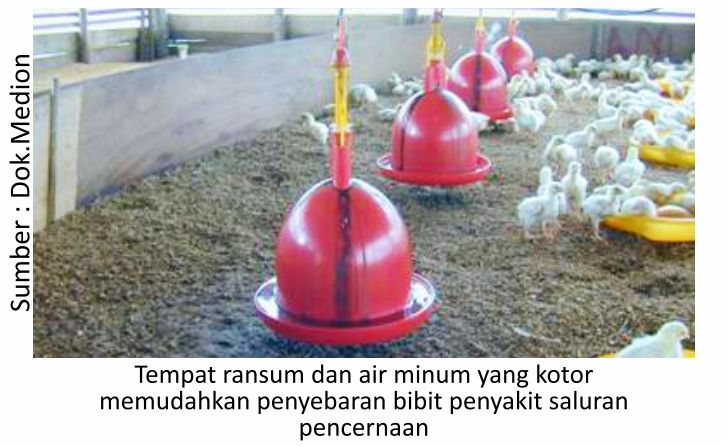
Imbalance of nutrients and non-compliance with the quality of the ration can affect the process of reception in the digestive tract so that it can damage certain organs. The digestive tract is very sensitive to high crude fiber and anti-nutrients or protein content that is too high causes excess uric acid levels followed by ammonia production. Vitamin A deficiency can also interfere with digestion in the chicken body due to a decrease in the work of the esophagus, gizzards and kidneys. In addition, bacterial contamination of the ration and/or drinking water can spread into the chicken's body and cause the chicken to develop gastrointestinal diseases.
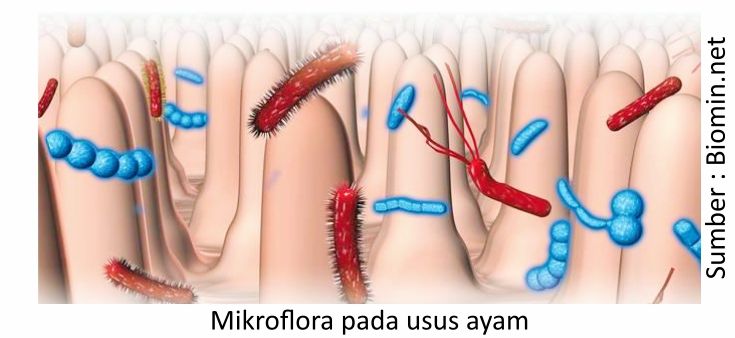
4. Balance of intestinal microflora
The balance of microflora or bacteria that are naturally present in the intestines is essentially dynamic, depending on the condition of the intestines. In a balanced state, the microflora provides benefits to the host. However, if this balance is disrupted, it can affect the morphology of the digestive tract, lead to the emergence of bacterial infections in the digestive system, and even damage the immune system of chickens. Bacteria that are normally present in the digestive tract of chickens can also cause infections, such as bacteria C. perfringens (causes of NE disease) when chickens are in poor condition and supported by uncomfortable environmental conditions, then outbreak NE can occur. This is triggered by the declining condition of the chicken's body, while the concentration of bacteria continues to increase. High concentrations of bacteria in the intestines can be excreted through feces and can also infect other chickens. These bacteria can cause inflammation and destruction of the intestinal lining. In addition, the bacteria will also produce toxins that can interfere with the absorption of nutrients by the intestines and cause increased intestinal peristalsis, which ultimately leads to symptoms of diarrhea.
5. Chickens experience stress
Stress in chickens is a normal physiological reaction in order to adapt to the situation and the treatment received by chickens. Examples such as cages that are too dense, temperatures that are too high, or sudden changes in rations. In stressful conditions, in the chicken's body there will be an increase in the production of corticosteroid hormones that can inhibit the immune organs in producing antibodies. This will trigger immunosuppressive effects that have an impact on chickens susceptible to disease, especially gastrointestinal diseases.
6. Lack of sanitation of the cage
Seeing the weather conditions that often change drastically at this time, the condition of the chicken's body tends to decrease due to stress and the body's defenses become not optimal so that the greater the chance of disease. The rainy season that still occurs in a volatile manner also indirectly affect the spread of the seeds of digestive tract diseases. Litter a damp and wet environment is a good medium for the growth of disease-causing microorganisms.
7. Challenges of digestive diseases
The challenge of disease in a very high field will affect the length of the intestinal villi so that the absorption of nutrients will be disrupted. Here are some bacterial and parasitic diseases that have an impact on digestive disorders:
a) Necrotic Enteritis (NE)
Based on data collected by Technical Education and Consultation Medion (2017), NE cases often attack broilers aged 3-4 weeks, and in laying hens aged 3-8 months. Necrotic Enteritis it is a disease caused by Clostridium perfringens types A and C. This bacterium can cause tissue damage (necrosis) of the intestinal mucosa to death because it produces toxins (toxins) that can spread throughout the body. Alpha toxins are produced by Clostridium perfringens Type A. Alpha and beta toxins are produced by Clostridium perfringens Type C. It is this toxin that can cause necrosis of the intestinal mucosa.
Bacteria Clostridium sp. it is widely found in soil and water, but normally, in the intestines of healthy chickens, there are bacteria Clostridium sp. in a safe amount (does not cause the occurrence of outbreak diseases, red). When the condition of chickens is bad and supported by uncomfortable environmental conditions (the challenges of many disease agents, red) then outbreak NE may occur.
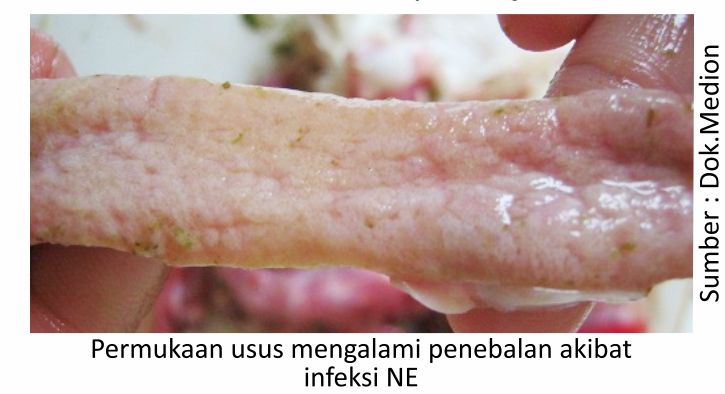
Some of the factors that trigger the occurrence of NE are unhygienic environments such as litter damp/wet, stress, weather changes, and the presence of secondary infections (coccidiosis, inclusion body hepatitis, Gumboro). The appearance of NE cases is usually triggered by an attack of coccidosis. Coccidiosis is a parasitic disease caused by protozoa (single-celled) of the genus Eimeria sp. When coccidiosis attacks, there will be bleeding and damage to the ileum (small intestine) tissue and increased decomposition of body water so that a lot of oxygen is produced. Damage to the intestine by coccidiosis, causing the intestine can not work to absorb nutrients resulting in the accumulation of nutrients in the intestine. The nutrients are then utilized by the bacteria Clostridium perfringens to breed.
Changes in the viscosity of the intestinal contents can also provoke the occurrence of NE. Such changes in viscosity are caused by the introduction of rations with too high a protein and energy content or sudden changes in the content of the ration.
B) coccidiosis
Coccidiosis in poultry caused by parasites Eimeria sp. There are 7 species Eimeria sp. what causes pain in chickens, namely E. tenella, E. maxima, E. necratix, E. Acervulina, E. Brunetti, E. Mitis, and E. Praecox. Each species Eimeria having a certain predilection (favorite place) in the intestines of chickens, so the wounds caused will also be different. For example E. acervulina attack the small intestine of chicken and not to cause bleeding, because the injured only the surface (epithelium) of the intestine only.
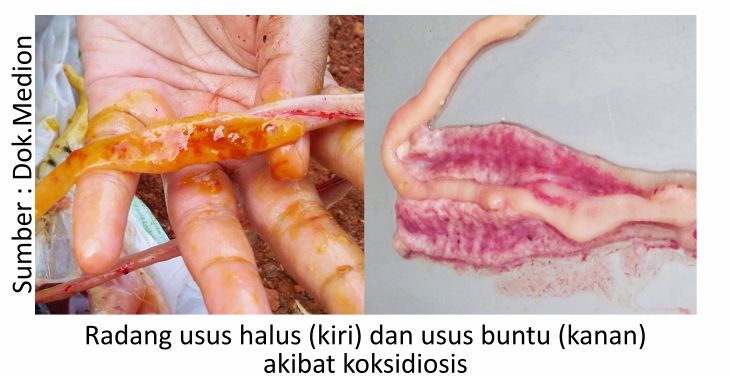
On species Eimeria others can infect the inner lining (endothelium) of the intestine where there are capillaries/blood vessel walls, causing bleeding. Cases of death from coccidiosis are more common in infected chickens E. tenella, because bleeding in the appendix causes anemia and then followed by death. Based on data collected by Technical Education and Consultation Medion (2017), cases of coccidiosis often attack at 3-4 weeks of age in broilers and > 5 weeks of age in laying hens.
c) Colibacillosis
The cause is bacteria Escherichia coli (E.bra). Bacteria E. Coli infection is a normal bacteria living in the digestive tract of chickens and from all over E.bra of those found, about 10-15% are potentially pathogenic. When viewed from the age of attack, in broilers, colibacillosis often attacks at the age of 3-4 weeks. In the 4-8-year-old (Technical Education and Consultation Medion, 2017).
Bacteria E. Coli infection high concentration in the small intestine about 106 E. Coli infection- Gramm. The bacteria spread and contaminate the dust, litter, and drinking water. One of the clinical symptoms of infection E. Coli infection in chickens, what can be observed is the presence of yellow diarrhea. Clinical symptoms are also followed by changes in Anatomical Pathology, where the colibacillosis form of diarrhea found intestinal inflammation (enteritis), while in coligranuloma the presence of granulomas (humpbacks) on the liver, cecum, duodenum and intestinal hangers was found.
From the data collected by the team Technical Education and Consultation Medion (2017), it is known that the disease colibacillosis and coccidiosis still often strikes on farms. Most cases of such gastrointestinal diseases are opportunistic. This means that normally disease-causing microorganisms are present in the intestine in controlled amounts, but when the condition of the chicken decreases due to stress etc., the microorganism earlier could develop into a pathogen.
How To Maintain The Digestive Health Of Chickens?
To obtain cost effectiveness and growth optimization of chickens raised, with regard to the function of the gastrointestinal tract, it is necessary to do:
- Maintaining the health of the digestive tract (intestine) through the provision and provision of rations with proper nutritional value/nutrition.
- Reduce the population of seed diseases around chickens. In reducing the seeds of diseases that exist around the chicken, the steps that can be taken include:
- Clean the coop. Coop cleanliness has a huge impact on chicken health and performance. When the coop is clean, the concentration of disease pathogens will decrease, thereby reducing disease challenges and keeping chickens free from digestive diseases.
- After cleaning, continue with liming. Liming the coop is necessary to reduce disease pathogens, one of which is coccidia, the cause of coccidiosis.
- A minimum rest period of 2 weeks is calculated after the cage has been cleaned and disinfected. This is to break the disease cycle.
- Disinfect empty cages with Sporades or Formades. Three days before chicks in, spray the cage and its equipment, including the feed and water containers, again using Medisep.
- Drinking water quality benchmarks include physical (clear, colorless and odorless), chemical (pH neutral and not hard) and biological (free from contamination E. Coli infection, Salmonella sp. or other disease-causing microorganisms). Sanitize drinking water (Desinsep) if the water source is positively contaminated E. Coli infection and other bacteria. Don't forget to always keep drinking areas clean from contamination such as feces and litter.
- Do monitor on feed consumption. In addition, periodically rotate the feed to increase appetite.
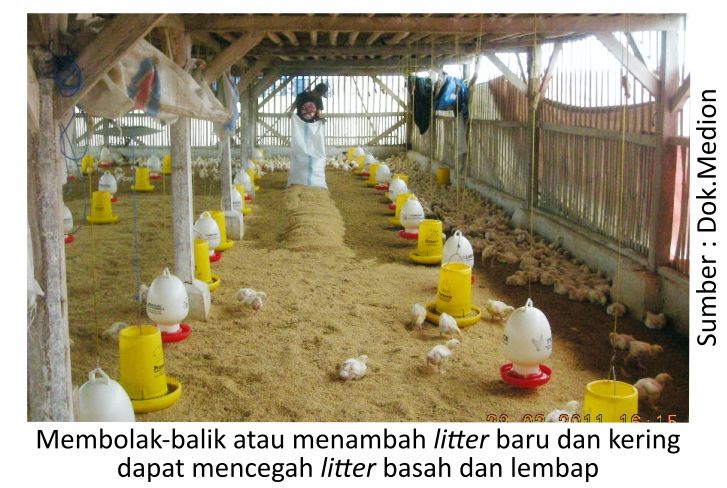
- Pay attention to temperature, humidity, ventilation, cage density, and quality. litter or husks, especially during the rainy season like now. In management litter, flip it over litter to prevent litter wet. Replace immediately litter the wet and clumping. If the number of agglomerates is small, then it can be sorted out and removed from the cage.
- In order to improve the health of the body and maintain digestive health can be given a multivitamin (Vita Stress(a) an anti-inflammatory and anti-inflammatory agent (Imustim) that can improve immunity and endurance.
Herbs in maintaining the digestive tract of chickens
Since ancient times, herbs have been used as a health potion, both for humans and livestock. Not only used as a supplement, herbal plants are also efficacious for healing diseases.
To produce quality herbal products, it takes a selected and standardized herbal plant sources that are processed in accordance with the way of making good herbal medicine (CPOHB). In addition, clinical testing is needed to prove the efficacy of these herbal products.
Fithera represents Medion herbs developed specifically to help cure bacterial infections (CRD, Korisa and Colibacillosis (dyspnea, heart and liver covered by fibrin)) and coccidiosis in poultry. Other advantages, Fithera it is safe to use on poultry and does not produce residues in livestock products (meat and eggs).
Herbal ingredients in the product Fithera proven to work as an antibacterial that works by killing bacterial cells through contact with the cell wall so that pores form on the bacterial cell wall. This results in the death of bacterial cells. Not only that, Fithera also works as an antiprotozoan in the asexual phase Eimeria, that is, by forming a layer on the intestinal villi so that the sporozoites are prevented from infecting intestinal cells and inhibiting the multiplication process (cell multiplication) Eimeria.
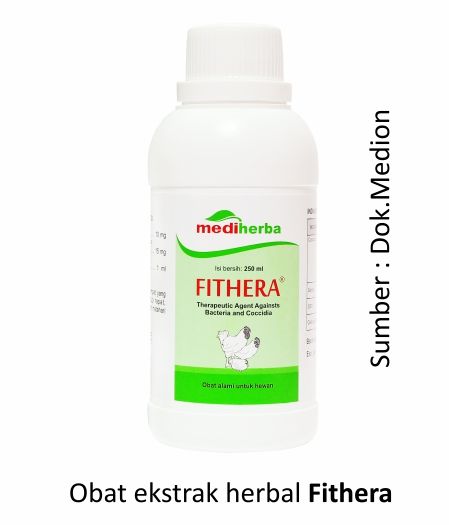
As cleaning program, Fithera can be given to the DOC after chick in and / or 7 days before the age of disease attack (coccidiosis, Korisa, CRD, and Colibacillosis (dyspnea, heart and liver covered by fibrin)) adapted to the age history of attacks. For treatment, Fithera should be given 7 days in a row when infected with bacteria and protozoa to work optimally.
To maximize working power Fithera, its use should not be mixed with disinfectants or chlorine. Water containing disinfectants or chlorine must still be settled 6 hours before use to mix drugs, vitamins, and Fithera.
Cases of indigestion in chickens can be caused by various factors, such as the presence of bacterial or parasitic disease infections. Therefore, Health Management and maintenance measures are also needed to control cases of disruption so that more losses do not arise.
May be useful. Greetings.