Sdri. Nadia Marva – by email
One way to optimize feed quality is to pay attention to the feed mixing process. What factors influence in feed mixing? Thank you.
Answer:
Thank you for the submitted question. Mixing is an activity that aims to obtain a homogeneous mixture of two or more raw materials. The quality of the homogeneous mortar determines the quality of the resulting feed. The result of homogeneous mixing will improve the performance of livestock. Factors that affect the process of mixing feed include :
Raw material size
In the process of mixing raw materials, the particle size must be uniform so that it can be mixed homogeneously. Particle size of raw materials can affect the level of homogeneity either mixed manually or using mixer. Raw materials in the form of grains, as well as other raw materials in the form of chunks, are milled in advance so that the particle size is uniform. The critical point in the subsequent mixing of raw materials is the premix due to its shape powder and it is easily dusty and added in small amounts so that caution is needed in mixing with other ingredients so as not to be scattered.
Raw material mixing sequence
The mixing order of raw materials can affect the even dispersion of raw materials during mixing. The sequence of mixing raw materials starts from the raw materials whose percentage of use is a lot, then continues with a little. In mixing feed the use of premixes or raw materials whose use is a bit like salt can be mixed first with some raw materials homogeneously, after which it can be mixed with other feed ingredients. For example, for mixing laying hen feed formulation phase layer consisting of corn, bran, soybean meal, meat bone meal and Mix Plus LLM3A. Then the mixing sequence is by mixing the premix daluhu Mix Plus LLM3A with a portion of Bran until homogeneous. Furthermore, the mixing sequence starts from feed ingredients that use a lot to a little, namely corn, soybean meal, Bran, meat bone meal and the last mix with a mixture of premix with Bran earlier until homogeneous.
Mixing time
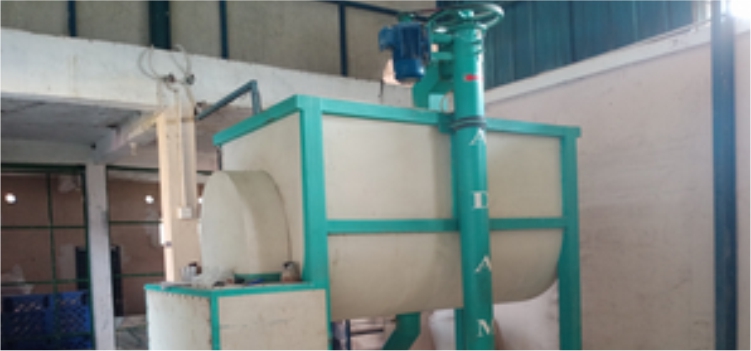
The mixing time is affected by the type of mixer used. Mixing by using mixer horizontal usually takes about 4-5 minutes, while the use of mixer vertical takes longer about 10-20 minutes. Time mixing too fast can cause mixing has not stirred optimally, while the duration mixing too long can occur segmentation is the separation of raw material particles. Time mixing can be increased in line with the increasing level of use of liquid materials in the mixture, because the mixture will become more viscous and slow down the flow of feed in mixer. This risks causing layers on the sides and screws mixer, so that the mixing efficiency decreases and the risk of contaminating batch next.

Mixing capacity
Mixing capacity can affect homogeneity. This relates to the ability mixer in the process of mixing raw materials. Capacity mixer the optimal one can be filled to 60-90% of its capacity so as to achieve optimal homogeneity.
Homogeneity control
Homogeneity checks need to be done to ensure the feed has been mixed homogeneously, it illustrates that all the nutrients in the feed are distributed evenly so that livestock get optimal nutrient intake. The usual test to control the homogeneity of the feed mixture can use the salt content test (NaCl) as an indicator. Homogeneity of feed is good if it has a level of value coefficient variation (CV) below 10%. It is important to note that this is not the case when the animal is feeding on its own (selfmixing), so in addition to testing the nutrient content of the mixture according to the formulated nutrient target, homogeneity control is also important. Feed homogeneity test (salt content test (NaCl) can be done in Medion laboratory MediLab.