The business of raising chickens has a great chance of making a profit and is quite lucrative if it is taken seriously and done correctly. But in its implementation can not be separated from the challenges. One of these challenges is the threat of disease, especially viral diseases that have not found a cure. As a result of the vaccine and biosecurity strict is one of the efforts that can be done to prevent it. In the implementation of vaccination, an appropriate program is needed in accordance with the health status of chickens and the age of disease attack.
Determinants of the success of vaccination based on the principles of materials, methods, human and Mileu (4M) as seen in the figure below which one is the method.
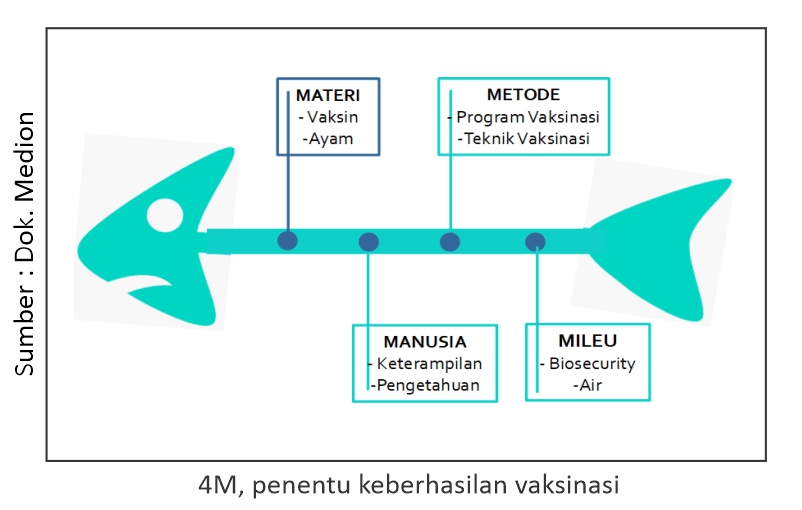
The methods here relate to vaccination techniques and vaccination programs. This vaccination Program is made with the aim of maintaining immunity/chicken antibodies are always in a protective level. This means that before the antibody level drops below the protective standard, the chicken must be vaccinated immediately. If the level of chicken antibodies is below the standard and at that time there are many cases of the disease, then the body's immunity is not able to withstand the attack of disease seeds.
Benefits Monitoring Antibody Titer for determination of vaccination schedule
Ways that can be done to find out whether chicken antibody levels are at protective levels or not by doing monitor antibody titer. Monitoring antibody titer to determine the revaccination schedule is recommended for farms layer or breeder. Chicken humoral antibody titers (antibodies circulating in the blood) can be measured using serological tests. This test technique uses blood serum as a sample, because it contains antibodies. Antibodies are immune substances produced by white blood cells to combat antigens (germs).
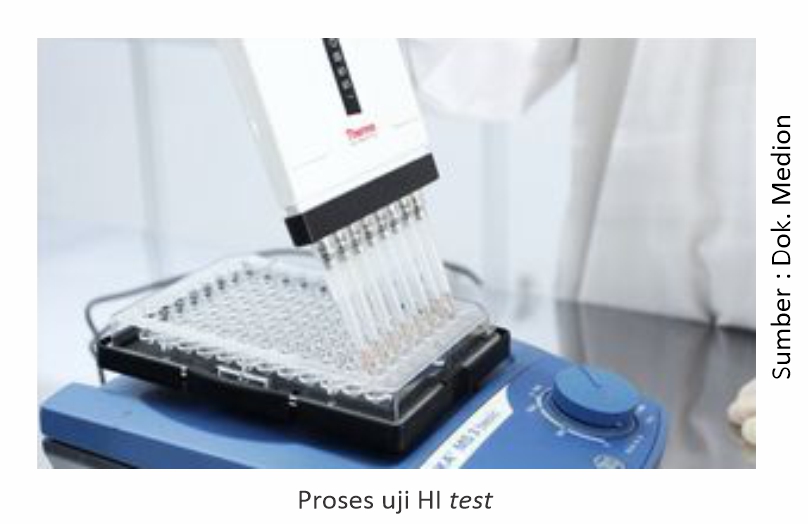
There are several types of serological test methods, the most commonly applied in poultry farming is the method Hemaglutination Inhibition Test (HI test)as seen in the image below and Enzym Linked Immunosorbent Assay (ELISA). Test HI test used to measure antibody titers against diseases that can agglutinate / coagulate red blood cells such as ND, AI and EDS. While the ELISA test is commonly used to measure antibodies to IB, IBD/ Gumboro, ILT and other diseases.
The results of these serological tests can be used to determine the appropriate vaccination or revaccination schedule in chickens. Vaccination is the process of administering vaccines into the animal's body to provide immunity against certain diseases. While revaccination is a repeat vaccination that aims to increase or increase the antibody titer from previous vaccinations that have started to fall in the hope that the antibody titer in the chicken's body is always in a protective level so that it can be protected from disease attacks.
The length of the antibody titer persists at the protective level in the chicken's body is influenced by several factors, one of which is the challenge of disease in the field. The higher the challenge or airy infection makes the antibody titer quickly drop. Another factor is immunosuppressive conditions, which are conditions that can decrease the immunity of chickens such as Gumboro, mycotoxicosis, stressed chickens, etc. Serological tests carried out regularly every month will provide an overview of antibody titers owned by chickens. These Data will help to estimate the schedule of revaccination.
The right time to revaccinate is when the antibody titer has started to fall or is close to the minimum titer standard in providing protection. For example when the standard titer HI test It's not on chicken layer that is 6 log2 or Geometric Mean Antibody Titers (GMT) 64 we should revaccinate when the antibody titer is close to 64 but there is no need to wait for the titer to be below 64. Because it is already a bit late considering that the vaccine needs time to work so that the antibody titer is at a protective level. To be at the protective level of the active vaccine it takes 2-3 weeks and the inactivated vaccine 3-4 weeks post vaccination.
Based on the example of serological test results against ND in chickens layer as shown in Table 1 can be analyzed as follows :
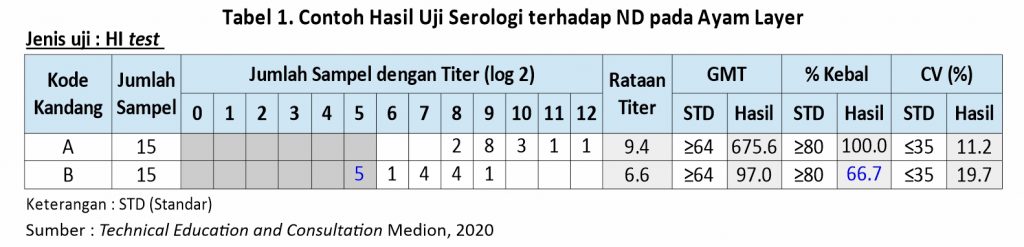
- A cage is the result of ND titer in chickens layer age 36 weeks with old post vaccination 4 weeks. From the results of the titer we can see that the average titer and GMT are above the standard, then the immune percent is also above the standard with coeffisien of variance (CV) below 35% which indicates that the chicken antibody titer is uniform. Based on the results of the serological test, it can be concluded that the chicken is not yet time for revaccination. Chicken antibody Titer in cage a needs to be checked for another 3-4 weeks to find out if the antibody titer has dropped and revaccination needs to be done.
- Cage B is the result of antibody titer against ND in chickens layer age 40 weeks with old post vaccination 8 weeks. From the results of the titer, we can see that the average titer and GMT are above the standard, but the immune percent is already below standard that is 66.7% with a uniform CV. From the titer picture, it can be concluded that the chickens in cage B need to be revaccinated. Revaccination should be carried out before all antibody titers are below standard.
Benefits Monitoring Antibody Titer for Baseline Titer
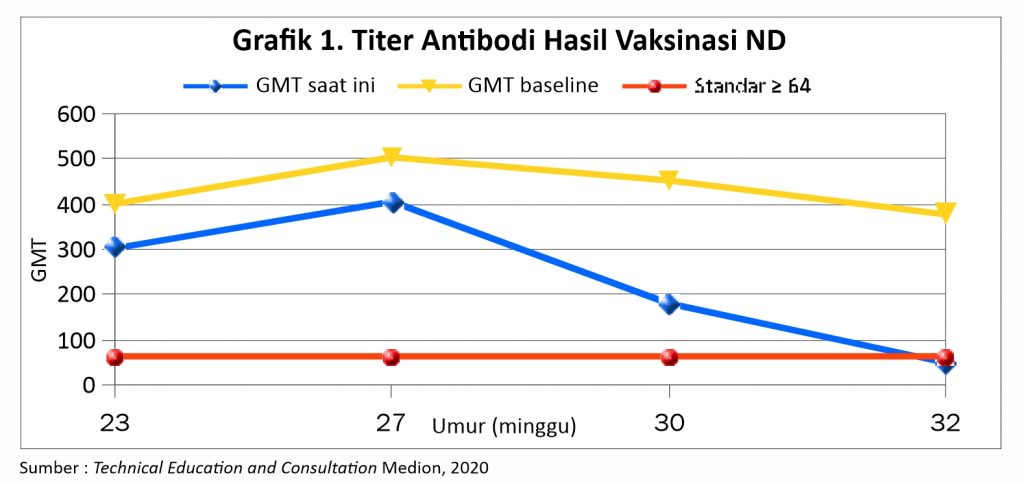
Other benefits that will be obtained if farmers routinely perform monitor titre is to get a picture baseline titer (basic titer) is safe for a farm. Thus, if at any time found a picture of titers that are different from normal or different from baseline this may be an early warning (early warning system) will condition the chicken. Manufacture baseline titer can be done at the age of the beginning of production, production peak age and at other critical ages. Here is one example baseline titer performed at the beginning of the production period and the results monitor titers that do not correspond to baseline titer.
Based on the example of Graph 1 of antibody titers against ND the results of ND revaccination at the age of 20 weeks, then carried out monitor titer at 3, 7, 10 and 12 weeks after vaccination. Previously, farmers routinely perform monitor antibody titers thus have baseline titer against ND as seen on the yellow line on the chart. Then in the next period farmers do monitor antibody titer to ND to see a picture of the titer as shown in the blue line of the graph. In the period seen that there is a decrease in titer faster when compared with baseline titer. This can provide an early warning for farmers regarding the condition of their chickens.
After looking at some of the results of the discussion above we can conclude that monitor the antibody titer is very important for determining the exact vaccination schedule and the picture baseline titers for chickens layer which has entered production. Not only ND, but also antibody titers of other viral diseases can we monitor. We never know when the threat of viral disease seedlings will attack on the farm. Therefore, relying on the history / history of disease attacks in the previous period is still not enough without doing monitor antibody titer.
To perform serological tests to carry out monitor antibody titer, breeders can do it in Medion Laboratory (MediLab). There are 16 branches MediLab spread across major cities in Indonesia. Expected with MediLab this, chicken farmers in Indonesia can always monitor the health of their livestock.