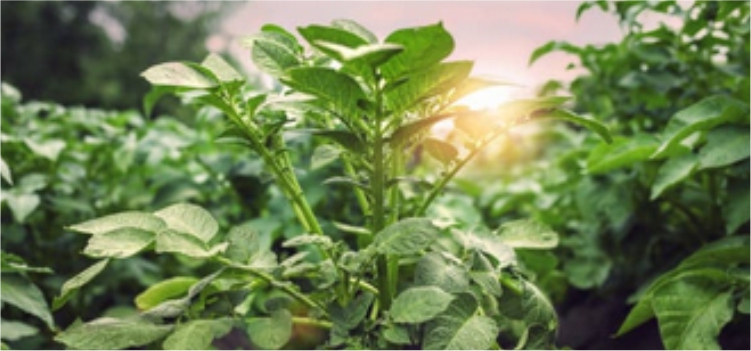
PotatoSolanum tuberosum L.) is one of the agricultural commodities included in the family Solanaceae. Potatoes are vegetables that are harvested from the tuber. Potatoes are used as processed foods, household consumption, fast food restaurants, to the flour and chips industry. Potatoes become a source of carbohydrates, proteins and vitamins.
Potatoes have a fairly high economic value and are not easily damaged, unlike other vegetables that are easily damaged. Potato production in Indonesia is not only to meet domestic needs, but also becomes a profitable export commodity. Potatoes are exported both in fresh and processed form.

According to BPS (2022), the consumption of potatoes by the household sector in 2021 was 771.49 thousand tons. The need for potatoes every year has increased and is predicted to increase along with the growth of the population.
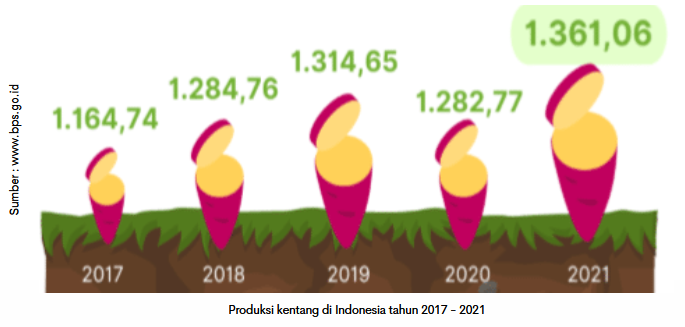
Potato production in Indonesia in 2021 amounted to 1.36 million tons. Production increased 6.1% from a year earlier. The potato harvest area in 2021 increased to 75,850 ha, while in 2020 it was 65,430 ha. The provinces that produce the most potatoes are East Java, Central Java, and West Java.
Potatoes in Indonesia are suitable for planting in Highlands (more than 1,000 MASL), temperatures range from 15-20°C. The characteristics of good soil for potato cultivation include medium texture, loose, fertile, good drainage, and soil pH 5-6.5. Dense soil will inhibit the formation and growth of potato tubers.
In the cultivation of potato plants there are various challenges, both caused by environmental factors and factors of plant pest organisms (OPT) that interfere with the growth of potato plants. Pests that attack potato plants include:


Late Blight
One of the pests affecting potato crops is late blight. Late blight produces the highest Attack area on potato crops compared to other pests. The area of late blight attacks in Indonesia in 2020 was 13,350 ha, as shown in Graph 1. The resulting damage can reduce potato production by 50-100%. The High area of attack and the damaging effect make late blight the main pest that needs to be controlled.

Late blight caused by fungi Phytopthora infestans. This fungus not only attacks potato plants, but can attack tomato plants, peppers, eggplants, peppers, and families solanaceae others. Mushrooms Phytopthora infestans it spreads through wind, water and requires wet conditions to thrive.
Potato rot disease develops quickly if the environmental conditions are favorable, including at a temperature of 18-21°C and humidity above 80%. Late blight develops best in the rainy season and high humidity, between December-February.
Mushrooms Phytopthora infestans can survive inside potato tubers and the remains of previously affected plants. Potato tubers that have been infected can potentially be carried and spread in the storage of tubers (warehouse).
Symptoms Of Late Blight
Symptoms of late blight (Phytopthora infestans) are as follows:
- Symptoms of attack occur when the leaves start to grow or the plant is 3-6 weeks old and usually starts from the lower leaves, then propagates to the top

- The initial attack there are wet spots with irregular shapes on the edges and middle of the leaves
- The spot then widens and is brown/gray in color with a slightly dark center
- Active blotches are covered by masses sporangium like white flour
- Late blight can spread to other parts of the plant such as stalks, stems and bulbs
- High attack will make the whole plant die
- Disease attacks on potato tubers cause brown or purplish-black spots.
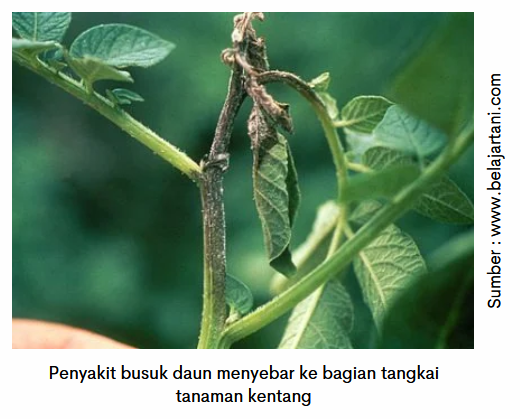
Symptoms Of Late Blight
Control of late blight can be done in various ways to suppress the development and spread of disease but still safe for the environment and maintain ecosystem balance. Control is carried out by technical, mechanical, biological, and chemical culture.
1. Technical culture
- Clean the environment around the land from previous crop residues and weeds. Mushrooms Phytopthora infestans can survive on the remains of previously attacked plants.
- Arrangement of drainage so that there is no inundation during the rainy season. Waterlogging can increase humidity and become an optimal environment for mold to develop.
- Using healthy and certified seeds to ensure seed quality and free from disease.

- Spacing should not be too tight to reduce the humidity of the planting area, especially during the rainy season (30-40 x 70-80 cm).
- A planting rotation with crops is not a host of late blight, so it can break the life cycle of diseases present in the land. For example, cabbage, chicory, broccoli, radishes, beans, cucumbers, among others.
2. Mechanical
- Pluck the part of the plant where there was an early attack of late blight.
- Collect and destroy the affected plant parts (burn/bury).
3. Hayati
Biological control uses natural enemies in the form of pathogens. Pathogens are microorganisms (fungi) that can suppress late blight in the field.
Mushrooms Pseudomonas flourescens for the control of late blight. Potato seedlings are dipped in a solution of a biological agent Pseudomonas flourescens.
4. Chemical
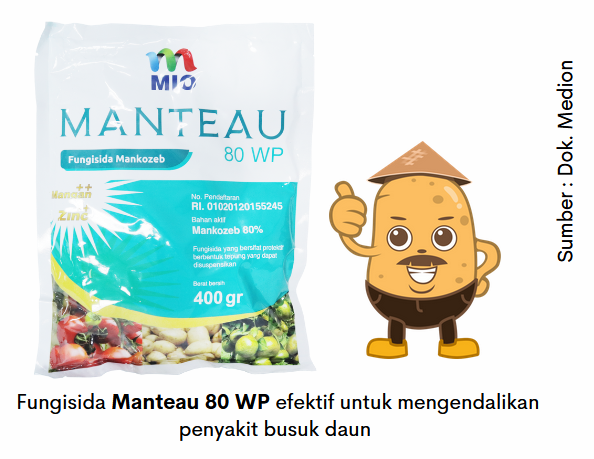
Late blight control using toxic chemicals or fungicides is the most widely practiced and most effective way to control the disease. The use of fungicides must be in accordance with the invading disease. Fungicide Manteau 80 WP is one of the effective fungicides to provide protection from late blight.
Fungicide Manteau 80 WP has the active ingredient Mancozeb 80%. Manteau 80 WP has a contact way of working that prevents diseases from infecting plants and developing. At the time of application of fungicides should be added Diffuse as an adhesive, leveler and penetrator so that the fungicide that has been sprayed is not easily lost when it rains. In addition to Manteau 80 WP, another active ingredient that can control late blight is Chlorotalonil (Qiunil 75 WP).