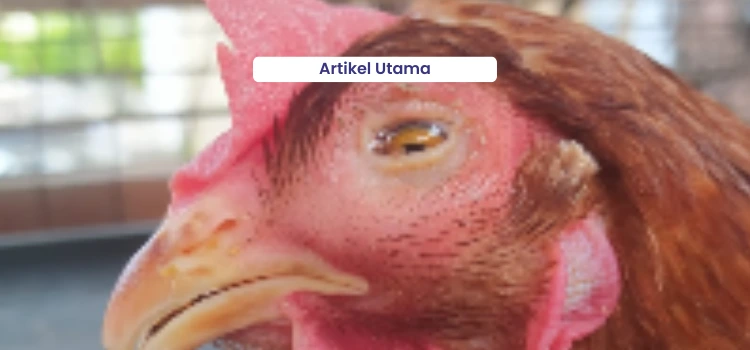

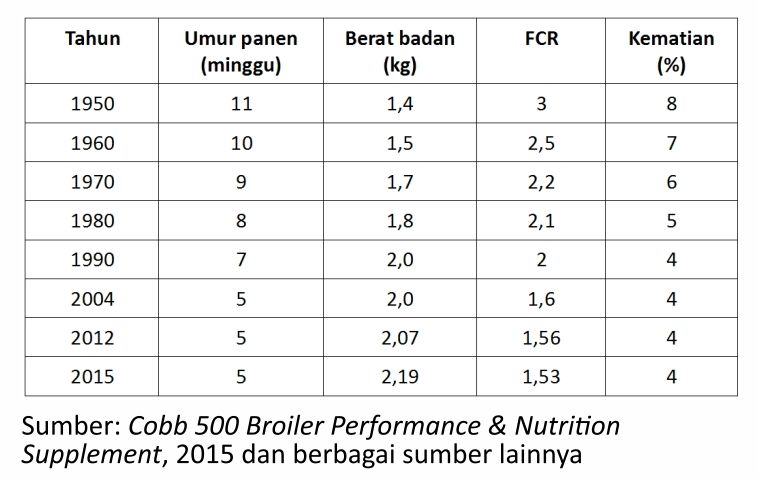
The evolution of the human genome (broiler) in line with the genetic quality improvements made by experts. The main purpose of raising chickens broiler is to produce meat. Therefore, experts continue to develop chicken strains that result in the production of quality meat with a high level of feed efficiency. This genetic improvement also results in morphological changes, among others:
1. Faster growth
Poultry broiler can reach a weight of 2.191 g within 35 days (Cobb 500 Broiler Performance & Nutrition Suplement, 2015). From year to year the growth is getting faster and more efficient in converting feed into meat (FCR). Even if the maintenance management is implemented very well, it is not impossible when the performance of chickens broiler obtained exceeds the performance standards set by the breeding company/ breeder.
2. Bigger breast meat
Geneticists are constantly trying to optimize the growth of meat in the breast. But it has an impact, currently chicken broiler becomes more stooped and the movement activity is slight.
3. Fewer feathers
In the formation of feathers, a sufficient amount of nutrients is required. With fewer feathers, the utilization of feed for weight growth will be much more optimal. However, chickens will become more sensitive to changes in temperature and humidity of the environment. So that controlling the temperature and humidity of the cage should be routinely carried out regularly.
Genetic potential will be optimal if supported by environmental factors that are in accordance with the conditions of growth and development of the chicken. This development is not without constraints, despite the relatively short maintenance time. Of course, it must be anticipated from the beginning of the maintenance of chickens, especially during critical periods of maintenance.
Critical Period Of Chickens Broiler Management
Critical period of chickens broiler this is a time when chickens are growing rapidly. The critical period occurs in the first 2 weeks of keeping chickens. You could say also during the brood of chicks or future brooding period,. Like a newborn baby, usually will be treated in a special room for more intensive supervision, sometimes even need to be treated in the incubator room to get warmer.
Likewise, in chickens that are in a critical period, should be given monitor more so that growth is optimal. Why is it important? Because at this time the digestive system and the immune system are not yet perfect and are not ready for environmental changes. In this period, there will be a process of cell multiplication (hyperplasia) for the development of vital organs and systems of chicks, including:
a. Immune system
Immunity that plays a role at this time there are 2 namely passive and active immunity. In the case of a chicken, the egg yolk is transferred from the egg to the egg yolk (maternal immunity/ maternal antibodies). Therefore, the absorption of the remaining yolk should take place quickly and completely. While active immunity is produced from the administration of vaccines (vaccinations) and field viral infections.
In the field, maternal antibodies will not survive for a long period of time and will decrease (decrease) levels periodically. Given the challenge of disease seeds around chickens is relatively high, then we need to vaccinate periodically. Vaccination must be done precisely (right vaccine, right dose, right application, and right time) in order to succeed in optimally bluffing antibodies/immunity.
b. Digestion
While still in the hatching machine, the digestive organs of the chicks are anatomically underdeveloped and functional. As soon as the chicks hatch, these digestive organs, especially the proventriculus, gizzard/ gizzards, and intestines, will undergo changes in morphology (increase in size/ diameter and length) and physiology (digestive enzymes begin to be produced).The digestive organs develop rapidly on the 4th to 6th day, and begin to decline on the 10th day (Noy and Sklan, 1997). The development of the size of the digestive organs and these enzymes will later affect the metabolic processes and absorption of feed nutrients. In order for the digestive organs to develop quickly, this is where the importance of ensuring feed intake chicks are reached maximum from the first day chick in.
c. Thermoregulation system (regulation of body temperature)
Chicks can not regulate their body temperature the first 5 days of rearing (are poikilotermic) until the age of 14 days is not fully able to regulate body temperature. In other words, the body temperature of the chicks is strongly influenced by the ambient temperature. Therefore, the temperature of the cage must always be observed.
d. Body skeleton (bones) and feathers
The skeleton of the Chick's body develops with age. This skeletal development includes the gain of bone mass, thickness, and length. The formation of an optimal body frame will be able to support rapid weight growth and suppress rejection caused by paralysis or disability.
Frequently encountered problems
Discussion about the critical period of chicken rearing broiler indeed, there will be no end, the facts in the field show that maintenance management factors play an important role in producing chicken performance. However, sometimes farmers do not realize this, so they sometimes neglect to keep the chickens in comfortable conditions for growth. Among them are:
a. The building is not yet ready for demolition (chick in)
This condition can occur especially if the rest period (empty cage) is short, so the farmer has not had time to clean the cage or equipment thoroughly. If this happens, it can cause the DOC does not immediately get a comfortable place to live.
b. The brood Cage is too dense
For reasons of efficiency, the brood Cage is filled with a number of chickens that exceed capacity, so this can cause competition in getting food, drink and clean air between chickens.
c. Curtain management errors
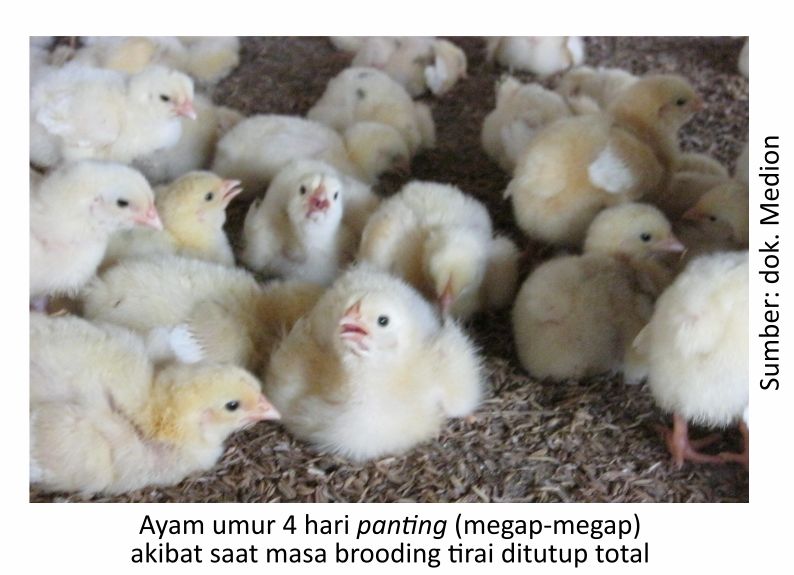
For reasons of fear of cold in the future brooding period,, usually the cage curtain will be completely closed with the aim that the heat from brooder focused. This can affect the smooth circulation of clean and dirty air and even become a trigger factor for infectious diseases such as respiratory diseases. Chickens will also suffer panting (gasps) because of the content O2 reduced. Coupled with management litter which is less good, for example too moist or dry.
d. Cold chicken
The cold conditions themselves are usually the result of breeders too efficient heating, so that the heating capacity that should be for 1,000 heads is used more than 1,000 heads.
e. Do not recheck the cage
Farmers will know the growth and development of chicks if diligently check the condition of the chicks, whether the heater is enough, whether feed intake log in, etc. But sometimes things like this are still underestimated.
Forming Quality Meat
How can the critical period in chickens be passed properly? So that the target we expect, chickens can grow optimally can be achieved. There are 5 important points that we must pay attention to, namely:
a. Management brooding period, optimal
Critical period or period brooding period, occurs in chickens aged 0-2 weeks. Failure of chicken keeping broiler on time brooding period, will complicate the achievement of chicken productivity in the next phase of rearing. To prepare brooding phase good, then the breeder needs to prepare a clean and comfortable cage before chick in.
The cleanliness of the cage has a very big influence on the health and performance of chickens. When the cage conditions are dirty, the concentration of disease seeds is still high so that the chances of chickens getting the disease are greater. Conversely, when the cage conditions are clean and have been disinfected, the concentration of disease seeds will decrease so that the challenges of disease seeds are reduced and chickens are safer. Cleaning the cage must be done thoroughly, ranging from washing the cage, equipment, spending litter and feces, up to calcification, and disinfection.In the making chick guard (chicken bulkhead), breeders are recommended to use zinc and formed into a circle or ellipse. For extents chick guard, can be adapted to the DOC population to be maintained. Per 1 m2 can accommodate 50-60 DOC and one area chick guard no more than 1,000 DOC.
Install the heater at an angle of 15° which serves to spread the heat evenly over a larger area so that the DOC is spread and reduces the risk of death from jostling. It's a gas stove like IGM (Indukan Gas Medion) can be used to heat 750-1000 Doc tail.
Carry out a cage break of at least 14 days, starting after all the cleaning and disinfection processes of the cage have been completed. The goal is to break the life cycle of disease seeds optimally so that they do not find hosts (chickens) to grow and pollute the cage. During the rest period of the cage, all cage curtains are closed and limit all activities in the cage and its surroundings.
b. Adequate nutrition and drinking water
In the critical period, the faster the chicks consume feed, the faster the digestive organs, immune system, thermoregulation system and skeleton of the Chick's body develop, so the weight standards are quickly achieved. Panda et al., (2006) reported that chicks that are not given feed and drinking water within 48 hours of hatching, can lose weight by 7.8% of the initial weight. Therefore, when DOC arrives:
- Give 2-5% sugar water (20-50 grams of brown sugar in 1 liter of drinking water) as soon as the DOC is released in the cage brooding period, to replace the energy lost during the trip.
- Along with giving drinking water, give feed little by little into the feed bin. DOC cache capacity is limited and maintained the freshness of the feed is the reason the feed should be given a little bit with the frequency of frequent administration. Another advantage is that the farmer can simultaneously control the condition of the chicken.
- Feed and drinking places should be provided in accordance with the number of chickens. The distribution must also be evenly distributed so that all chickens can eat and drink together. We must ensure the distribution of chicken feed is sufficient, so the place to eat and drink should be adequate for all chickens, do not let there be chickens that do not get feed and drinking water.
c. Availability of fresh air
The availability of clean air is very important because one of the components of air is oxygen gas which plays a major role in the metabolic process of chickens. If there is less oxygen in the cage, the health of the chickens will suffer. Especially if in the cage a lot of harmful gases such as ammonia and CO2.To create clean air, one of them is by setting the cage curtain open and close. However, this arrangement must be adjusted to environmental conditions, especially temperature and wind speed around the cage. In rainy and very cold weather, install an additional curtain (inner curtain) to protect the chicks during the brooding period. Never close the cage brooding period, entirely without the slightest gap. It can reduce the content of O2 and increase toxic gases such as CO2 as well as ammonia.
As a result, the respiratory system of chickens will be disrupted.In addition to the arrangement of curtains, the adequacy of clean air can be done by adjusting the density of the cage. Cages that are too dense can cause the temperature in the cage to be more stuffy and hot, causing increased drinking water consumption which results in wet stools. This can trigger high ammonia gas. We recommend that the density of chickens in the cage is set according to the age increase / increase in chicken body weight (Table 3).
d. Awake health management
To keep chickens in good health, it can be done by :
Vaccination Program according to regional conditions
The purpose of vaccination is to bully the formation of immunity/antibodies from the body to prevent infection. From the picture of the disease that affects chickens broiler the vaccine that must be given to chickens broiler namely ND, Gumboro and AI. However, it is worth considering IB and korisa vaccinations if the area is prone to IB and korisa diseases. The program of vaccination activities can be adjusted to the conditions of each farm (history and level of disease vulnerability).
Medication Program or administration of drugs and vitamins
Can be done cleaning program (prevention) is to provide broad-spectrum antibiotics to prevent disease infection before the seeds enter the chicken body. Cleaning program is given 3-4 days before the outbreak of the disease (the appearance of clinical symptoms) based on the case history at the previous maintenance. For example, in the previous maintenance period, chickens were attacked by CRD at the age of 20-21 days, then in the next maintenance period, antibiotics can be given as a preventive measure at the age of 17-19 days. Antibiotics given are Proxan-S, Doctril, or Collimezyn. In addition, provide supportive therapy to maintain stamina or help the growth of chickens by giving vitamins such as Vita Stress, Neobro or Strong N Fit and immunostimulants (Imustim) to prevent disease infection
Strictly biosecurity
Biosecurity aims to prevent disease seeds from entering the farm and spreading out of the farm. As farmers, we are a must to implement biosecurity strictly. Traffic control of vehicles and livestock facilities needs to be done. Because it can act as a vector/carrier of disease seeds. No less important is the arrangement of the visit schedule of the operator / PPL who oversees several cages, when the visit must be started from new young chickens to old chickens or healthy chickens to sick chickens. If the previous visit to the sick chicken should not visit the chicken coop healthy because the operator can be a source of disease carriers.
Biosecurity activities that are equally important are sanitation and disinfection, namely ensuring that TRA and TMA are routinely washed and disinfected using disinfectants such as Medisep, Zaldes or Sporades. As well as disinfection of guest cars, visiting guests, and cages for contents, especially during an outbreak of the disease. This disinfection will minimize the number of disease seedlings in the home environment.
e. Chicken condition control
In order not to miss when keeping chickens, we need to check and control the chickens. Control should be done more intensively at the beginning of rearing, such as checking the Chick's cache and legs 2-3 hours after the first ration. Chicks are said to be comfortable if they have found at least 75% of the child's sample with the cache feeling full, supple and soft, and when touched kakai feels warm. Always control the condition of the chicken and the cage so that the chicken feels comfortable, especially for the temperature and humidity of the cage which can be described by the activity and spread of chicks.In addition to checking directly, what can be done is to look at the data fields recording (production notes).
By looking at recording can see the results of work and help analyze if problems occur. But not all breeders discipline in filling recording.From the whole discussion above we can conclude that the critical period is a period of determining the final result. The breeder is obliged to observe a balance between optimal maintenance management and timely achievement of body weight. Greetings.