Father Lalu Rahadi
Lombok-NTB
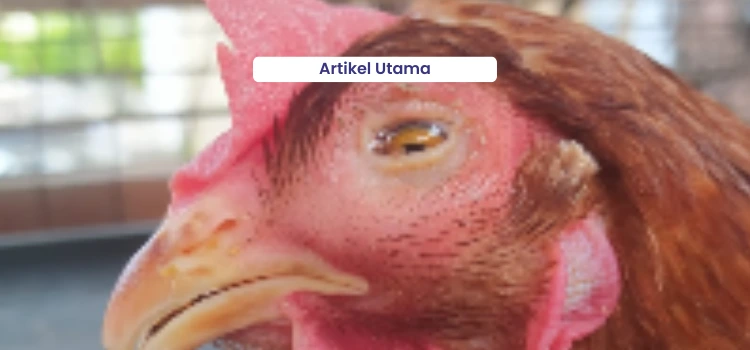
Why did my laying hen suddenly die in the cage cage with a thin body condition and a slightly bluish comb? Thank you.
Answer:
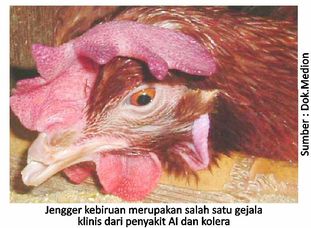
Dear. Mr. Lalu Rahadi, thank you for the question. A bluish comb is one of the clinical symptoms of some diseases. To be able to diagnose the exact cause must see a history of disease that has ever existed in the cage, the presence of clinical symptoms and changes in anatomical pathology (changes in organs after chicken surgery) supported by laboratory tests. However, bluish Combs and the presence of death can occur in cholera or Avian Influenza (AI).
Some other clinical symptoms that occur in chickens infected with cholera are decreased appetite, lethargy, feather loss, diarrhea that is initially watery yellowish, then will turn greenish with mucus (mucus), increased respiratory rate, facial area, Combs and wattles swell to contain cheesy and solid matter. After the chicken is dissected, inflammation of the trachea, bleeding in the form of ptechiae (points) or echymosis (spread/extends) on the heart, lungs, heart fat and abdominal fat. The enlarged liver is striped in color and there are necrotic white spots.
While on the symptoms Avian Influenza the acute form (HPAI) is characterized by a rapid disease process with a high mortality rate, impaired egg production, respiratory disorders, excessive dilation of the eyes, swelling in the head and face area and bleeding under the skin followed cyanosis or bluish tint of the skin, head, wattle and comb.
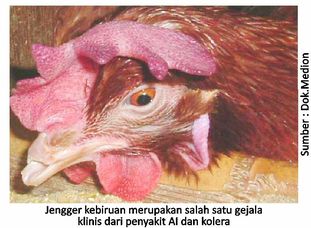
Even so, it is advisable not to take the picture of a bluish comb as the main benchmark in diagnosing the disease. It is necessary to have as much other information data as possible that leads to conclusions about the disease that affects the father's chickens. The more data obtained, the conclusion will be easier. The data that needs to be done include the pattern of spread, history of disease, clinical symptoms and organ changes when the chicken is dead in order to obtain a more accurate diagnosis of the disease. If necessary, the test can be performed in the laboratory Medion (Medilab) to help confirm the diagnosis of disease attacks HI test and ELISA methods on suspected AI attacks.
Handling actions that need to be done when the Blue comb is found :
- Remove the chicken carcass immediately and as far away from the cage environment as possible.
- Perform selection and reject chickens with severe conditions.
- Immediately separate chickens with mild symptoms in different cages (isolation cages).
- If it leads to cholera, give antibiotics such as Choleridine, Therapy, etc. (select one).
- Meanwhile, if what is found is the case of AI, then do selective culling of poultry and chickens that are still healthy are vaccinated with Medivac AI or Medivac ND-AI.
- Provide supportive therapy with multivitamins such as Vita Stress or Fortevit.
- Provide rations as needed in both quality and quantity.
- Support with good chicken keeping management, such as smooth air circulation, do not wet feces, etc.
- For example, if you want to use a vacuum cleaner, you can use a vacuum cleaner with a vacuum cleaner (Neo Antisep, Medisep or Zaldes), etc.
In addition to due to infectious attacks, bluish symptoms can also be due to the position of the chicken that is placed at the far end of the battery cage. This results in a lack of oxygen intake or fresh air as well as balanced feed and drinking water. Feeding and drinking water should be evenly distributed and make sure each chicken gets a balanced intake and smooth air circulation.