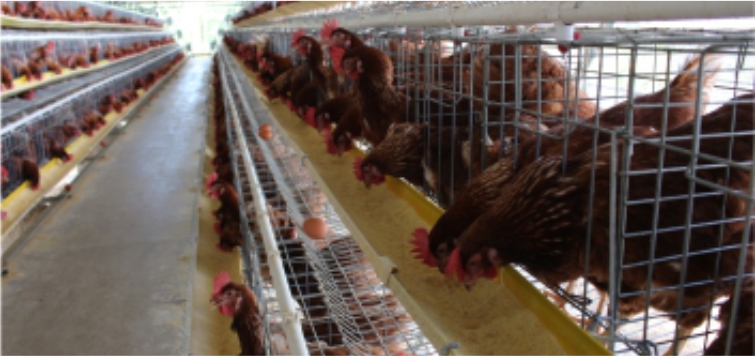
A Mineral is an inorganic compound that makes up 4% of the chicken's body. Mineral needs for chickens need to be met through rations because the chicken's body can not produce it. Minerals can be divided into macro and micro minerals.
Makro mineral terdiri dari kalsium (Ca), fosfor (P), magnesium (Mg), sulfur (S), kalium (K), natrium (Na) dan klorida (Cl). The micro minerals/trace mineral is a group of minerals that the body needs in small quantities. Although the amount needed is small, this micro-mineral is very useful in supporting various processes in the chicken's body. Contoh mineral tersebut antara lain mangan (Mn), zinc/seng (Zn), iron/zat besi (Fe), iodine (I), copper/tembaga (Cu), selenium (Se) dan cobalt (Co).
Mineral needs for chickens in the production period are needed as raw materials for the formation of Contents and egg shells. Lack or deficiency of minerals can cause decomposition of chicken organs (such as bones) to obtain minerals. The long-term impact is that chickens can experience paralysis due to fragile bone conditions.
Mineral requirements for laying hens
The currently cultivated laying hens already have superior genetic properties. Existing genetic improvements make laying hens reach peak production faster and lay more eggs. The consequence is that chickens have to carry out metabolic processes faster. This condition causes the need for minerals to increase because it takes an active part in various metabolic processes in the body such as precursors (adjuvants) of enzyme work, hormones and ion transport.
Despite the many advantages of improving their genetic potential, laying hens are more prone to stress. The stressful condition of chickens will require a greater amount and intake of minerals. This is the same as a chicken that is under immunosuppression. If the mineral needs are met, the stress conditions can be resolved.
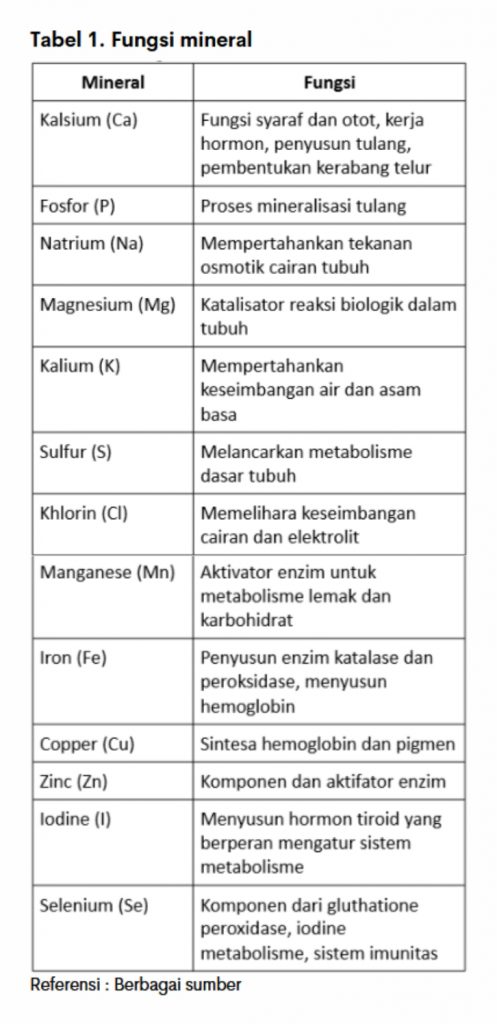
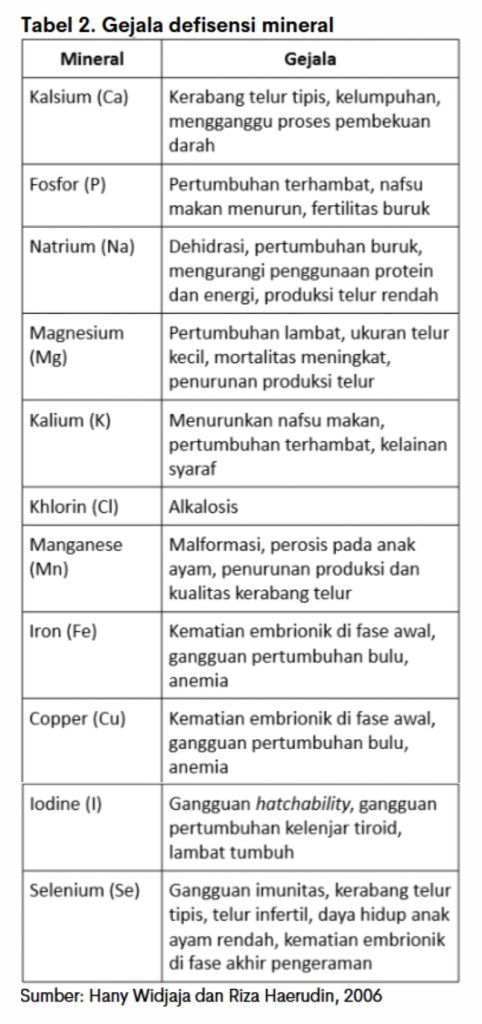
The role of minerals in the biological processes of the body is very diverse and each mineral has a different function (Table 1). However, if the mineral needs of chickens are not met, there will be a mineral deficiency condition. Symptoms of mineral deficiency are listed in Table 2.
Sources of macro and micro minerals
A ration of good quality should be able to meet the nutritional needs of chickens in any period of their development. Mineral fulfillment in the ration is not dominant and usually only around 5-8% of the total ration. However, if the mineral needs are not met, it will affect the metabolic process which leads to a decrease in chicken performance. So that the mineral needs are met, it is necessary to add using mineral source raw materials such as Stone flour, dicalcium phosphate (DCP), or monocalcium phosphate (MCP).
a. Rock flourLimestone)
Stone flour is a mineral raw material made from limestone grinding. The mineral content found in rock flour is Ca, Fe, Mg and P. There are two main types of wood flooring (wood flooring): wood flooring (wood flooring) and wood flooring (wood flooring)mash) and details (grit). Rock flour with larger particle size will stay longer inside gizzard. With that, the release of Ca occurs slowly and the need for Ca minerals for kerabang is more guaranteed.
b. Dicalcium phosphate (DCP)
DCP is a supplement that is used as a source of phosphorus minerals for laying hens. DCP is made from natural materials such as mineral rocks (phosphate rocks) obtained through the heating process. In addition, DCP can also be formed from a reactive combination of calcium oxide and phosphoric acid through the precipitation process.
c. Monocalcium phosphate (MCP)
MCP is one of the feed ingredients of calcium and phosphorus mineral sources whose manufacturing process is like DCP (precipitation) but uses a different ratio of 1.3 phosphorus and 1 calcium. So the phosphorus content in MCP is higher than DCP.
d. Bone Meal
Bone meal is a waste of bone grinding that has been extracted gelatin or collagen. The Shape of bone meal is brown flakes with a rough texture and a distinctive aroma like beef. This raw material becomes one of the feedstocks of Ca and P mineral sources, as well as other micro minerals.
e. Shellfish flour
Shellfish is a mineral source material derived from shellfish that has undergone a grinding process. This raw material is a source of calcium minerals and the content of carbon (Caco₂) is higher than bone meal which is about 35%.
Mixing minerals in the ration
Cases of mineral deficiency can be prevented by taking mineral supplementation. This mineral supplementation can be done by farmers in the form of adding a single mineral or in the form of adding premixes. Examples of mineral supplements that can be given are Mineral Feed Supplement A.
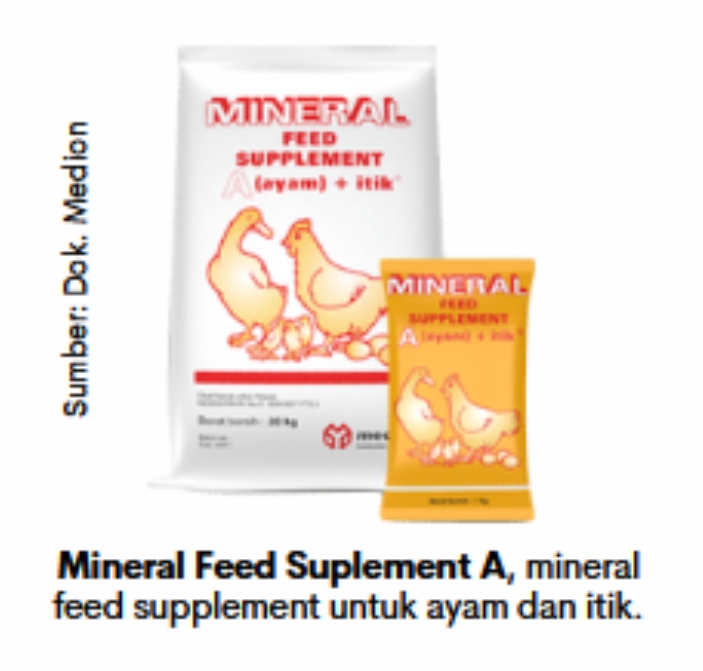
The thing to consider when going to do mineral supplementation and other mineral sources is the mixing technique. The added mineral supplements must be mixed homogeneously in the ration so that each chicken gets an even amount of minerals. Mixing of mineral supplements is done gradually starting from mixing into the ration of a small amount and small size. Then move on to a larger amount and so on until the entire ration is mixed with the mineral supplement. It would be better and easier to use mixer horizontal so that the mixing process is more efficient.
Mineral raw materials to be added to the ration should be considered first particle size. The size of the mineral particles will affect the duration of absorption in the body. The greater the size of the mineral particles, the longer the presence in the body will be released slowly so that (slow release). Process slow release this is important during the formation of the egg shell, which takes 20 hours in the uterus.
There are two main types of water treatment plants in the United States: water treatment plants (mash) and coarse grain (grit). Dosage form mash will be absorbed more quickly by the body than the form grit. These two preparations should be given to the ration of chickens in a ratio of 65-70% in the form of grit and 30-35% in the form of mash.
In general, mineral raw materials in the form grit given daily to laying hens starting phase pre–layer to reject to prevent mineral deficiency. Raw materials in the form of grit it also serves to help the process of digestion of food in the gizzard so that the efficiency of feed utilization increases.