Minerals
Minerals are one of the key nutritional components essential for livestock survival. They are classified into two categories: macro minerals and micro minerals. Macro minerals are those required in large amounts—more than 100 mg per kg of feed. Examples of macro minerals include:
- Calcium (Ca)
- Phosphorus (P)
- Potassium (K)
- Sodium (Na)
- Chloride (Cl)
- Magnesium (Mg)
- Sulfur (S)
Meanwhile, micro minerals are minerals required in small amounts, <100 mg/kg of feed. The components of micro minerals include:
- manganese (Mn)
- iron (Fe)
- copper (Cu)
- zinc (Zn)
- iodine (I)
- selenium (Se)
Micro minerals are also known as trace minerals. They play an important role in various metabolic, enzymatic, and biochemical reactions in the body. However, their availability is often overlooked in feed components. This can lead to potential cases of trace minerals deficiency. Based on clinical signs, nutrient deficiency cases—including trace minerals—are very difficult to differentiate in the field.
In general, trace minerals are required only in small amounts, but it is important to note that their absence can cause negative effects on livestock. So, what roles do trace minerals play in poultry feed? This article will comprehensively discuss the functions of trace minerals in poultry nutrition.
Functions of Trace Minerals
Trace minerals play an important role in livestock. Each trace mineral has its own specific function, including:
1.Manganese (Mn)
Enzyme activator for fat and carbohydrate metabolism, involved in bone formation, and determines eggshell quality.
2. Iron (Fe)
Component of the enzymes catalase and peroxidase, and essential for hemoglobin formation.
3. Copper (Cu)
Plays a role in enzyme function, hemoglobin synthesis, and pigment formation.
4. Zinc (Zn)
Component and activator of enzymes such as carbonic anhydrase in red blood cells, carboxypeptidase and dehydrogenase in the liver (Sukariada et al., 2014), responsible for embryo development and bone formation.Select 62 more words to run Humanizer.
Forms part of the thyroid hormone, which regulates the body’s metabolic system.
Forms part of the thyroid hormone, which regulates the body’s metabolic system.Select 88 more words to run Humanizer.
6. Selenium (Se)
Component of glutathione peroxidase, involved in iodine metabolism, and supports the immune system.
Requirements for Trace Minerals in Poultry
Poultry obtain most of the minerals they need from feed, with a smaller portion coming from drinking water. Therefore, mineral supplementation or addition in feed is necessary to meet their nutritional requirements. The macro mineral needs are largely fulfilled through the inclusion of mineral-rich raw materials such as limestone or grit, MCP, DCP, and sodium bicarbonate. Meanwhile, micro mineral requirements are supplied not only from feed ingredients but also from the addition of premix in the feed—the primary source of trace minerals. The levels of mineral supplementation can be categorized into four groups as follows:
- Deficiency
If the supplementation level is below the recommended standard, hens are at high risk of experiencing mineral deficiency and showing clinical deficiency symptoms. - Sub-optimal
If the supplementation level meets the recommended amount, subclinical deficiencies may still occur when hens experience stress or illness. This level is insufficient to support maximum productivity and performance. - Optimal
When the supplementation level is adjusted according to field conditions, allowing hens to reach their full genetic potential. - Overdose
If the supplementation level exceeds the toxic threshold for livestock, it can lead to mineral toxicity.
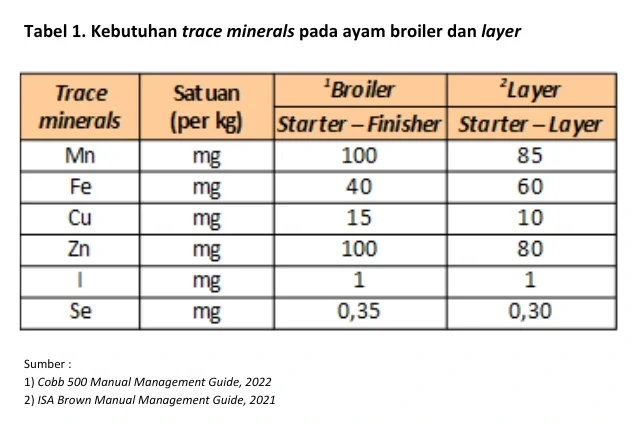
Ideally, trace mineral supplementation should be provided at the optimal level to achieve the best livestock performance. The following Table 1 shows the trace mineral requirements for broiler and layer chickens.
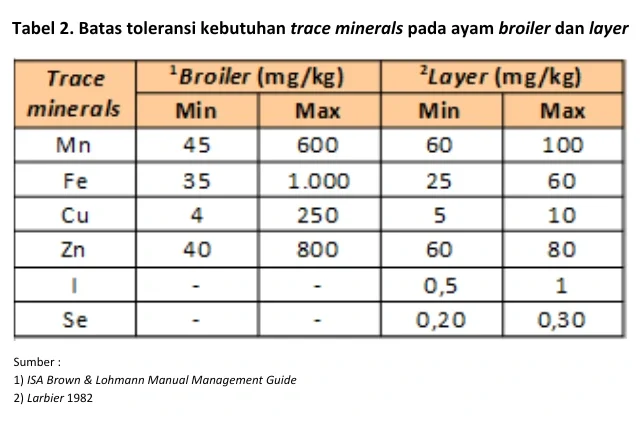
To prevent toxicity in livestock, trace mineral supplementation must also consider their tolerance limits. Table 2 presents the tolerance limits for trace mineral requirements in broiler and layer chickens.Select 63 more words to run Humanizer.
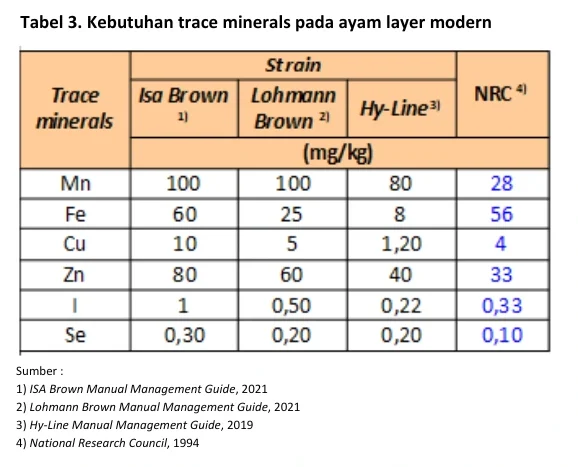
In addition, current genetic improvements have enabled modern chickens to achieve higher productivity levels. To meet these targets, modern hens must undergo faster metabolic processes. This condition increases the demand for minerals, including trace minerals, as they play active roles in various metabolic functions such as serving as precursors (cofactors) for enzymes, hormones, and ion transport. Table 3 shows the differences in trace mineral requirements between today’s modern layer chickens and the NRC recommendations.
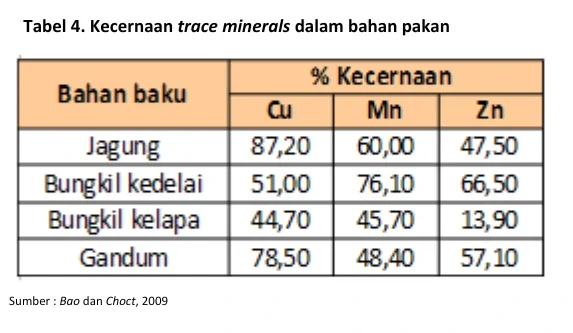
The requirement for trace minerals in feed can also be determined by considering the quality of the feed ingredients. This can be evaluated based on the digestibility of each ingredient used in the feed formulation. Therefore, even though trace minerals are present in the feed ingredients, their digestibility levels must also be taken into account. The digestibility of minerals is directly correlated with their absorption by the animal. Table 4 provides examples of trace mineral digestibility in common feed ingredients.
The Role of Trace Minerals in Poultry
The components of trace minerals have specific functions and benefits for the animal’s body. A combination of trace minerals can work synergistically, but some may also act antagonistically or oppositely. This can occur when the quantities of minerals differ or are imbalanced. Therefore, it is important to ensure that mineral supplementation follows the concept of providing precise and balanced amounts.
Several studies have extensively discussed the positive effects of trace mineral supplementation in feed, including:
- Productivity of Broiler and Native Chickens
Hatab et al., (2022) demonstrated in their study that supplementation of the mineral zinc (Zn) in 5-week-old broiler Cobb strain chickens at a dosage of 40–60 mg/kg of feed increased body weight and optimized feed conversion ratio (FCR). Similarly, Fahrina et al., (2021) reported that supplementing 60 mg/kg of zinc (Zn) in the feed of native IPB-D3 chickens improved body weight and feed efficiency.
Zinc (Zn) is known as an essential trace mineral that serves as a cofactor for various enzymes in metabolic systems (Bun et al., 2011). Therefore, zinc (Zn) supplementation supports metabolic processes that enhance livestock performance. - Productivity of Layer Chickens
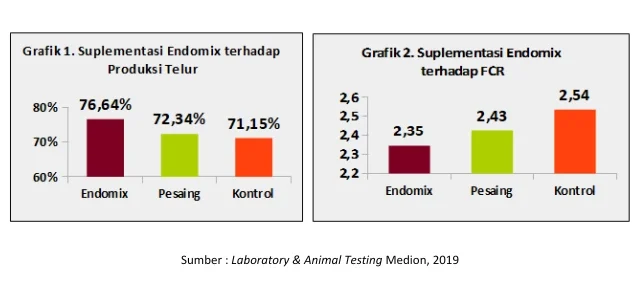
The use of Endomix, which contains a combination of trace minerals, in 72-week-old Lohmann layer hens at a dosage of 500 g/ton of feed has been proven to improve productivity, as indicated by higher egg production (% HD) and optimized feed conversion ratio (FCR).
- Eggshell Quality
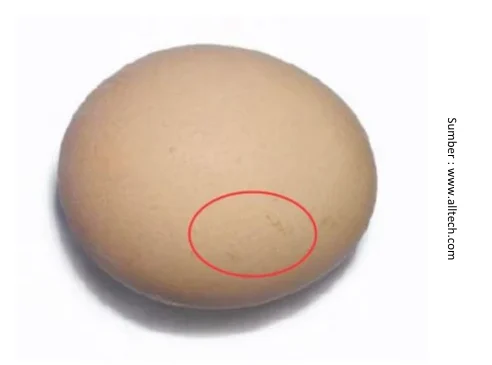
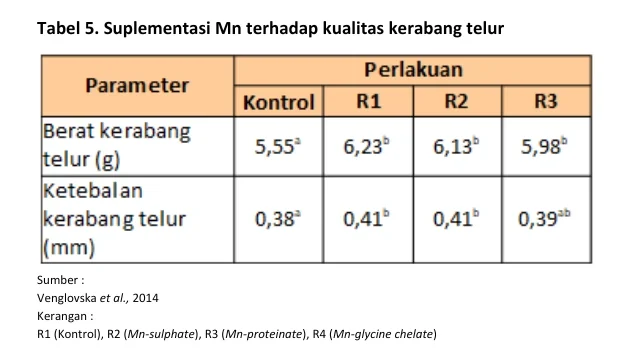
One of the trace minerals, manganese (Mn), can improve eggshell quality, such as shell weight and thickness. Venglovska et al. (2014) reported that Mn supplementation increased eggshell weight and thickness compared to the control group (without Mn supplementation). Conversely, manganese deficiency can lead to a decline in shell quality, including the appearance of speckled eggshells.
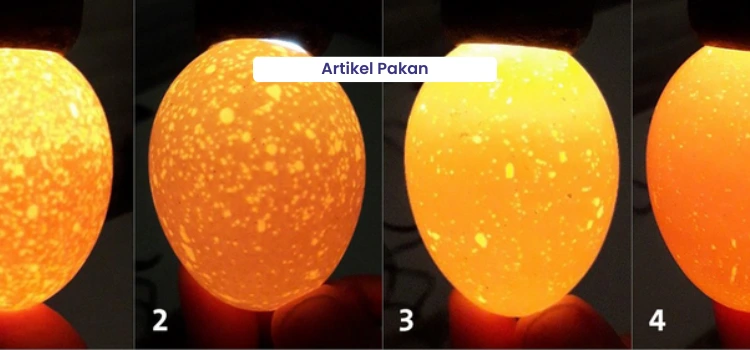
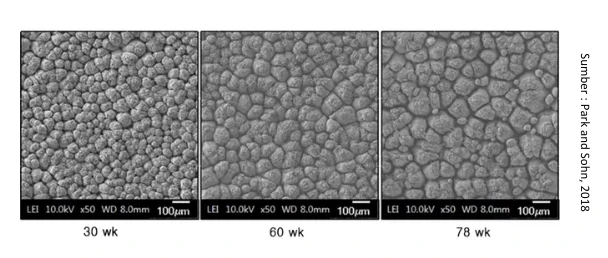
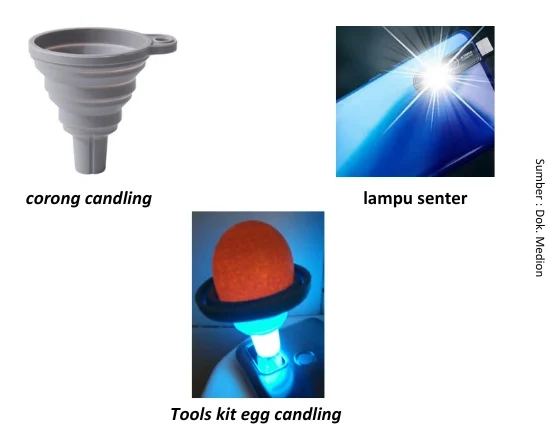
In addition, supplementation of trace minerals can also improve eggshell density. According to Qiu et al. (2019), supplementation with trace minerals such as Zn, I, Mn, and Cu increases shell density by reducing the size of the mammillary knobs and enhancing the thickness of the palisade layer. The mammillary knobs, which form the palisade structure, tend to enlarge as hens age; therefore, shell density is closely correlated with shell strength. Eggshell density can be observed using an egg candling toolkit (candling cone and flashlight).
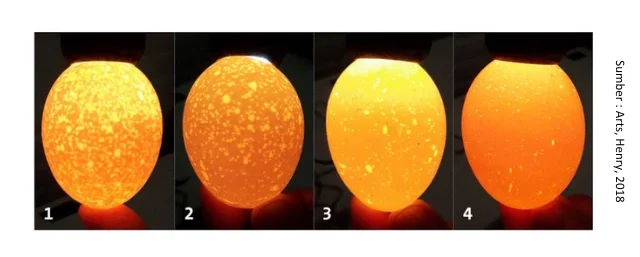
Note:
1: very speckled; 2: speckled; 3: lightly speckled; 4: less speckled
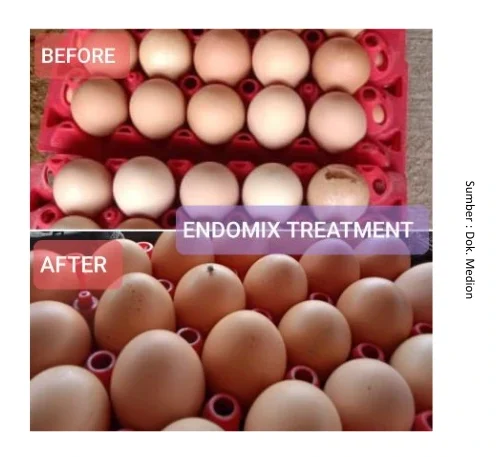
In addition, the combination of trace minerals contained in Endomix also helps optimize eggshell quality, including shell color. This is useful in field cases where eggshell quality becomes uneven or pale. Moreover, when hens are older (the older the hen, the paler the shell color), adding Endomix is the right choice to maintain eggshell color.
Several micronutrients such as Fe, Cu, Mn, and Zn function as chelating agents within the molecular structure of protoporphyrin IX (Solomon, 1987). Therefore, when the supply of micro minerals is adequate, the eggshell pigmentation process becomes optimal.
- Antioxidants
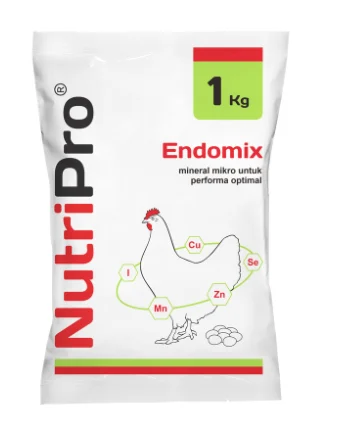
Modern hens are more susceptible to stress, which can trigger increased production of free radicals in the body. Several micro minerals (trace minerals) act as antioxidants with the ability to neutralize these free radicals. Such trace minerals include Zn, Se, and Cr. Supplementation of trace minerals can be added to feed using products like Endomix, which contains a combination of essential trace minerals.
- Immune System
One of the indicators used to assess livestock health is the measurement of lymphoid organs. Fahrina et al. (2021), in their study on native IPB-D3 chickens supplemented with 60 mg/kg of Zn, compared spleen size (an immune organ) between the Zn-supplemented and control groups.
The results showed that Zn significantly affected spleen percentage. Chickens fed without Zn had larger spleens, although still within the normal range. The spleen weight percentage observed in the study ranged from 0.14–0.19%, while the normal range is 0.11–0.23% of live body weight. According to Jamilah et al. (2013), the spleen enlarges (swells) in diseased chickens due to the accumulation of more antigens, indicating an immune response to infection.
That’s a brief overview of the role of trace minerals in poultry feed. Hopefully, it will be useful.