Vaccination is the act of giving a vaccine to stimulate the formation of protective antibodies and uniform according to the type of vaccine given. In order for the formation of chicken antibody titer to be optimal, vaccination must be carried out appropriately.
One factor that needs to be considered that can affect the success of vaccination is the proper storage and handling of vaccines. How to properly maintain the quality of the vaccine to keep it good?
Quality Vaccine
The World Animal Health Organization (OIE) states that in order to achieve an optimal level of protection against disease, the vaccine used must be of good quality. In principle, a good quality vaccine is a vaccine containing a virus that is homologous to a field virus and comes from a virus isolate that has been characterized (purified).
A homologous vaccine will provide more optimal protection, so that livestock will not be infected with the disease, the decline in production does not occur and viral contamination of feces or respiratory tract (shedding virus) can be pressed.
In addition, the vaccine must also have a stable genetic composition, the inactivation process is perfect in inactivated vaccines (through laboratory tests), free of contamination of other infectious agents, contain high concentrations of antigens, use adjuvant high quality, and has a high level of safety, potency and effectiveness (passed laboratory tests and field tests).
However, a vaccine with good quality is still not enough to guarantee its success in forming protective immunity. Other risk factors that often hinder in terms of storage or handling (handling) the vaccine.
Cold Chain System
Management / arrangement of products during the storage and transportation period is in the range that is in accordance with the requirements to maintain quality (potential, etc.) from the manufacturer to the hands of users.
In the case of patients who have been diagnosed with CKD (quality control), stored in cool room the vaccine has a temperature of 2-8°C. Should cool room this is in addition to being available at the factory, it is also available in the marketing area/distributor vaccines.
Preparation of the vaccine in cool room it should also pay attention to the density of the pile so that the circulation of cold air is evenly distributed. Furthermore, from the factory, the vaccine is distributed to the Marketing/distributor area using a special vaccine delivery car equipped with a cooling machine so that the temperature is maintained.
Proper storage system
Understanding how to store the correct vaccine so that the vaccine is still in good quality when given to livestock, some things that need to be considered include :
- When the farmer has purchased the vaccine, store the vaccine in a refrigerator set at a temperature of 2-8°C.
- Store the vaccine in the refrigerator and not in the refrigerator freezer.
- All types of vaccines, such as Medivac AI, should not be stored at temperatures adjuvant (carrier substance) the vaccine virus will be damaged at freezing temperatures. That means, the vaccine virus in it will also not be able to survive long if adjuvant- it's broken. To avoid this, then application of cold chain (cold chain) must be done by producers and vaccine users (breeders, red).
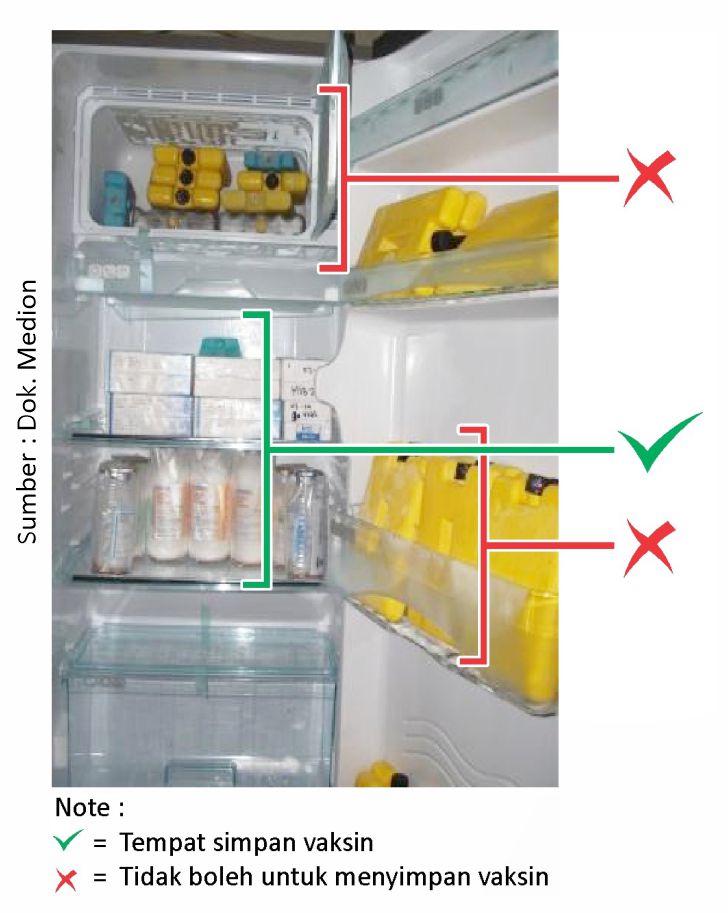
- The refrigerator should be set aside only for storing vaccines. Do not open the lid of the refrigerator too often so that the temperature in it remains stable.
- Do monitor refrigerator temperature routinely so that refrigerator damage is detected early.
On farms, there are often cases of power outages that result in the death of refrigerators. In such conditions, over time the temperature of the refrigerator will increase. As long as the refrigerator temperature is still in the interval of 2-8°C, this will not affect the quality of the vaccine.
However, if the temperature of the vaccine has been outside the interval of 2-8°C within > 2 hours (for active vaccines) or > 24 hours (for inactivated vaccines), then the vaccine should no longer be used even though physically there is no change. When the refrigerator temperature exceeds the storage temperature limit, which is 2-8°C, it is feared that the content of vaccine microorganisms has lost its potential and is not able to stimulate the formation of antibody titers optimally.
Therefore, when the power goes out and we don't have an electric generator (genset), then the alternative is that we can add some ice cubes so that the refrigerator temperature remains optimal for storing the vaccine.
The use of vaccines in the field
There are several aspects that need to be considered in vaccine handling in general, namely:
- Vaccine dispensing from the storage room must pay attention to the expiration date (FEFO, First Expired First Out) and vaccine entry sequence (FIFO, First In First Out).
- Check the condition of the vaccine when it will be used.
- When distribution and temporary storage, the temperature of the vaccine is always conditioned 2-8°C.
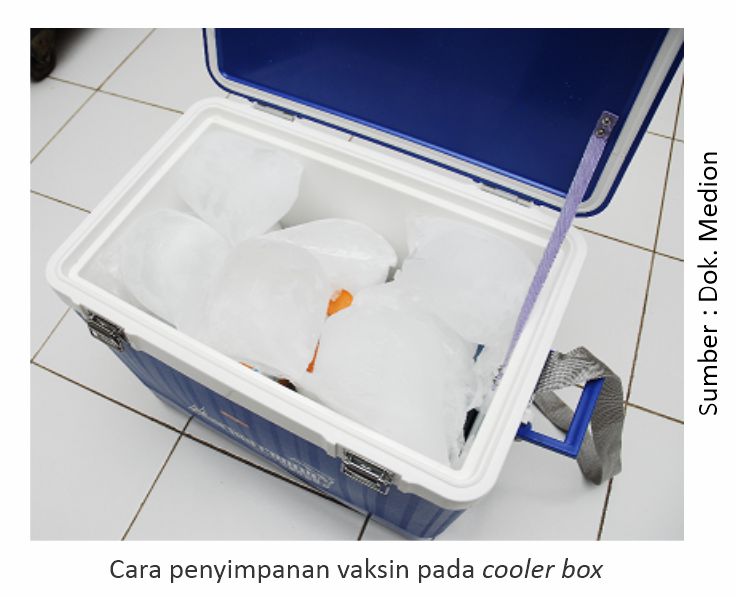
- Put the vaccine in the middle marina cooler/ ice flask/filopur, only then give ice cubes/ice pack frozen/ thermafreeze freeze around and above the vaccine. The ratio of vaccine and Ice Cube is about 50% : 50%. Do not carry the vaccine in plastic because it is feared that the temperature in it does not reach 2-8°C.
- Before giving it to chickens, do not forget about the process thawing (increasing the temperature of the vaccine gradually from 2-8°C to close to chicken body temperature / room temperature). The trick is to hold the vaccine until it doesn't feel cold anymore. This must be done to prevent chickens from being stressed by sudden changes in temperature, and so that the vaccine is easily absorbed in the chicken's body. One thing that also needs to be remembered during the vaccination process is that the vaccine does not need to be given ice cubes anymore. The vaccine is no longer available in marina cooler the temperature is 2-8°C because it can lower the potency of the vaccine. Inactivated vaccines should be administered immediately after the process thawing and should be discharged for 24 hours.
In order for the immunity of the vaccination result to be optimal, you should pay attention to the following points when vaccinating:
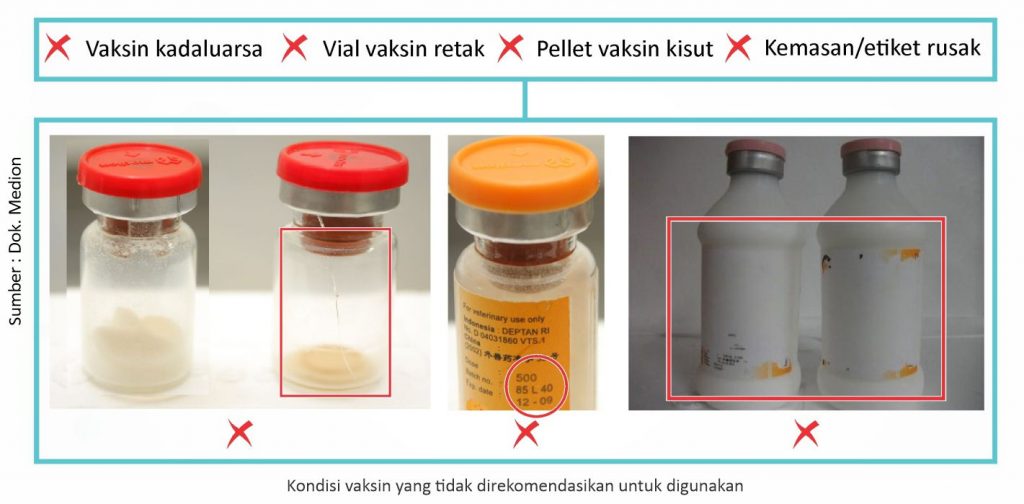
- Do not use the vaccine if the bottle is cracked or the seal is damaged and note the vaccine batch number and note the expiration date
- The chicken to be vaccinated is in good health. For example, if chickens are affected by korisa, treatment should be done first.
- Use the recommended vaccination technique (proper technique) and if using a syringe, make sure the syringe used is sterile. The syringe used can be a manual syringe/disposable syringe or if the number of chickens a lot can use an automatic syringe/Socorex which can be sterilized and reused.
- When vaccinating via drinking water, make sure the drinking water used to dissolve the vaccine is free of chlorine, disinfectants, or metals (iron, Ca, Mg, etc.) and has a neutral pH. To it, add Medimilk 10g / 5L or Netrabil 5g / L of drinking water 30 minutes before the vaccine is dissolved to improve the quality of the water, so as to keep the vaccine working well during administration.
- Make sure each tail gets the same and uniform dose. When vaccinating, avoid rough treatment that causes chickens to stress or inject incorrectly and do not rush, no chickens are missed not vaccinated and pay attention to the vaccine time limit after dissolving.
Maintaining the quality of vaccines is not limited to storing them at cold temperatures. Many critical points must be continuously controlled starting from upstream to downstream, meaning that since the vaccine is finished being produced until it reaches the hands of farmers. This is none other than the aim that a quality vaccine is able to form immunity in chickens optimally. Greetings.