One of the chicken rearing period that determines the success of the achievement of performance is the period brooding period,. Time brooding period, or the brood period in chicks lasts until the chickens are 2 weeks old. At this time the chicken will experience very rapid growth and includes all the organs that play a role in the life and productivity of chickens.
This will greatly affect the performance of chickens in the next maintenance period. Some parts are experiencing rapid development during brooding period, is the immune system, digestion and regulation of body temperature. In addition, there will be growth and development of bone skeleton and muscle mass.
The survival of chicks largely depends on the conditions of the cage brooding period,. This is because chicks at this time do not have a perfect thermoregulation system so they cannot regulate their body temperature properly.
Extreme ambient temperatures will easily make chicks suffer stress, grow slowly, experience health problems, and even die. Therefore, the heater becomes one of the components that are needed during the period brooding period.
The role of heaters for the comfort of chicks
Future success brooding period, will be achieved when using the heater properly so that the chicks will feel comfortable. The comfort of the chicks can be described by activity and dispersal in the cage. The ideal temperature will make the chicks spread evenly and move normally.
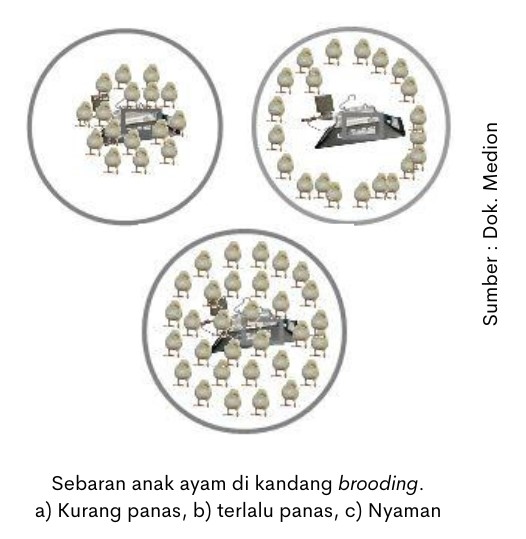
Temperature control brooding period, it needs to be done periodically and as often as possible to ensure that the temperature is in accordance with the needs. The ideal temperature requirement for chicks will depend on age. The older the age, the lower the required temperature will be. The standards for air temperature requirements for each age of chickens are attached to the Main article in Table 3.
Heating for Time Brooding
There are several types of heaters that are commonly used by farmers during the brooding period, such as gas-fired heating, firewood, coal and kerosene. However, the use of gas-fired heating will be easier and more practical to do than the use of other heaters.
The use of other fuels has some drawbacks, such as unstable heat/difficult to regulate and smoke generated, then the use must be considered by farmers.
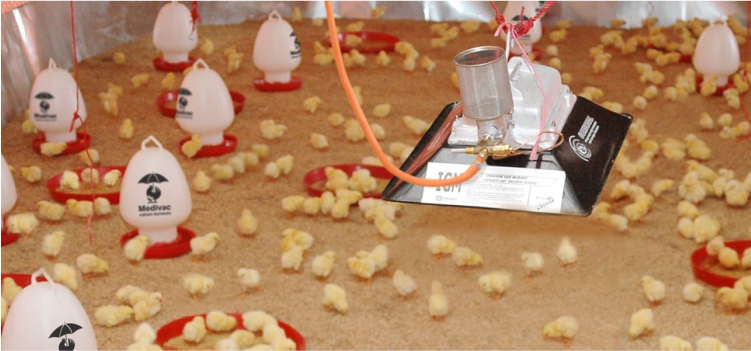
Gas-fired heaters are more widely used by farmers because they are easy to install, durable and safe. The heat produced is stable, focused, does not cause noise or air pollution (smoke), and the temperature can be adjusted as needed. An example of a gas-fired heater is a brood Gas Medion (IGM) and Super Saver.
IGM is an artificial heater for chicks belonging to the breed spot heater. This type of heater only heats a certain point or area in the cage so that fuel consumption is more efficient.
The heat generated from IGM is radiant infrared which is easily absorbed and optimally gives heat to chicks. Heat from infrared can enter the Chick's body until the blood vessels dilate and blood flow becomes smoother.
Other heating options are Super Saver which includes Type central heater/space heater that will heat the air throughout the cage. Space heater usually placed in front of the area brooder with relatively slow air movement to create more optimal air heating.
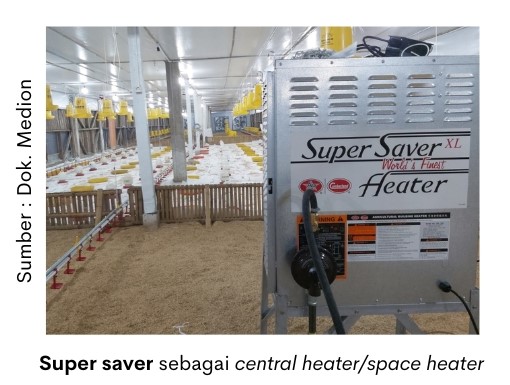
These two types of heaters can be used together to get the best results. Space heater like Super Saver will work to warm the room air while some spot heaters such as IGM work to warm certain areas of lower temperature.
Efficient Use Of Gas Heating
The biggest cost of using a gas heater certainly comes from the investment costs of purchasing and refilling LPG gas cylinders. In an effort to reduce these costs, it is necessary to save or streamline the use of LPG gas during brooding period,. Efforts that can be done, among others:
Regulating gas consumption
The first way to save gas is to regulate the use of heating but still have to meet the temperature needs of the chicks. To find out whether the temperature of the cage is according to the needs of chicks or not, temperature control can be done regularly. Temperature control can be done 1-3 hours after chick in and continued 2-3 hours. Position the thermometer for temperature measurement at a height of 20-30 cm from litter.
To save the use of LPG gas, during the brooding period, the heater does not need to be turned on for 24 hours. The heater can be turned on by adjusting the target temperature needs of the cage environment at that age because the chicks are still susceptible to cold temperatures and still depend on the heater. The next day after more than 3 days of age, the use of heaters can be gradually reduced according to the conditions of the chicks and the weather in the local area.
Pay attention to the condition of the hose and gas cylinder
Other things that can be done to ensure there is no gas leakage on the gas hose, hose clamps or LPG gas cylinders. If there is a pungent smell of gas, immediately check the origin of the source of the odor then immediately make repairs if there are damaged components.
Installing the heater correctly
The installation of the heater will determine whether the heat felt by the chicks is optimal or not. Note that the number of heaters installed in each enclosure brooding period, must be adjusted to the capacity of each type of heater. In addition, the installation position of the heater must be right so that the heat can be evenly distributed to all chicks.
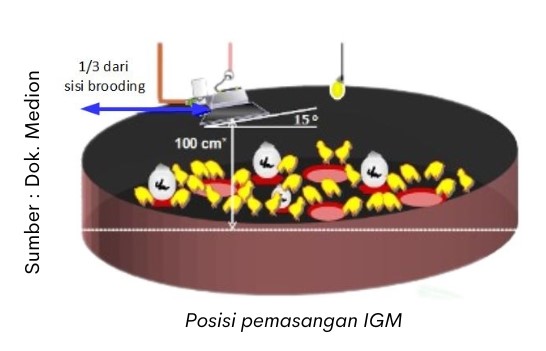
One IGM it can be used as a heater for 1000 chickens in a 4.5 m diameter chick guard area. Installation way IGM need to be hung on the edge of the area chick guard (1/3 area of the edge) at a height of 100 cm from the surface of the cage floor with a slope angle of 15° towards 2/3 of the other cage area.
Installation of a heater with an angle of 15° serves to evenly distribute heat over a larger area. In addition, the heat generated is focused on the heated area and is not dissipated into other areas.
As for one Super Saver it has a capacity of 10,000 DOC so it offers practicality for cages with more population. Generally space heater laid out on the ⑧ of the entrance or the front of the area brooding period,.
Minimum distance Super Saver against the base of the cage is 0.5 meters and placed with a minimum distance of 3 meters from the area brooder. Husks, rations, and other materials should not be stacked on top of the machine and keep flammable materials from space heater.
Storage and maintenance of heaters
In order for the heater to function properly, it must be routinely maintained. Storage should not be arbitrary because if one part of the heater clogged with dust and dirt, the heat that comes out will not be optimal. This causes farmers to increase the volume of gas so that the use of gas will be more wasteful.
Here's how storage and maintenance of gas heaters are recommended:
- Keep the heater in clean condition. Clean spare part heating from dust regularly. For example, after the heater is finished using or once every 2-3 days. Use a low-pressure air spray to clean dust on the outside and inside of the heater. Do not use high-strength sprays, water, or chemicals to clean the heater.
- Keep the heater in a dry and clean place. Do not keep the heater on the floor or in a damp place.
- Put the heater in a wrapping bag/cardboard box when storing to protect against dust adhering.
- If a malfunction of the gas heater is noticed, do not attempt to dismantle it yourself. Immediately contact the field officer of the relevant gas heating manufacturer. IGM dan Super Saver it is a gas heater that provides free service and is valid for life.
Thus the discussion about the importance of heating in the future brooding period, for convenience, reduce the risk of death and optimize the growth performance of chickens. May be useful.