

Cats, as beloved household pets, can contract diseases through various means—either by exposure to infectious agents in the environment while playing or through contact with other infected cats. In Indonesia, a tropical country, one of the most common diseases affecting cats is worm infestation.
Worm infestation can occur in both kittens and adult cats, although kittens are more susceptible. Infected cats may experience stunted growth and other health problems such as anemia. Cat owners should be cautious, as worm infestation can easily spread between cats and even transmit to humans (zoonotic disease).
How Do Cats Get Worm Infestations?
Worms have a life cycle that generally begins with eggs, followed by larvae, and then develops into adult worms. The most common types of worms found in cats are roundworms and tapeworms. Cat owners should be aware of these two types, as their transmission can occur through various different routes.
A. Roundworms
One of the most common worms found in cats is Toxocara cati. The transmission of this type of worm begins with its eggs (infective stage), which are excreted along with the feces of an already infected cat. These eggs can then contaminate the surrounding environment and various media.
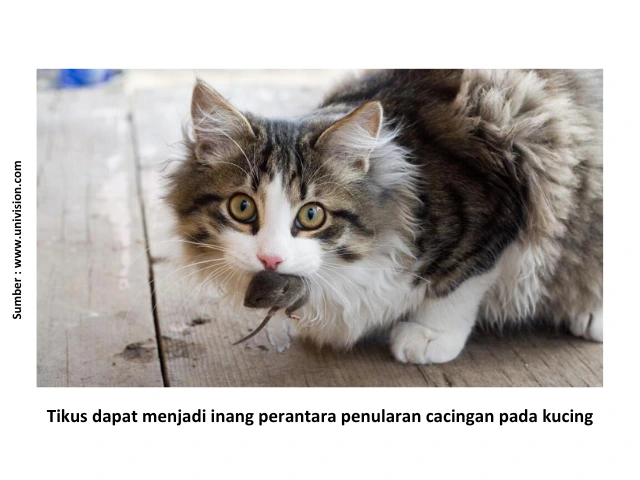
A healthy cat can become infected with worms after accidentally ingesting worm eggs present in contaminated food or the environment. Transmission may also occur when a cat eats an intermediate host, such as a mouse, that already carries worm larvae within its body.Select 57 more words to run Humanizer.
It should also be noted that in kittens, transmission can occur through the mother’s milk if the mother cat is already infected with worms.
Another type of roundworm that can infect cats is Ancylostoma. The transmission of this worm is quite similar to Toxocara cati, but its infective stage occurs during the larval phase of its life cycle.
Thus, transmission occurs when a cat ingests Ancylostoma larvae present in contaminated media (such as food, drinking water, or others) or consumes an intermediate host (such as a mouse) that carries the worm larvae in its body.
Another route of transmission can occur when worm larvae penetrate through the skin and then migrate to various organs, including the digestive tract.
B. Tapeworms
One of the worms in this category is Dipylidium caninum. The transmission of this worm involves a parasite that lives on the cat’s body (ectoparasite), namely fleas. Worm eggs present in the environment are ingested by flea larvae, and the eggs then develop within the body of the flea larvae.
The flea larvae then develop into adult fleas while still carrying the worm larvae in their bodies. A cat may accidentally ingest these fleas while grooming its body (grooming), allowing the worm larvae to be ingested and subsequently develop into adult worms in the cat’s digestive tract.
Cat owners should be vigilant about worm infestations, as the transmission of this disease is not limited to cats—humans can also become infected. Transmission to humans occurs in the same way as in cats, namely through accidental ingestion of worm eggs that have contaminated hands, food, or other media.
Other routes of transmission, such as skin penetration (by Ancylostoma worms) and accidental ingestion of fleas (carrying Dipylidium caninum worms), can also occur in humans.
Break the Worm Transmission Cycle!
Living in tropical regions, which are ideal for parasite development, poses a constant risk of worm infestations affecting cats’ health. Therefore, as a cat owner, it is essential to take preventive measures to break the worm transmission cycle in cats, including:
- Provide a litter box with litter (Dr. Litter) so that cats have a designated place to relieve themselves. If there is more than one cat in the household, a litter box should be provided for each cat. Regularly clean the litter by removing waste daily and thoroughly wash the litter box once a week. After cleaning, use a disinfectant (Medisep/Formades) on the litter box.
- Implement a deworming program by administering worm medicine regularly to break the life cycle of worms in cats. Vermistop can be given to cats and is effective against roundworms, which commonly affect cat health.
Administer 0.5 ml of Vermistop per kilogram of the cat’s body weight. It can be started for kittens older than 2 weeks and is also safe for pregnant cats. In addition to the deworming program, Vermistop can be used to treat cats already infected with roundworms. - Eliminate ectoparasites on cats by administering Endtick. A cat free from ectoparasites can avoid various other diseases, including worm infestations. This relates to the earlier explanation that ectoparasites (fleas) can serve as intermediate hosts in the transmission of tapeworms (Dipylidium caninum).
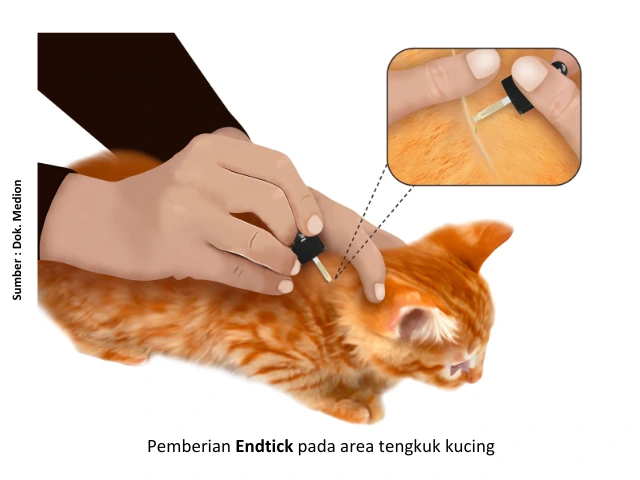
Endtick can be used as an effective anti-ectoparasite treatment to eliminate fleas, ticks, and mites on cats. Apply 2 drops per kilogram of the cat’s body weight on the nape of the neck once a month. However, note that Endtick should only be used for cats weighing more than 1 kg or older than 2 months.
- Control or eliminate rodent pests in your home and surrounding environment. While your beloved cat may enjoy hunting prey such as mice, it is best not to allow your cat to catch or eat them. This precaution helps prevent the transmission of worm larvae from the mice.
- Avoid feeding cats raw meat. Provide cat food (Delicats/Kadofu) that is guaranteed to be hygienic and contains nutrients suitable for the cat’s needs.
- Regularly clean the cage, cage lining, and surrounding environment to minimize worm eggs and other pathogens. Also, spray an environmental anti-ectoparasite treatment such as Delatrin, which is effective in eliminating fleas, ticks, and mites in the environment.
- Maintain personal hygiene by washing your hands after cleaning the litter box or after any contact with cats.
The high incidence of worm infestations in cats and the ongoing risk of transmission can be prevented by implementing a cat health program and maintaining a clean environment. This ensures that your beloved cats remain healthy at home while reducing the risk of zoonotic transmission.