Ibu Eka Wulandari – by email
I am a breeder of laying Quail, pure full feed and 3 months old. How to make optimal egg production 90% because sometimes experienced in 3 days only lay eggs 1 time?
Answer:
Thank you Mrs. Eka for the question submitted. There is a decrease in egg production only once for three days, it is necessary to dig deeper into what the cause is. Broadly speaking, there are two factors that affect the performance of egg production, namely infectious and non-infectious factors. The two factors can be related to each other so that the impact is greater. It is common to see decreased egg production in chickens with diseases such as infectious diseases such as ND, AI, EDS or IB. Meanwhile, if from non-infectious factors, the cause of egg decline could be due to poor DOQ quality, lack of nutritional rations and drinking water, poor air circulation and lighting programs and stress disorders due to rough handling.
In order to achieve optimal production performance, here we describe some important key actions that must be carried out from the start of production, including :
- Genetics and uniformity
Selection of DOQ seeds with genetic potential that has been crossed and the performance results are quite good.
2. Adequate nutrition
The quantity and quality of the ration provided is decisive for the production and quality of quail eggs. The fulfillment of the need for these nutrients, will produce quality eggs, and also play a role in increasing the amount of quail egg production. Provide rations with nutrients that match the needs of chickens in each period of their maintenance, especially the content of protein, amino acids, energy, fatty acids, calcium, phosphorus, as well as vitamins A, D, E and K. If the quality of the ration is not good, add Top Mix to improve its quality. In addition, provide adequate and quality drinking water.
3. Maintaining Quail health
Quail has a fairly high body resistance to disease, but vaccination is still needed to bully the immune system so that the Quail's immune system is more optimal. Some things that need to be considered in vaccination are vaccination programs adapted to local conditions, proper vaccine administration techniques, uniform vaccine doses, and given to healthy quails. Use good quality water if vaccinations are given through drinking water. Make sure the syringe is sterile and the needle is sharp if the vaccine application is by injection. Vaccination can be done to prevent diseases that affect egg production such as ND, AI, EDS and IB. In addition to vaccination, supplementation aims to reduce stress, increase stamina and body power, and maintain optimal productivity. Some of the products that can be given include Quail Vitanak, Vita Stress, Quail MediEgg and Imustim.
4. Minimise disease seeds
Minimize disease seeds in the cage with the following routine activities:
- Job descriptions: responsible to ensure the quality of the product and the quality of the product. responsible to ensure the quality of the product. responsible to ensure the quality of the product. responsible to ensure the quality of the product. responsible to Medisep and drinking water sanitation with Desinsep. Apply footwear dip before entering and exiting the cage.
- Drinkers should be washed and disinfected every time the farmer will change or fill drinking water, while the feeders, which are usually in the form of long wooden boxes, are sufficiently dredged to prevent mold from growing on damp rations. Remove accumulated feces daily.
- Pests that often disturb Quail livestock include rats, cockroaches, and ants. Prevention against rodent pests can be done by setting rat traps. If pesticides are needed, use them wisely.
- Separate the sick Quail, while bury or burn the carcass of the dead quail.
5. Comfortable cage atmosphere
The cozy atmosphere of the cage for quails includes:
- Smooth air circulation can prevent the transmission of disease seeds through the air that rotates in the cage.
- Avoid noisy and noisy atmosphere because it will create stress Quail.
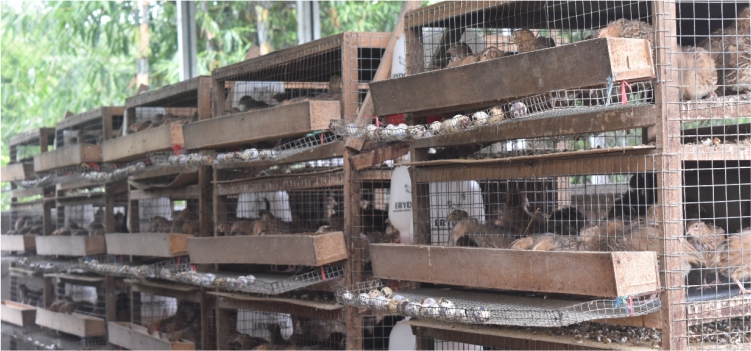
- The spacious cage can guarantee all quails get ration, drinking water and oxygen evenly. The density standard of production phase laying Quail according to Sudjani (2016) is 50 head/m2.
- In the egg-laying phase, lighting has an effect on ration consumption and egg production. It is better to provide lighting for quails for 24 hours, especially for quails that are just starting to lay eggs. However, lighting can be provided 15 hours after all the quails have laid their eggs.