Mr. Herwandi – By email
As a livestock farmer who mixes my own feed, sourcing corn and BKK is quite difficult due to limited availability and rising prices. How can I maintain feed nutrition while meeting my livestock's needs cost-effectively? Does Medion have any suggestions for alternative raw materials?
Answer :
Dear Mr. Herwandi, thank you for your question. Feed ingredients such as corn and soybean meal (BKK) make up a fairly high proportion of feed formulations.. Corn is generally a primary energy source, accounting for approximately 40-55% of the total, while cassava starch is the primary protein source, accounting for approximately 20-35% of the total feed formulation. Therefore, changes in the prices of these two raw materials can directly impact feed costs. This is a significant concern, as feed costs can account for approximately 70% of total production costs in poultry farming (Akhadiarto et al., 2025).
In 2026, the government took various steps to maintain the availability and price stability of feed ingredients, including the Corn Food Supply and Price Stabilization (SPHP) program and the policy of centralizing BKK imports through Perum BULOG/Berdikari. The Ministry of Agriculture stated that current pressure on feed prices is influenced by a combination of global and domestic factors, one of which is the change in the rupiah exchange rate against the US dollar, which can impact the prices of imported feed ingredients, such as BKK. Corn Gluten Meal (CGM), minerals, and other imported raw materials. This situation is also reflected in several regions, where, based on information received from customers as of September 21, 2026, the price of corn received was in the range of IDR 7,100–7,300/kg, while the BKK price had reached IDR 9,000–10,000/kg, both on and off the island.
Why is it necessary to look for alternative raw materials?
In the face of rising raw material prices, feed formulation cannot be based solely on the price per kilogram. Each raw material must be evaluated based on its nutritional contribution, including energy, protein, amino acids, fat, phosphorus, and fiber, as well as its availability to livestock. This aligns with the principle of feed formulation, which is to meet chickens' nutritional needs through the right combination of raw materials while still considering ration cost efficiency (Liu, 2011).
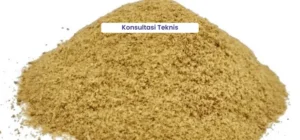
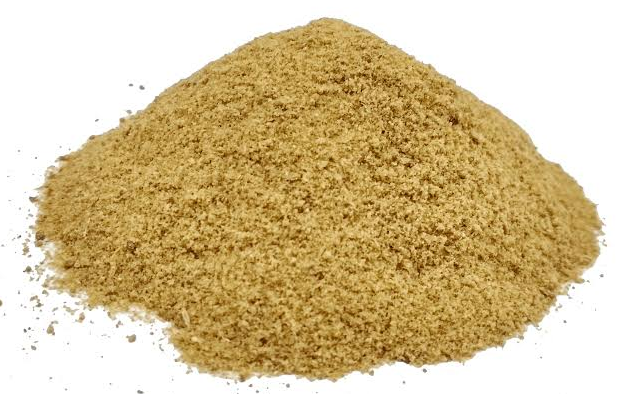
One way to maintain ration cost efficiency is to utilize alternative raw materials that can still meet the chickens' nutritional needs. Some alternative raw materials with the potential to be used as protein sources include: Distillers Dried Grains with Solubles (DDGS), Corn Gluten Meal (CGM), Corn Fermented Protein (CFP), palm kernel meal, Full Fat Soybean, and Rice DDGS. Among these materials, Rice DDGS can be an alternative raw material for protein sources and can even be used as an energy source in feed formulations. (Figure 1).
Rice DDGS As An Alternative
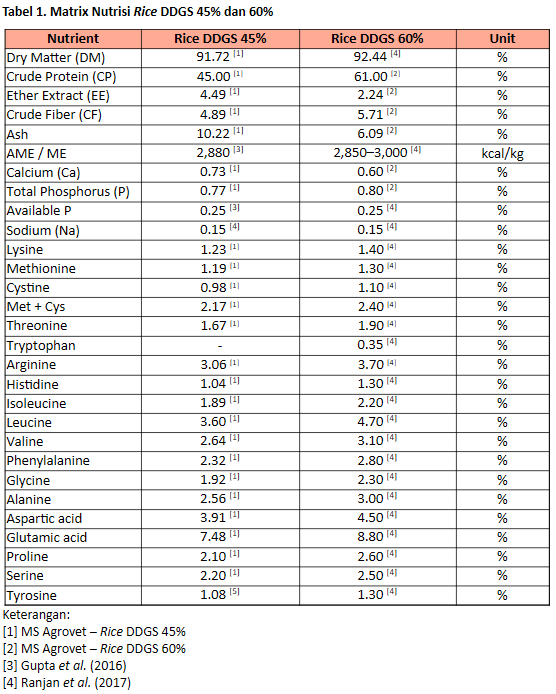
Rice DDGS is a byproduct of the rice-based ethanol production process. During fermentation, most of the starch in rice is converted into ethanol and carbon dioxide, while the protein, fat, minerals, and other nutritional components remain in the residue, which is then dried into a powder. rice DDGS (Liu, 2011). Singh's research et al., (2011) show that rice DDGS is a source of energy and contains easily digestible amino acids and readily available phosphorus, which have the potential to be used in feed. However, its nutritional content... Rice DDGS can vary depending on the raw material and production process, including fermentation conditions and processing. The following are some of the nutritional values of the raw materials. Rice DDGS (Table 1).
Usage Rice DDGS for Livestock Farmers Self Mixing
The use of alternative raw materials can provide opportunities to optimize feed costs, especially for livestock breeders. self mixing. Rice DDGS is widely used as a substitute for BKK raw materials such as research. Khose at al. (2021) on broiler show that rice DDGS can be used as a partial protein replacement with the addition of enzymes. In laying hens, rice DDGS has also been studied by Raju et al. (2023) as an alternative feed ingredient. Raju et al. (2023) reported that the use of rice DDGS up to 7.5% did not have a negative effect on egg production, feed efficiency, and egg mass, while the use of 15% decreased several performance parameters and nutrient retention. Vinay's research et al. (2019) on laying hens showed that rice Up to 10% DDGS can be used with enzyme supplementation. Based on this data, the use of rice DDGS can be given 7.5-10% in the feed composition.
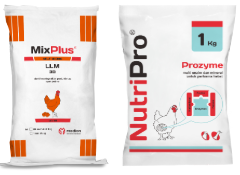
On the breeder self mixingMicronutrient needs also need to be considered when macronutrient raw material formulations change. Therefore, the use of premixes can be part of a strategy to help meet micronutrient needs in rations, such as Mix Plus LLM3B to top up and back up micronutrient needs. Usage rice DDGS also needs to consider the presence of antinutrients such as phytate and NSP, which can limit nutrient utilization. Enzymes are provided to help increase the availability and utilization of nutrients from rations containing rice DDGS like Prozyme which contains multienzymes, namely phytase, xylanase, amylase and protease and is equipped with a biocatalyst that accelerates the work of the enzyme (Figure 2).
Therefore, the use of alternative raw materials in feed formulation can be considered when corn and BKK are limited and their prices continue to increase. Rice DDGS can be an alternative in formulation self mixing as a source of protein and energy, while still considering ingredient quality, usage level, nutrient balance, and nutrient availability. Changes in raw material composition also need to be accompanied by adjustments to vitamin, mineral, and enzyme requirements to help optimize nutrient utilization. Thus, alternative raw materials are not simply substitutes for corn or BKK, but rather part of a formulation strategy to maintain feed cost efficiency without compromising chicken needs and performance.