What are the causes of chickens not laying eggs?
Mr. Supriyadi from Semarang-Central Java
Why do laying hens (layer) can you stop laying eggs? It occurs in chickens older than 50 weeks. After surgery does not indicate the chicken is infected with a disease that attacks the reproductive tract. Is there anything other than a disease that causes my laying hens not to lay eggs again? For the answer I thank you.
Answer:
In the system of keeping laying hens, the key to the success of the chickens develop and lay eggs optimally is in terms of management. This is certainly supported also by genetics and feed consumed.
The cause of your chicken can not lay eggs after that age can be caused by several things as follows:
1. Diseases
There are several specific diseases that can attack the reproductive organs of laying hens so that the chickens stop producing. These diseases include ND, IB and AI. In addition, the cessation of laying eggs can be caused by the condition of the body that is not good or in a state of immunosuppressive, so that when a secondary disease infection can lead to permanent damage to the reproductive tract. It would be nice, to ensure the presence of infection in the chicken, you can take samples to be tested in the laboratory.
2. Quality pullet and bad laying hens
If the quality pullet less, then the quality of chicken production or layer nor will it be good, so it does not have a long production persistence. This is what causes the laying hens to stop producing faster. The importance of this management control especially during the first 5 weeks or while in Phase starter where in this phase there is hyperflasia or cell multiplication, there is also the growth of important organs such as respiratory, digestive, immune and reproductive organs. In addition, this week, attention should be paid to diseases that can cause stunted growth of the reproductive organs.
3. Improper feed
Giving the wrong Feed, reducing the dose or limiting the amount of feed available can lead to malnutrition in chickens. If feed intake or feed consumption does not enter, it will correlate with the formed body weight. The importance of weight control every week at the time starter, Once every 2 weeks for Phase grower, and once every 1 month for the phase layer is to evaluate if there are chickens that are late in achieving their body weight. When the body weight drops dramatically or does not match the standard, it is impossible for the chicken to produce eggs. What must be considered in the feed is the nutritional content contained must be sufficient to meet the basic needs of life and production. On time pullet, laying hens should be given grit to stimulate cache magnification for targets feed intake can be achieved. In addition grit used for calcium reserves when laying hens will enter the egg-laying phase. In the phase layer or egg-laying, the protein required by the chicken will be greater than the time of the phase grower. The Protein is used for egg laying mainly the production of egg white or albumen. Do not reduce the amount of feed when laying, especially during the beginning to the peak of production.
4. Severe stressful conditions
Stress can arise from treatment or management, Feed changes, inappropriate environments or in response to an infecting disease. Chicken layer now it will be genetically easier to stress and sensitive to feed changes. Excessive stress in chickens will have the potential to be immunosuppressive so that the immune system will decrease and secondary diseases will be easier to infect. In addition, prolonged stress in chickens will affect production that decreases or even stops permanently.
5. Hair lossmolting)
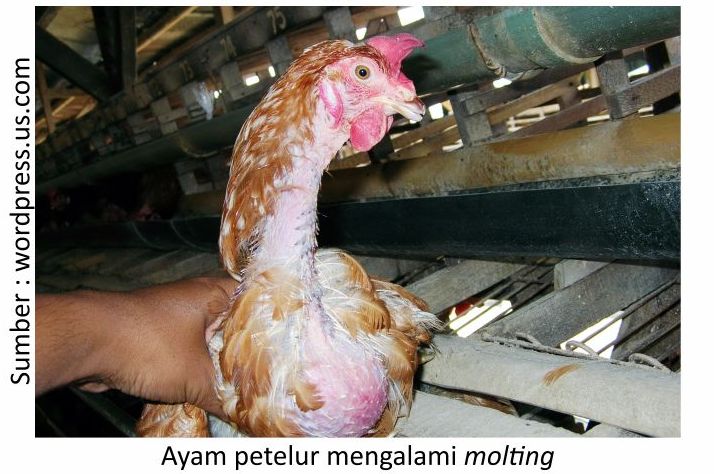
Molting it is a natural process that usually occurs in laying hens that have been producing for quite a long time and lasts for ± 4 months. Nevertheless, the process molting can be accelerated by applying the method molting force or force moltingtreatment,which takes only 6-8 weeks. In the field itself, the technology force molting this is what breeders usually apply. Force molting has a close relationship with egg production, during which force molting there will be a drastic decrease in egg production or the chicken stops laying altogether, as well as a decrease in body weight. After the program force molting ends (already more than 30 days), then the chickens can be given a complete ration with normal portions and the body weight will gradually increase again. As for accelerating the formation of feathers after the process force moltingaddition, can be given supplements containing amino acids, vitamin B complex, A, D, E and some essential minerals. Awarding Aminovit, Strong Egg or Mineral Feed Supplement A from the 31st day until the chicken enters the 2nd reject period, it is known to accelerate feather formation, suppress the effects of stress experienced by chickens and accelerate egg production with better quality.