Mr. Ahmad
Email : ahmadsanisantosa11@gmail.com
I would like to ask, How is the management litter/ husk from start starter up to finisher in the postal cage?
Answer :
Dear. Mr. Ahmad, thank you for the question. When to start maintenance, litter it should be prepared 3 days before the chicks enter (before chick in). Litter which is ready, then distributed evenly to all parts of the cage and sprayed with disinfectant to eradicate the seeds of the disease attached. When the time comes chick in, 2-3 hours before the chicken comes in litter re-disinfected. For this type of disinfectants are used such as Medisep or Antisep.
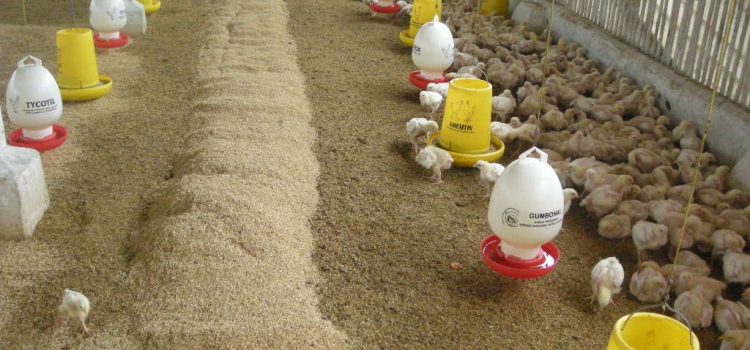
For postal cages, thickness litter the beginning is about 8-12 cm. In addition litter also need the addition of lime or zeolite. Sprinkle lime first on the earthen floor, and then stacked with husks. Lime or zeolite serves to help absorb water so that litter become drier. Lime is also useful to prevent the occurrence of coccidiosis that commonly occurs in chickens at the age of 3 weeks, because coccidia (the cause of coccidiosis) is not resistant to the heat produced by Lime.
If during maintenance the amount of litter wet or lumpy just a little, then it can be taken and replaced with litter new clean and dry. However, if litter wet/agglomerate a lot and evenly in the cage, then you should sprinkle lime and stacked with litter new. After that, immediately find and evaluate the cause litter wet/clumping. Add thickness litter at the beginning so that as an adult there is not too often an addition.
Here are some things to consider so litter stays dry and works well:
- Use litter with the appropriate thickness.
- From the very beginning of maintenance, carry out control litter regularly once every 3-4 days. If found litter it's wet, so take care of it litter the lump is in accordance with its condition.
- In the first week of brooding period,, use newsprint on top litter. In addition to working to keep chicks from eating litter, newsprint can also help speed up the drying of feces / chicken droppings.
- Fix if there is a roof of the cage or place / drinking water leak.
- Make sure there are no leaks on nipple and Chicken drinkers (TMA).
- Provide quality rations and drinking water so that the stool does not get wet.
- Control the density of the cage.
- Avoid hasty work, especially during the change of drinking water, do not spill it on litter.
- Ventilation of the cage should be good so that air circulation is smooth and the cage is not damp. Add a fan in the cage so that air circulation is smoother.
- Control the temperature, humidity and density (density) of chickens in the cage. Adjust the area of the cage to the number of chickens kept.