The appearance of symptoms of torticollis (twisted Chicken Neck) is always identified with the presence of infection Newcastle Disease (ND). However, the symptoms of torticollis is a strange thing when it appears in young chickens. Given the density of ND vaccination programs conducted in Indonesia both on breeding and commercial farms. In fact, in commercial chickens, nd vaccination has been given at a very early age, namely
Torticollis in young chickens
One farmer in West Java this morning was confused by the behavior of a group of chickens in one of the cages he owned. The age of the chicken is not even 3 weeks but it looks strange symptoms that appear such as the head and neck shaking or shaking subtly as if they were dancing and the frequency was frequent. The suspicion that arises at the sight of such changes leads to ND that one of the attacks can attack the nervous system of chickens. Then testing is carried out in the laboratory to confirm the cause. From the results of laboratory tests it was determined that it was not caused by ND but by disease Avian Encephalomyelitis (AE) or inflammation of the brain tissue.
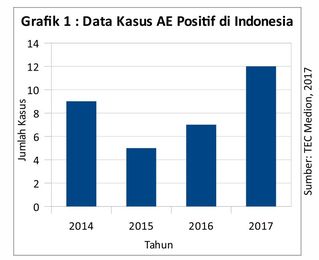
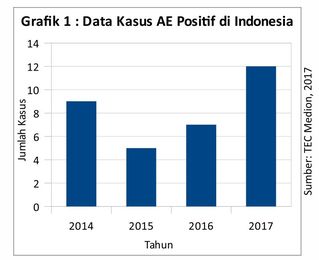
AE is a viral disease caused by picornavirus which can attack the nervous system of chickens, turkeys and quails. When compared with other viral diseases such as ND, AI or Gumboro AE cases are not so many. It's just the number of confirmed positive AE case reports with the test Polymerase Chain Reaction (PCR) increases every year (Graph 1).
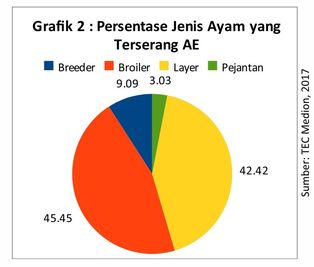
In addition, the types of chickens that are affected by this disease are chickens broiler followed by the chicken layer. On chicken breeder and commercial males, AE cases are also sometimes found although in small quantities (graph 2).
How does the AE case occur ?
Healthy chickens can become infected with this disease due to direct contact with sick chickens (horizontal). Transmission can also be transmitted vertically, namely from Broods that have been infected with AE before. Chicks that have just hatched from their eggs contain the AE virus and within a few days will show symptoms of the disease. The incubation period when the virus infection occurs in the incubator can last for 1-7 days but if the infection by contact, the incubation time required is at least 11 days. AE disease can affect all ages only the nerve symptoms that arise are only shown in young chickens aged about 1-6 weeks. This is in line with the data collected by the team Technical Education & Consultation Medion as seen in graph 3 below. While in adult chickens nerve symptoms do not appear but there is only a mild decrease in production.
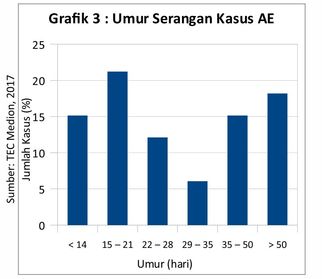
The morbidity (morbidity) of AE disease varies according to the transmission rate and can reach 60%. While the mortality rate (mortality) is relatively high when it reaches 50%. In addition to the mortality rate, the selection rate due to chickens that experience tremors or tremors is also high.
Some chickens are able to survive the attack of this disease allows its growth to be disrupted. In adult chickens, egg production can be abnormal or not according to the standard is also sometimes found in some tails appear cataracts (whitish membrane) in his eyes.
Clinical symptoms and Anatomical Pathology
Clinical manifestations that arise due to Ae virus infection are the appearance of nerve symptoms in young chickens. Signs, chickens stagger (ataxia), head and neck shaking or tremors therefore this disease is also called epidemic tremor. Sometimes the chicken neck is twisted (torticollis). If the chicken is disturbed, trembling will arise that lasts for a while and can occur again at irregular intervals until finally the chicken dies. Ae case report Data that goes to Tec Medion and has been confirmed positive for AE shows symptoms of head tengkleng-tengkleng, torticollis, tremor neck and head area, some chickens look collapsed like paralyzed.
In production chickens, there is a decrease in production of about 5-10% which usually lasts for less than 2 weeks followed by production back up. There is no decrease in the quality of eggshells due to AE infection, only in chickens breeder there is a decrease in hatchability by 5%.
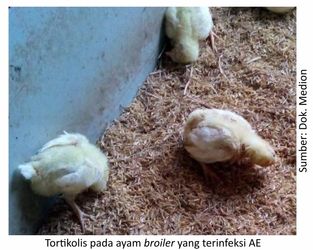
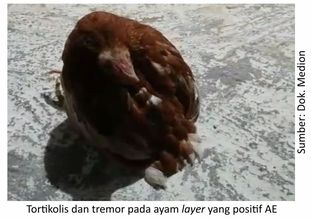
The examination (post mortem) in most cases, there are no visible signs of damage to the ventricles (gizzard). If the skin in the head area is opened, the inner brain Shell will look reddish. The study was conducted with a group of researchers from the University of Illinois at Urbana-Champaign (haemorrhages) mild-moderate.
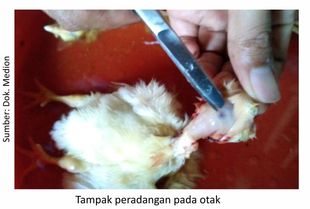
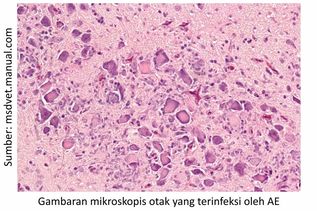
When microscopic observations (histopathological examination) found perivascular cuffing the brain cells in the brain (encephalomyelitis). In addition to the brain, these lymphocyte cells can also be found in the proventricular and ventricular muscles (gizzards).
Prevention & Treatment
There is no treatment for viral diseases such as AE, so prevention needs to be done by giving vaccinations, especially to chickens breeder. Vaccination can be given at the age of 10-14 weeks or no later than 4 weeks before the chickens lay eggs. The vaccine can be given to chickens through a wing puncture injection (.), using an active vaccine in combination with pox (smallpox) Medivac AE-Pox. Ae vaccination in chickens breeder dimasa grower plays a role to maintain egg production and prevent transmission from mother to Chick and ensure the hen has maternal antibodies from the mother that serves to protect the chicks in the early days of maintenance. While giving vaccinations to chickens layer commercial aims to prevent the presence of infections that can reduce egg production.
In addition to protecting the inside of the body with vaccination, it is better to combine with biosecurity and good maintenance management that is able to protect from the outside of the chicken's body. Practice biosecurity a good one can eliminate the challenge of the virus around the chicken so that the virus does not easily enter the chicken's body. Regularly maintain the cleanliness of the cage area and disinfection at least once a week during the maintenance period with Antisep, Neo Antisep or Sporades.
Because there is no treatment to kill the AE virus that has infected chickens, therefore what can be done when in farm the Ae outbreak :
- Immediately culling (reject) chickens that have signs of Ae infection. For dead chicks, the carcass can be destroyed by burning or burial.
- Give multivitamin preparations or immunostimulants such as Imustim to help increase the immunity of chicks.
- Immediately tighten biosecurity. Contaminated cages and equipment must be disinfected immediately. Characteristics AE virus is a virus that does not amplify the selection of disinfectants need to be considered. Choose a disinfectant that contains iodine or formaldehyde like Antisep, Neo Antisep or Sporades capable of killing the virus.
Many causes make torticollis in chickens. Therefore, more and more increase knowledge and increase accuracy in observing changes that are needed by farmers or livestock practitioners in maintaining chicken health for maximum productivity. Greetings.