Since the implementation of restrictions on use feed additive in the form of Antibiotic Growth Promotor (AGP), emerging challenges for the poultry industry include a surge in gastrointestinal diseases, decreased growth and production performance, stringent biosecurity requirements, and the need for effective alternatives to AGP. These restrictions relate to residues in meat, eggs, and other poultry products that contribute to antimicrobial resistance (AMR), where pathogenic bacteria become resistant to commonly used antibiotics.

Antibiotic Growth Promotor (AGP) in poultry feed aims to eliminate pathogenic bacteria in the digestive tract, thereby helping optimize performance and reducing the incidence of digestive diseases. In the field, various alternative types of AGP exist to ensure the same function, such as probiotics, prebiotics, phytobiotics, and so on. acidifier, enzymes, etc. This is done to ensure the maintenance and production of safe and healthy poultry products. The following are alternative types of AGP that can be used:
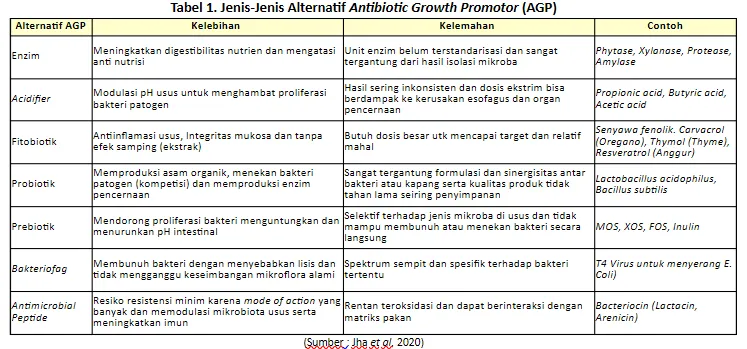
Of the several alternative AGPs available, probiotics are among the most frequently used in the field. Several studies have shown that probiotics can support chicken health and performance. Furthermore, the final product is guaranteed to be safer and healthier for consumers.
Definition & Types of Probiotics for Chickens
Probiotics are live microbes that are given directly to livestock with the aim of improving the balance of microbes in digestion and reducing unwanted microbes such as E. Coli, Salmonella, Clostridium, etc. (Fuller, 1997). According to Priastoto et al. (2016) probiotics are feed additive Live microbes that benefit the host's digestive tract. Some probiotics produce digestive enzymes that can increase the concentration of digestive enzymes in the host's digestive tract, thereby improving nutrient digestibility.
The microbiota is a collection of various microbes living in the digestive tract, consisting of bacteria, fungi, and protozoa. There are many types of microbes used as probiotics. Not all microbes can be used as probiotics, except those that meet certain criteria. The requirements for microbes that can be used as probiotics include (Gaggia et al. 2010 in Zurmiati et al. 2014) :
- Non-toxic and non-pathogenic
- Clear taxonomic identification
- Can live in the target species
- Able to survive, colonize and actively metabolize in the target (resistant to digestive fluids and bile, persistent in the digestive tract, adheres to epithelium or mucus and compete with host microflora)
- Producing antimicrobial compounds
- Antagonist against pathogens
- Can alter immune response
- Unchanged and stable during storage and in the field
- Survival in high populations
- Has good organoleptic properties
A key factor in selecting a good type of probiotic microbe is that it must survive in the digestive tract after passing through the stomach (resistant to acid and bile salts). Here are some types of microbes used as probiotics:
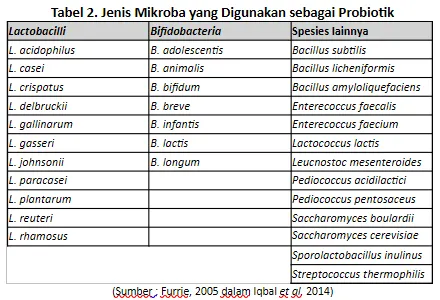
Microbes commonly used as feed additive poultry among others Lactobacillus sp, Bifidobacterium sp, Bacillus sp. and Saccharomyces cereviceae. The advantages of probiotics in the form of bacteria Lactobacillus can maintain intestinal health and suppress pathogenic bacteria. Bacillus very stable in extreme environments and helps in nutrient absorption. Bacteria Bifidobacterium can produce organic acids to inhibit pathogenic bacteria in the digestive tract of poultry. Saccharomyces cerevisiae Creating anaerobic (oxygen-free) conditions favored by beneficial bacterial microbes. Combining multiple probiotic strains generally provides a synergistic effect that is more effective in maintaining the balance of the digestive tract microbiota than using a single microbe.
Mechanism of Probiotics in Chicken Digestion
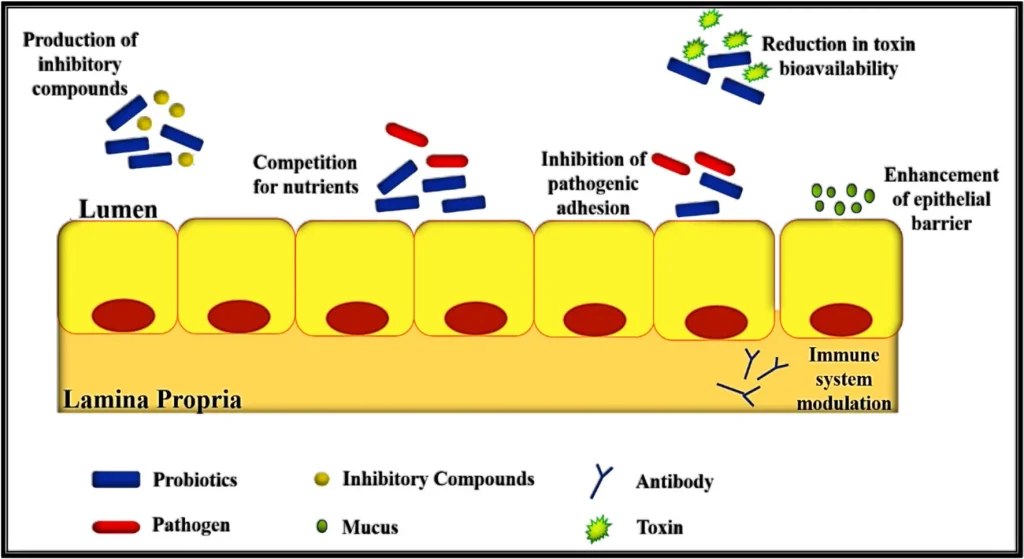
The general mechanism of action of probiotics in poultry is by balancing the gastrointestinal microbiota through several mechanisms, including competition for space and nutrients, production of antimicrobial substances, boosting the immune system, and optimizing digestion and nutrient absorption. The ultimate goal is to achieve optimal microbiota balance, with a population of beneficial microbes (good microbes) exceeding the population of harmful microbes (pathogens). The recommended ratio in the gastrointestinal tract is approximately 85%:15%. Here are some detailed mechanisms of action of probiotics in the gastrointestinal tract:
a. Competing for space and nutrition
Probiotics have the ability to survive in the digestive tract and attach to intestinal cells. This is the initial stage for colonization and subsequent modification of the host's immune system. This strong ability to attach to intestinal cells will cause probiotic microbes to dominate and pathogenic microbes to be reduced from the host's intestinal cells, thus inhibiting the growth of pathogenic microbes (Zurmiati et al. 2014).
Probiotic microbes inhibit pathogenic microbes by competing for food substrates for fermentation. These food substrates are necessary for the proper growth of probiotic microbes. Food for beneficial probiotic microbes in the digestive tract is also called prebiotics. Prebiotics are generally derived from feed ingredients high in fiber. Prebiotics can also be administered separately through feed additive in feed such as Fructooligosaccharide (FOS), Mannan-oligosaccharides (MOS), inulin and ß-glucan.
b. Producing antimicrobial substances
The ability of probiotic microbes to secrete toxins can inhibit the growth of pathogenic microbes in the digestive tract. These toxins act as antibiotics against pathogenic microbes. Probiotics can produce organic acids produced by lactic acid bacteria, such as lactic acid and acetic acid, which can lower the pH of the digestive tract. Furthermore, probiotics also produce peroxide compounds that are antagonistic to pathogenic bacteria.
c. Improved immune system
Probiotics can boost the immune system or modulate immune cells by activating immune cells and increasing antibodies (stimulating immunoglobulin A secretion). This helps improve the chicken's immune system and eliminates the occurrence of diseases, especially digestive problems.
d. Optimization of digestion and absorption of nutrients
Some probiotics can produce digestive enzymes such as amilase, protease and lipase which can help increase the concentration of digestive enzymes in the host's digestive tract, so that digestion and absorption of nutrients are more optimal.
Benefits of Probiotics for Chickens
Various challenges of digestive tract diseases often arise and are sometimes difficult for farmers to avoid due to changing seasons, variations in feed quality, inappropriate maintenance management, etc. The following is disease incidence data collected by the team. Technical Education and Consultation Median for the last three semesters. This data can be used as a reference for controlling and preventing digestive disorders that can affect poultry productivity and health.
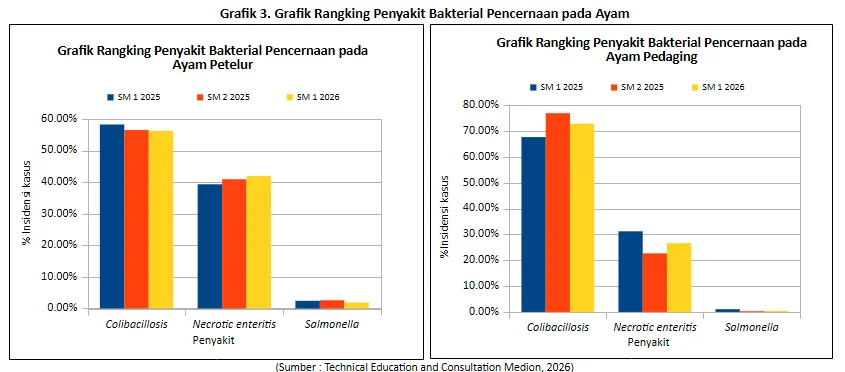
Prevention is better than treatment when the chicken is already sick, one of which is the use of probiotics in chicken farming which can play an important role as a natural alternative to antibiotics (Antibiotic Growth Promoters/AGP) to optimize health and productivity sustainably. Here are some of the benefits of using probiotics for chickens, including:
1. Improve chicken performance
Optimal chicken performance is supported by proper and balanced nutrition, not just macro and micronutrients. Gastrointestinal health is essential for optimal digestion and nutrient absorption. feed additive Probiotics play a role in maintaining poultry digestive health. Probiotics help produce digestive enzymes in the digestive tract, thus optimizing nutrient digestion. Proper nutrient digestion leads to optimal nutrient absorption. This positively correlates with chicken performance, both in terms of meat and egg production.
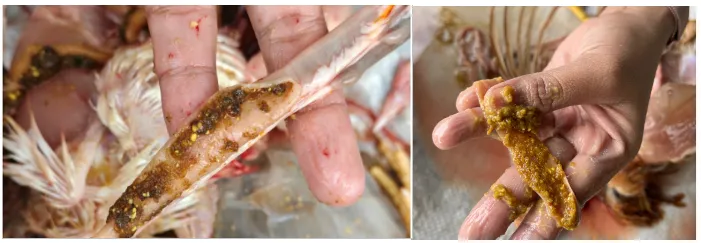
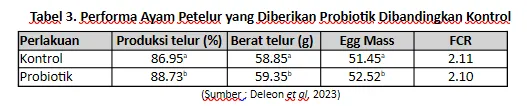
A healthy digestive tract is key to nutrient absorption. If incompletely digested feed is found, this indicates a digestive tract disorder. Evaluating the causative factors and as a preventative measure, probiotic supplementation can help reduce inflammation in the chicken's digestive tract by suppressing the growth of harmful bacteria, repairing damaged intestinal linings, and balancing the gut microbiota. Research has also shown that adding probiotics to feed can improve the performance of laying hens compared to controls (without probiotics). According to Deleon, et al. (2023) which states that the addition of Bacillus subtilis in laying hens, shows that performance results can increase for egg production parameters, egg weight, egg mass, and FCR.
2. Improve the immune system/health
The immune system is considered the primary foundation for poultry, serving as a frontline defense, protecting the body from pathogens. One of its roles in the digestive tract is the gut microbiota, whose beneficial microbes compete with pathogens and maintain a balanced composition. The addition of probiotics as a supplement feed additive can modify the composition between good and pathogenic microbes, by competing for space (exclusion competitive) and nutrients in the digestive tract. It can also release antimicrobial substances that suppress the growth of pathogenic microbes. Increasing the population of beneficial microbes correlates with an improved immune system, thus protecting chickens from disease outbreaks.
3. Reduces ammonia odor
The smell of ammonia from chicken coops is a major source of environmental unrest. Ammonia gas also significantly impacts the health and productivity of chickens. Ammonia in coops is formed from a chemical reaction between uric acid (C5H4N4O3) and water (H2O) and enzymes Bacterial urease. According to Sjofjan (2003), probiotics can suppress the activity of protein-degrading microbes in feces, thereby reducing ammonia levels. Identified probiotic microbes include lactic acid bacteria (LAB) and several genera. bacillus.
Bacillus produce bacteriocin (bulgarican) which functions to suppress the growth of gram-negative pathogenic bacteria. Suppressed growth of gram-negative bacteria results in less production of the urease enzyme which can be used to convert uric acid into ammonia thereby reducing ammonia. In addition, bacillus producing acid will cause a decrease in the pH of the digestive tract which causes gram-negative bacteria to die and produces a lot of H ions+ available in feces which can bind fecal ammonia into ammonium (NH4+) so that there is little release of fecal ammonia (Riza et al. 2015 ).
4. Improve the quality of poultry products
The use of AGP alternatives results in safer and healthier products for consumers, as they leave no residue. In this modern era, consumers are starting to become more concerned about brand quality and safety assurance including meat and egg products in chickens. The use of probiotics as feed additive can considered as an alternative to AGP in feed mixtures to ensure the quality of the resulting poultry products.
Implementation of Probiotic Use in Chickens
Implementation of probiotics in chickens, namely as feed additive, not nutritive in nature, plays a role in replacing AGPs improve livestock performance and health. Probiotics can be administered to chickens in feed or drinking water. The microbial content of probiotics can be either single or mixed. The success of probiotic use in the field can be influenced by many factors, such as variations in individual chicken responses to probiotic microbes. Probiotics do not act as essential nutrients where there is no dose response, but rather there is only a threshold level of use.
One of the probiotic products from Medion is Probiomix. Probiomix is feed additive which contains probiotics to improve digestive health and chicken productivity. Probiomix contains a combination of microbes including bacillus subtilis, bacillus licheniformis, bacillus amyloliquefaciens, lactobacillus acidophilus and saccharomyces cerevisiae. The combination of several microbes has a specific function in inhibiting pathogenic bacteria, for example Bacillus subtilis, Bacillus licheniformis, Lactobacillus acidophilus also Saccharomyces cerevisiae can eliminate bacteria Clostridium perfringens causes Necrotic enteritis (Khalique et al. 2020) while Bacillus amyloliquefaciens can hinder Escherichia coli causes Colibacillosis (dyspnea, heart and liver covered by fibrin) in poultry (Richad et al. 2024). It can be mixed with feed at a dose of 0.27 grams per kg of feed or 0.27 grams per 10 kg of body weight.
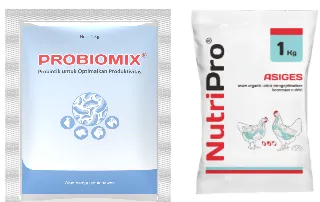
(Source : Dr. Medion)
The use of probiotics can be combined with feed additive Other probiotics have excellent synergistic effects in improving digestive health and chicken performance. The combination of probiotics and prebiotics, which are specific food sources for beneficial bacteria, allows the probiotics to multiply and colonize effectively in the digestive tract. Furthermore, the combination of probiotics and acidifier like Asiges which contain a combination of organic acids. Organic acids function to optimize the pH of the digestive tract, which is a comfortable condition for good microbes, while the growth of pathogenic microbes can be suppressed. Let's consider the use of probiotics wisely as a feed additive An alternative to AGP, to support chicken performance and health. We hope this is helpful.