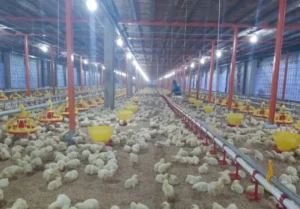
Good broiler management is reflected in recording complete and accurate. In addition to facilitating the evaluation of errors that occurred in the previous period, data recording it still has many other benefits as will be discussed in this supplement article.
Benefits Recording in the field
Previously not infrequently breeders assume that recording used to control the performance of plasma and cage children, so the goal is just to calculate profit and loss. Though the data recording it should be understood in a broader sense. With charging recording seriously, the data has many benefits, including:
- Help map the history of disease attackswith the data recording disease attacks from month to month in the past few years, farmers can continue to be vigilant. In addition, patterns of disease attacks both viruses and bacteria that occur in a single flock can be mapped. Armed recording, the history of the disease that infects the flock is no longer enough to remember and be more accurate. In the end, farmers can be more accurate in evaluating and perfecting prevention programs in the coming period.
- Case management tools penyakitDalam this data recording serves as an Anamnesis. Anamnesis (history of disease events) which is the initial stage in the diagnosis of disease, is needed to diagnose a disease. For example, vaccines / drugs that have been given, antibody titers, death patterns, body weight achievement, feed in take, and so forth.
- The application of biosecurity is more controlledthe activity of examining cages or flocks suspected of having diseases is preceded by looking at the data from each flock that will be visited. Checking starts from a healthy chicken coop, then to a chicken coop suspected of being sick. Without looking at the data recording, cage employees who enter healthy cages after previous contact with sick chickens and trigger disease transmission.
- It is necessary to know what actions and equipment are needed to create a comfortable kennelfor example, by recording the temperature parameters of the cage. If at certain times the cage temperature is detected to be very high, then the breeder can open the cage curtain wider and start turning on the fan (fan) so that the temperature drops quickly. With these comfortable temperature conditions, the performance of chicken production can be optimal.
- Improve the cost efficiency of health ProgramData incidence of disease that occurred in the previous period will usually be recorded on form recording. From these data, farmers can evaluate and improve health programs, especially in determining the schedule of vaccination programs, cleaning program, and disinfection and dosage administered. With the program records will certainly be more efficient and affect the calculation of maintenance costs.
Components Recording Preservation
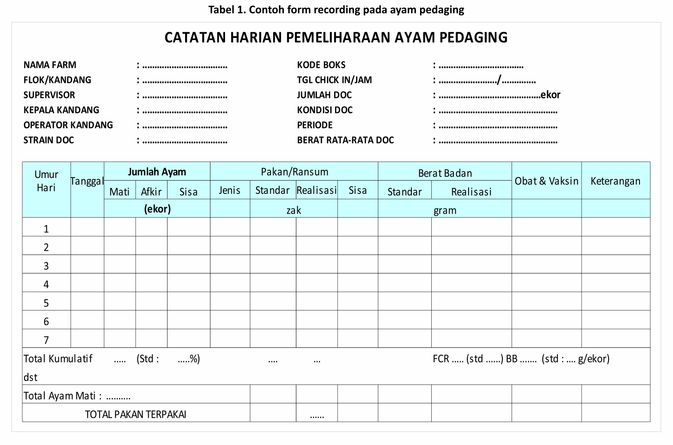
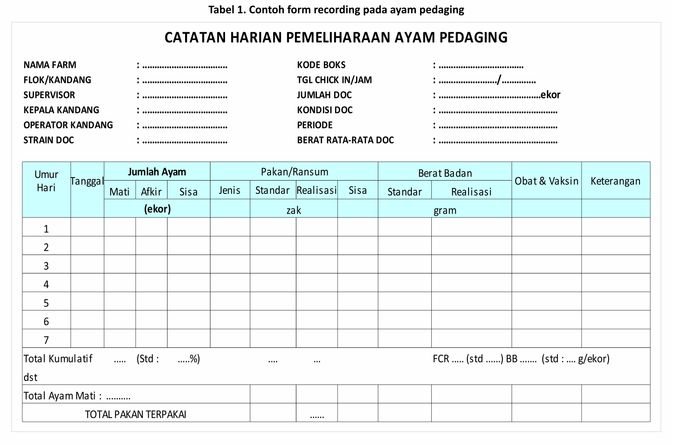
Form recording the table of contents (recording) which contains all parameters related to maintainability. Technically, creating a table of records is not difficult. First create a table format recording daily data on broiler cages for each of them, as seen in the example table recording the Daily cage data are below (table 1.). Then communicate with all employees in the cage to always fill in the data.
For chicken farmers with a pattern of partnership and large scale, the process recording related to the recording of chicken production data is commonly done. In the field, about recording what needs attention to support the success of broiler rearing program? Here are some of them:
- Population. Knowing the number of chicken populations that are kept is very important, so the number of populations should always be in-update. Appropriate population Data can prevent errors in treatment, vaccine administration, and vitamins (such as lack or excess doses) so that they can affect the success of treatment or vaccination.
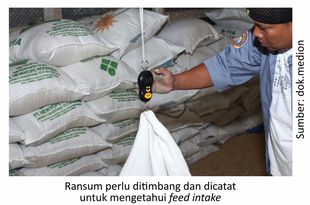
- Program and amount of ration. These Data also need major attention in recording to find out the amount of rations spent, the rest, as well as maintain the availability of ration stocks in warehouses. Recording here it includes recording the composition of the ration, the amount of ration consumed and the remaining ration. The ration to be given should always be weighed, so that the amount of feed that runs out can be known. Compare the amount of chicken consumption per day with the standard breeder, so the performance of chickens can be monitored constantly. These data are very useful for calculating the amount of expenditure and evaluating the performance of chickens. For example, if one day the consumption drops, accompanied by a non-uniform weight performance, the farmer can take action as soon as possible.
- Depletion (depreciation). Shrinkage includes the number of chickens that died, diafkir, or lost. This Data must always be recorded because every time there is a certain amount of shrinkage, the farmer must readjust the amount of ration with the latest population. The amount of shrinkage can also be a health control, such as disease attacks that cause chicken mortality.
- Weight loss. Weight Data in broiler rearing programs is very important to note considering the continuous effect on chicken performance and yields achieved. Weight control Data obtained should be compared with data from breeder. Ideally, the average body weight of the cage is greater than or equal to the standard. If the average body weight is less than the standard, the breeder can decide on appropriate measures.
- Medical history (Medical Record). Recording health including vital is noted because it is needed to decide exactly when to vaccinate, administer drugs, and rolling drugs.
- Stock items. Stock items such as ration stocks, vaccines, vitamins, drugs, disinfectants, husks, or other materials that will be used by farmers to support production. Strict stock control will minimize damage and maintain the availability of goods for continuous maintenance.
Filling in the data can be done when the cage employees feed the chickens in the morning or evening. Furthermore, the cage daily data is re-recorded by the manager in the cage daily logbook. The next stage is to process the cage data into a line or bar chart. This will make it easier to evaluate the maintenance program and analyze the success of the business obtained. It would be better if the results of the recapitulation of the data compared with standard data breeder.
From all of the above we can conclude that recording accurate will make it easier for farmers to evaluate and control the development of performance produced by chickens. Recording it is always needed because it can be the right basic reference for determining the next maintenance program. Recording it only needs to be made in a simple but neat and requires the discipline of the cage child to take notes from time to time. Good luck.