Infectious Bursal Disease (IBD) is a highly contagious acute immunosuppressive disease of young chickens caused by Infectious Bursal Disease Virus (IBDV). IBD was first discovered in the Gumboro area of Delaware, United States, in 1962. This is the area where it was first discovered, which is why IBD is often called Gumboro disease. To this day, IBD infection remains a concern in the poultry industry due to its high mortality and morbidity rates, which result in significant economic losses.
IBD Disease in General
Gumboro disease or IBD is caused by the IBD virus which belongs to the group of double-stranded RNA viruses (double stranded) from family Birnaviridae and genus AvibirnavirusThe IBD virus is non-enveloped, making it more stable and durable in the environment, lasting up to three months. This non-enveloped structure also means it is only sensitive to certain disinfectants. ALDEHYDES and iodine and insensitive to groups ammonium quartener. The incubation period for this disease is 2-3 days, and it is transmitted horizontally from sick chickens to healthy ones. The disease is transmitted from sick chickens through bodily fluids or infected droppings, either directly or indirectly. Indirect transmission can occur through media such as: litter, drinking water and feed containers, livestock equipment, transportation equipment or workers contaminated with feces containing the IBD virus.
Data from the last three years (2024-2026) collected by Medion shows that IBD cases in broiler chickens occur in the third week, and in laying hens, the highest number of IBD cases occurs between 0 and 5 weeks of age. This is related to the bursa of Fabricius, which is the primary organ attacked by the IBD virus. The bursa of Fabricius actively develops at 3-4 weeks of age, making it the age at greatest risk for IBD infection. However, IBD cases under 3 weeks of age still require caution. Generally, IBD cases under 3 weeks of age are subclinical (without clinical signs and symptoms) and have significant immunosuppressive properties, which can thwart vaccination programs. However, it is possible that IBD cases under 3 weeks of age can also be clinical and show symptoms.
The immunosuppressive effects are the most concerning side effect of IBD, aside from its mortality and morbidity. This is because the IBD virus attacks the chicken's immune system, specifically the bursa of Fabricius, located above the chicken's anus (cloaca). Under normal conditions, the bursa of Fabricius regresses at the onset of sexual maturity.
Bursa of Fabricius is a place where most of the immature B lymphocytes gather (immature). These cells will undergo maturation in the bursa of Fabricius. Mature B lymphocytes (mature) when exposed to an antigen (field virus or vaccine), it will be activated and produce antibodies. When the IBD virus attacks immature B lymphocytes, the number of mature B lymphocytes will decrease. The decrease in the number of mature B lymphocytes is directly proportional to the number of antibodies produced.
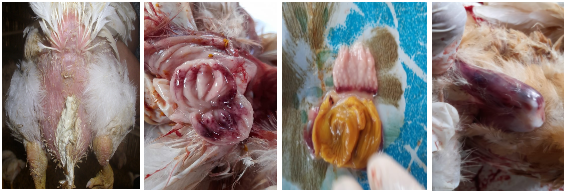
The clinical symptoms of IBD infection depend on the strain of virus infecting the chicken, the amount of virus, the age, the strain, the route of transmission, and the antibody levels in each individual chicken. Clinical symptoms of IBD infection include tremors, fever, dehydration, dull and erect feathers, and white diarrhea. A necropsy reveals organ changes (anatomical pathology), such as inflammation. bursa Fabrisius, inflammation at the border of the proventriculus with the ventricle, line-type bleeding (striae) in the thigh and chest muscles and swollen kidneys (Figure 1).
The diagnosis of IBD infection is based on clinical symptoms and anatomical pathological changes. Pathognomonic or characteristic changes of this disease are inflammation of the bursa Fabrisius. However, observation of changes in all organs is still necessary because the anatomical pathology can be similar to Newcastle Disease (ND) and other immunosuppressive diseases. It's also important to be aware of accompanying secondary infections, such as ND, colibacillosis, and coccidiosis. IBD can also be diagnosed by identifying the causative viral agent through PCR and sequencing.
Several predisposing factors that cause IBD infections to continue to appear even though vaccination has been carried out are:
- Management brooding period, less than optimal
- The presence of immunosuppressant factors such as stressful conditions, coccidiosis disease, etc
- The existence of Franky beetles as vectors carrying the IBD virus
- Less than optimal cage rest time
- Vaccination programs and applications are not appropriate
- Implementation biosecurity the less good
IBD Variant
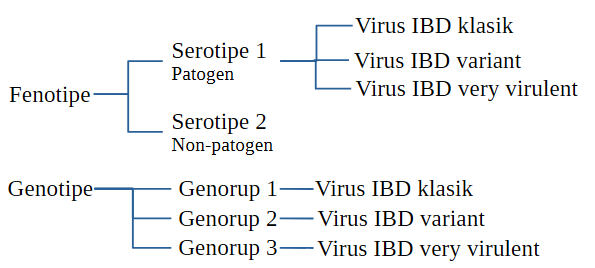
IBD viruses are classified based on phenotype and genotype. These phenotypes are based on the pathogenicity and antigenicity of the virus, which divides them into serotype 1, which is pathogenic in chickens, and serotype 2, which is non-pathogenic. Serotype 1 is then classified into three pathotypes based on its virulence: classic IBD virus, variant IBD virus, and highly virulent IBD virus (very virulent IBD). Based on genotype, IBD viruses are classified into three genogroups, namely genogroup 1 (classic IBD virus), genogroup 2 (variant IBD virus), and genogroup 3 (highly virulent IBD virus).
The IBD viruses found in the field since 2019 have been dominated by highly virulent IBD viruses (vvIBD), a highly virulent group of IBD viruses. This contributes to higher mortality (25-80%) in IBD cases. Compared with the classic IBD virus group, vvIBD causes similar clinical symptoms and anatomical changes. However, vvIBD causes hemorrhage. bursa Fabricius and muscle tissue that is more severe and takes place acutely.
Compared with vvIBD, the variant IBD virus does not cause clinical symptoms but has a permanent immunosuppressant effect that causes atrophy in the liver. bursa Fabrisius. Virus IBD variant menyerang organ kekebalan lain seperti limpa, caeca tonsil, thymus, dan sumsum tulang. Dapat ditemukan pembengkakan pada limpa, peradangan pada thymus dan atropi. Virus ini disebut menyebabkan gejala klinis persisten dengan kematian <5% atau bahkan tanpa kematian.
The prolonged persistence of variant IBD viruses in primary and secondary lymphoid organs highlights their potent immunosuppressive potential and explains their association with vaccination failure and increased susceptibility to secondary infections. Furthermore, the observed multi-organ tropism indicates that infected chickens may be a source of prolonged virus shedding, necessitating the implementation of appropriate measures. biosecurity and surveillance (observation) more closely.
Control and Prevention
The immunosuppressive effects of Gumboro disease have prompted farmers to be more vigilant. Preventive measures are an alternative solution to control this disease. A combination of vaccination, biosecurity and good maintenance management can be the key to controlling Gumboro disease.
1. Gumboro Vaccination
Vaksinasi Gumboro aktif konvensional dapat dilakukan minimal 2 minggu sebelum umur serangan penyakit di periode sebelumnya. Jika kasus terjadi pada umur <21 hari atau terdapat kematian >5%, maka dapat menggunakan vaksin Medivac Gumboro A. Sedangkan bila kasus terjadi pada umur >21 hari dengan kematian <5%, maka dapat menggunakan vaksin Medivac Gumboro B. For laying and breeding farms with long maintenance life, it can also combine the use of active and inactivated vaccines both as priming or repetition. Nowadays, Gumboro vaccination is also familiar in hatchery. Gumboro immune complex vaccine such as Medivac Gumboplex, usually applied in hatchery or when the chicken is 0-1 day old.
2. Biosecurity
Biosecurity needs to be tightened to minimize the presence of disease agents in the coop. Gumboro virus can survive for more than three months outside the chicken's body and remain infectious. This virus is highly sensitive to aldehyde disinfectants such as Formades and iodine group.
3. Good maintenance management
Good cage preparation will eliminate the IBD virus. The cage is cleaned of litter and feces. After cleaning, disinfection and lime can be applied. Then, the cage must be kept empty for at least 14 days. This is important to break the life cycle of the disease agent. brooding period, has a very big impact on chicken performance and the occurrence of disease infections such as Gumboro. If a leak occurs during the period brooding period, Due to less than optimal management, the development of the chicken's body, both in terms of body weight and organ development, will not be optimal.
Treatment against Gumboro
There is no effective cure for Gumboro disease. Treatments can reduce the mortality rate from kidney swelling, energy loss, or clinical symptoms caused by Gumboro attacks.
Screen sick chickens. Isolate sick chickens to prevent transmission. Disinfect the coop daily while there are cases. Use an iodine disinfectant (Antisep, Neo Antisep). Give Reduvir 2 ml per liter of drinking water for 5 – 7 days as a natural antiviral that can help reduce mortality in poultry infected with viruses. Reduvir contains extracts Rhizoma coptidis and Andrographis paniculata which has antiviral activity and is able to work to increase the body's immunity.

When anatomical pathology of swollen kidneys appears, food can be given Gumbonal as a urinary tract antiseptic to treat swollen kidneys. When given Gumbonal It should not be combined with antibiotics or other chemical medications. In cases of Gumboro accompanied by bacterial infections, additional antibiotics may be prescribed, depending on the specific condition. It's best to choose antibiotics that don't increase kidney function (such as sulfonamides and aminoglycosides).
Hopefully, this information can be an additional source of information for breeders in understanding cases of IBD or Gumboro variant and become a preventive strategy in dealing with IBD disease comprehensively.
References
- Hair-Bejo, M., Mazlan, M., Be, T. H., Han, C. H., Sohaimi, N. M., & Ugwu, C. C. (2026). Pathogenicity, immunogenicity, and multi-organ tissue tropism of a novel variant infectious bursal disease virus in specific pathogen-free chickens. Veterinary World, 19(2), 591-603.
- Takahashi, M., Oguro, S., Kato, A., Ito, S., & Tsutsumi, N. (2024). Novel Antigenic Variant Infectious Bursal Disease Virus Outbreaks in Japan from 2014 to 2023 and Characterization of an Isolate from Chicken. Pathogens, 13(12), 1141.